Mondal Arnab Kumar
Indian Institute of Technology, Hauz Khas, New Delhi, 110016, Delhi, India.
Appl Soft Comput. 2022 Jun;122:108867. doi: 10.1016/j.asoc.2022.108867. Epub 2022 Apr 25.
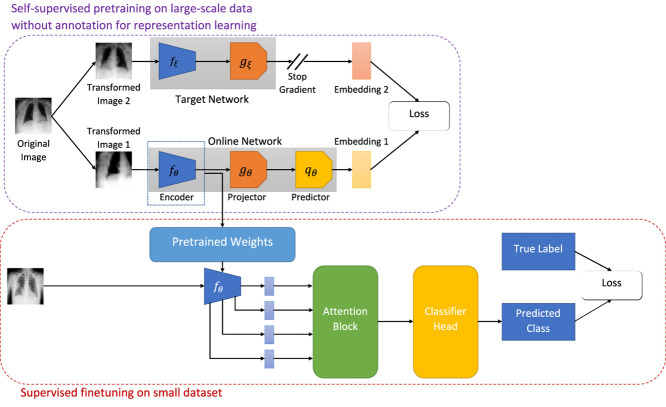
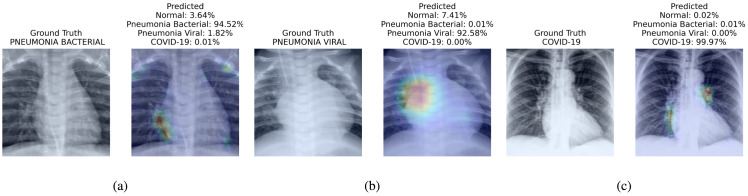
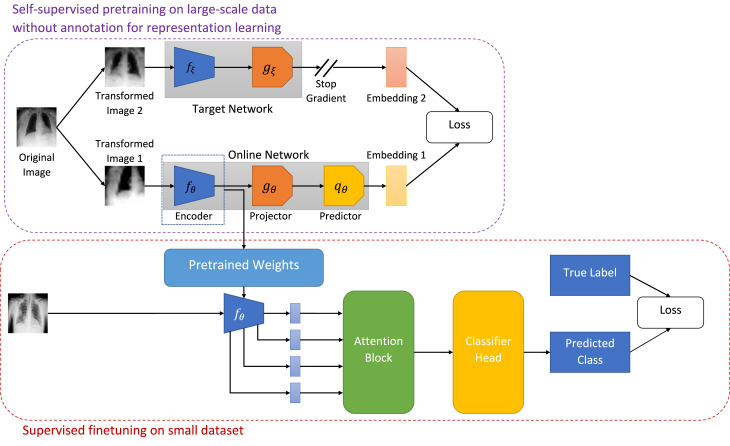
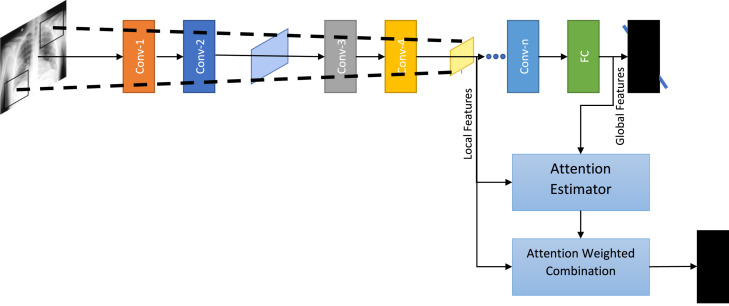
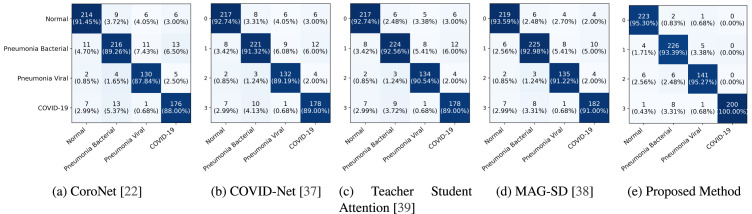
The COrona VIrus Disease 2019 (COVID-19) pandemic is an ongoing global pandemic that has claimed millions of lives till date. Detecting COVID-19 and isolating affected patients at an early stage is crucial to contain its rapid spread. Although accurate, the primary viral test 'Reverse Transcription Polymerase Chain Reaction' (RT-PCR) for COVID-19 diagnosis has an elaborate test kit, and the turnaround time is high. This has motivated the research community to develop CXR based automated COVID-19 diagnostic methodologies. However, COVID-19 being a novel disease, there is no annotated large-scale CXR dataset for this particular disease. To address the issue of limited data, we propose to exploit a large-scale CXR dataset collected in the pre-COVID era and train a deep neural network in a self-supervised fashion to extract CXR specific features. Further, we compute attention maps between the global and the local features of the backbone convolutional network while finetuning using a limited COVID-19 CXR dataset. We empirically demonstrate the effectiveness of the proposed method. We provide a thorough ablation study to understand the effect of each proposed component. Finally, we provide visualizations highlighting the critical patches instrumental to the predictive decision made by our model. These saliency maps are not only a stepping stone towards explainable AI but also aids radiologists in localizing the infected area.
2019年冠状病毒病(COVID-19)大流行是一场仍在持续的全球大流行,迄今为止已夺走数百万人的生命。在早期阶段检测出COVID-19并隔离受影响的患者对于遏制其快速传播至关重要。尽管用于COVID-19诊断的主要病毒检测“逆转录聚合酶链反应”(RT-PCR)准确,但它有一个复杂的检测试剂盒,且周转时间较长。这促使研究界开发基于胸部X光(CXR)的自动化COVID-19诊断方法。然而,由于COVID-19是一种新型疾病,没有针对该特定疾病的带注释的大规模CXR数据集。为了解决数据有限的问题,我们建议利用在COVID-19之前的时代收集的大规模CXR数据集,并以自监督的方式训练一个深度神经网络,以提取CXR特定特征。此外,在使用有限的COVID-19 CXR数据集进行微调时,我们计算骨干卷积网络的全局特征和局部特征之间的注意力图。我们通过实验证明了所提出方法的有效性。我们进行了全面的消融研究,以了解每个提出的组件的效果。最后,我们提供了可视化结果,突出显示了对我们模型的预测决策有重要作用的关键区域。这些显著性图不仅是迈向可解释人工智能的垫脚石,也有助于放射科医生定位感染区域。