Feki Ines, Ammar Sourour, Kessentini Yousri, Muhammad Khan
Digital Research Center of Sfax, B.P. 275, Sakiet Ezzit, 3021 Sfax, Tunisia.
SM@RTS : Laboratory of Signals, systeMs, aRtificial Intelligence and neTworkS, Sfax, Tunisia.
Appl Soft Comput. 2021 Jul;106:107330. doi: 10.1016/j.asoc.2021.107330. Epub 2021 Mar 20.
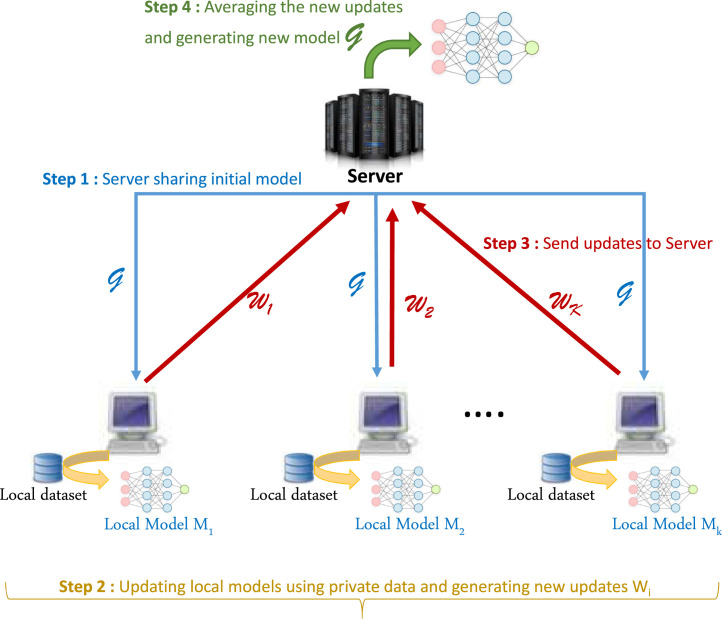
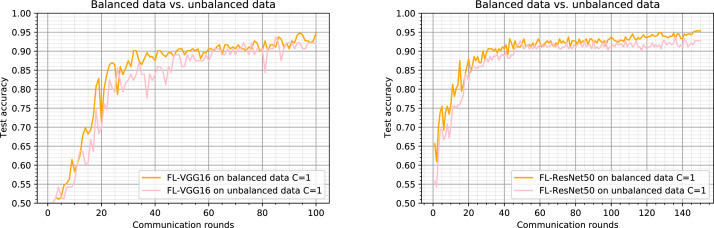
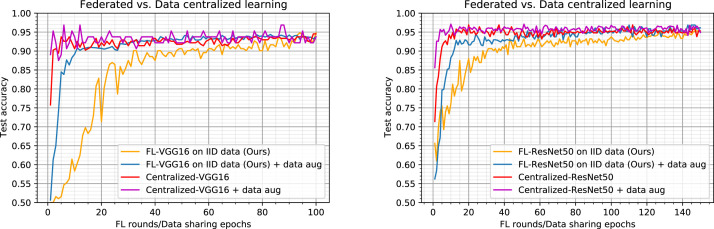
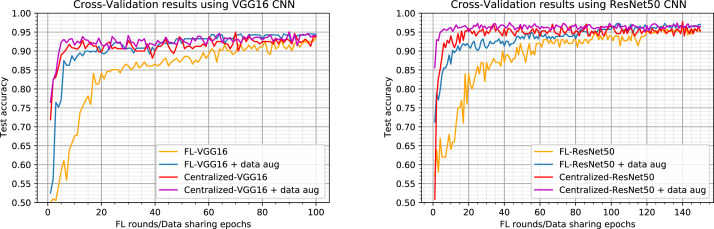
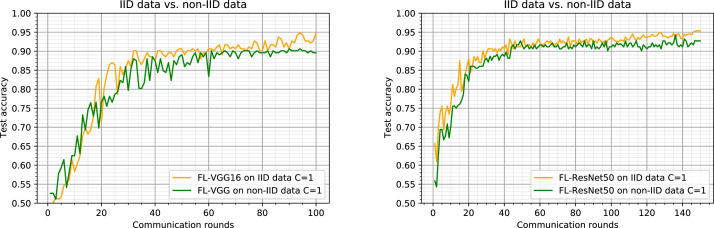
Today, the whole world is facing a great medical disaster that affects the health and lives of the people: the COVID-19 disease, colloquially known as the Corona virus. Deep learning is an effective means to assist radiologists to analyze the vast amount of chest X-ray images, which can potentially have a substantial role in streamlining and accelerating the diagnosis of COVID-19. Such techniques involve large datasets for training and all such data must be centralized in order to be processed. Due to medical data privacy regulations, it is often not possible to collect and share patient data in a centralized data server. In this work, we present a collaborative federated learning framework allowing multiple medical institutions screening COVID-19 from Chest X-ray images using deep learning without sharing patient data. We investigate several key properties and specificities of federated learning setting including the not independent and identically distributed (non-IID) and unbalanced data distributions that naturally arise. We experimentally demonstrate that the proposed federated learning framework provides competitive results to that of models trained by sharing data, considering two different model architectures. These findings would encourage medical institutions to adopt collaborative process and reap benefits of the rich private data in order to rapidly build a powerful model for COVID-19 screening.
如今,全世界都面临着一场影响人们健康和生活的重大医疗灾难:2019冠状病毒病,俗称新冠病毒。深度学习是协助放射科医生分析大量胸部X光图像的有效手段,这在简化和加速新冠病毒病的诊断中可能发挥重要作用。此类技术需要大量数据集进行训练,且所有这些数据必须集中起来才能进行处理。由于医疗数据隐私法规,通常无法在中央数据服务器中收集和共享患者数据。在这项工作中,我们提出了一个协作式联邦学习框架,允许多个医疗机构在不共享患者数据的情况下,使用深度学习从胸部X光图像中筛查新冠病毒病。我们研究了联邦学习设置的几个关键特性和特点,包括自然出现的非独立同分布(non-IID)和数据分布不平衡的情况。我们通过实验证明,考虑到两种不同的模型架构,所提出的联邦学习框架与通过共享数据训练的模型相比,能提供具有竞争力的结果。这些发现将鼓励医疗机构采用协作流程,并从丰富的私有数据中获益,以便迅速建立一个强大的新冠病毒病筛查模型。