Schuit Anouk S, Holtmaat Karen, Lissenberg-Witte Birgit I, Eerenstein Simone E J, Zijlstra Josée M, Eeltink Corien, Becker-Commissaris Annemarie, van Zuylen Lia, van Linde Myra E, Menke-van der Houven van Oordt C Willemien, Sommeijer Dirkje W, Verbeek Nol, Bosscha Koop, Tewarie Rishi Nandoe, Sedee Robert-Jan, de Bree Remco, de Graeff Alexander, de Vos Filip, Cuijpers Pim, Verdonck-de Leeuw Irma M
Department of Clinical, Neuro and Developmental Psychology, Faculty of Behavioral and Movement Sciences, Amsterdam Public Health Research Institute, Vrije Universiteit Amsterdam, the Netherlands.
Cancer Center Amsterdam (CCA), Amsterdam UMC, Vrije Universiteit Amsterdam, Amsterdam, the Netherlands.
Lancet Reg Health Eur. 2022 Apr 21;18:100390. doi: 10.1016/j.lanepe.2022.100390. eCollection 2022 Jul.
Many patients with incurable cancer have symptoms affecting their health-related quality of life. The eHealth application 'Oncokompas' supports patients to take an active role in managing their palliative care needs, to reduce symptoms and improve health-related quality of life (HRQOL). This randomized controlled trial was conducted to determine the efficacy of Oncokompas compared to care as usual among incurably ill cancer patients with a life expectancy of more than three months.
Patients were recruited in six hospitals in the Netherlands. Eligible patients were randomly assigned to the intervention (direct access to Oncokompas) or the control group (access to Oncokompas after three months). The primary outcome measure was patient activation (i.e., patients' knowledge, skills and confidence for self-management). Secondary outcomes were general self-efficacy and HRQOL. Measures were assessed at baseline, two weeks after randomization, and three months after the baseline measurement. Linear mixed models were used to compare longitudinal changes between both groups from baseline to the three-month follow-up.
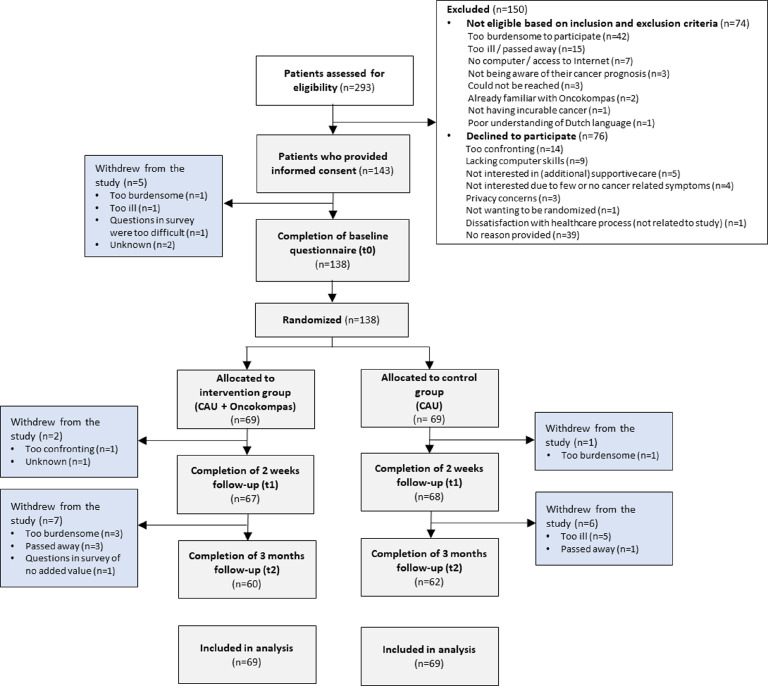
In total, 219 patients were eligible of which 138 patients completed the baseline questionnaire (response rate 63%), and were randomized to the intervention (69) or control group (69). There were no significant differences between the intervention and control group over time in patient activation (estimated difference in change T0-T2; 1·8 (90% CI: -1·0 to 4·7)), neither in general self-efficacy and HRQOL. Of the patients in the intervention group who activated their account, 74% used Oncokompas as intended. The course of patient activation, general self-efficacy, and HRQOL was not significantly different between patients who used Oncokompas as intended versus those who did not.
Among incurably ill cancer patients with a life expectancy of more than three months and recruited in the hospital setting, Oncokompas did not significantly improve patient activation, self-efficacy, or HRQOL.
ZonMw, Netherlands Organization for Health Research and Development (844001105).
许多无法治愈的癌症患者存在影响其健康相关生活质量的症状。电子健康应用程序“Oncokompas”帮助患者在管理其姑息治疗需求方面发挥积极作用,以减轻症状并改善健康相关生活质量(HRQOL)。本随机对照试验旨在确定与常规护理相比,Oncokompas对预期寿命超过三个月的无法治愈的癌症患者的疗效。
在荷兰的六家医院招募患者。符合条件的患者被随机分配到干预组(直接使用Oncokompas)或对照组(三个月后使用Oncokompas)。主要结局指标是患者激活度(即患者自我管理的知识、技能和信心)。次要结局是一般自我效能感和健康相关生活质量。在基线、随机分组后两周以及基线测量后三个月进行测量。使用线性混合模型比较两组从基线到三个月随访的纵向变化。
共有219名患者符合条件,其中138名患者完成了基线问卷(应答率63%),并被随机分配到干预组(69名)或对照组(69名)。随着时间的推移,干预组和对照组在患者激活度方面没有显著差异(T0 - T2变化的估计差异;1·8(90%CI:-1·0至4·7)),在一般自我效能感和健康相关生活质量方面也没有显著差异。在干预组中激活账户的患者中,74%按预期使用了Oncokompas。按预期使用Oncokompas的患者与未按预期使用的患者在患者激活度、一般自我效能感和健康相关生活质量的变化过程上没有显著差异。
在医院环境中招募的预期寿命超过三个月的无法治愈的癌症患者中,Oncokompas并未显著改善患者激活度、自我效能感或健康相关生活质量。
荷兰卫生研究与发展组织ZonMw(844001105)。