Fuentes German V, Doucet Eric N, Abraham Alyson, Rodgers Nikki K, Alonso Felix, Euceda Nelson, Quinones Michael H, Riascos Penelope A, Pierre Kristelle, Sarker Nuhash H, Dhar-Mascareno Manya, Cotlet Mircea, Kisslinger Kim, Camino Fernando, Li Mingxing, Lu Fang, Gao Ruomei
Chemistry and Physics Department, State University of New York College at Old Westbury Old Westbury New York 11568 USA
Biological Sciences Department, State University of New York College at Old Westbury Old Westbury New York 11568 USA
RSC Adv. 2020 May 1;10(29):17094-17100. doi: 10.1039/d0ra00846j. eCollection 2020 Apr 29.
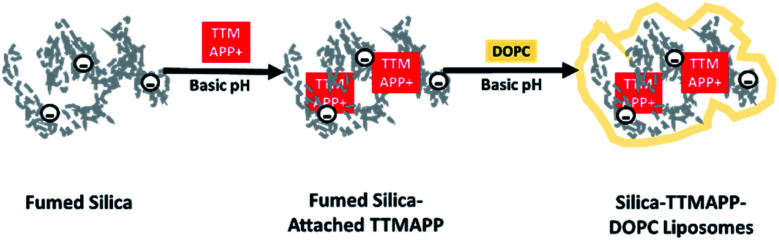
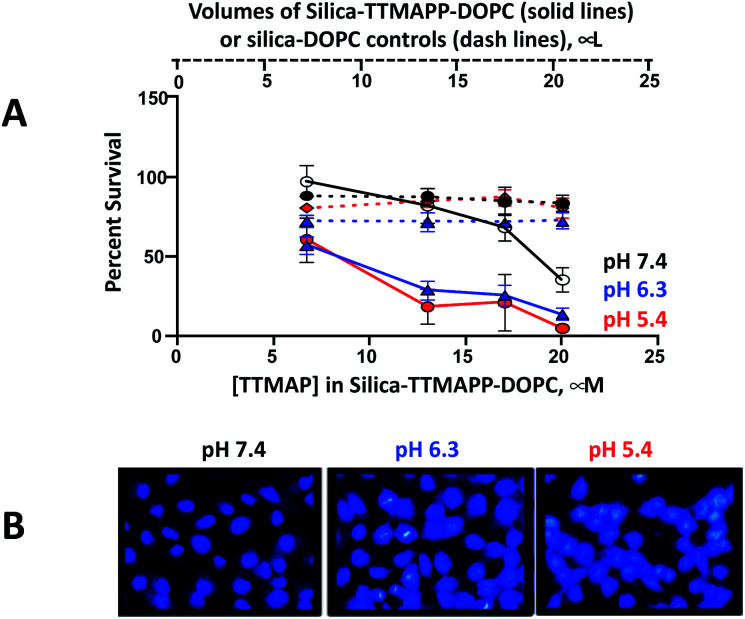
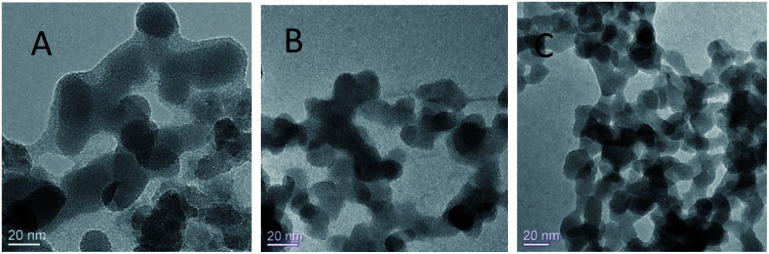
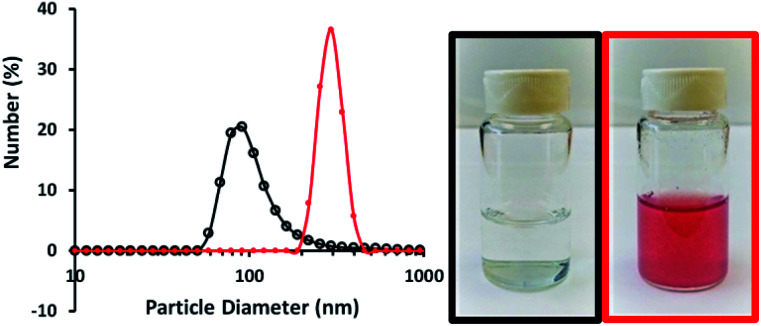
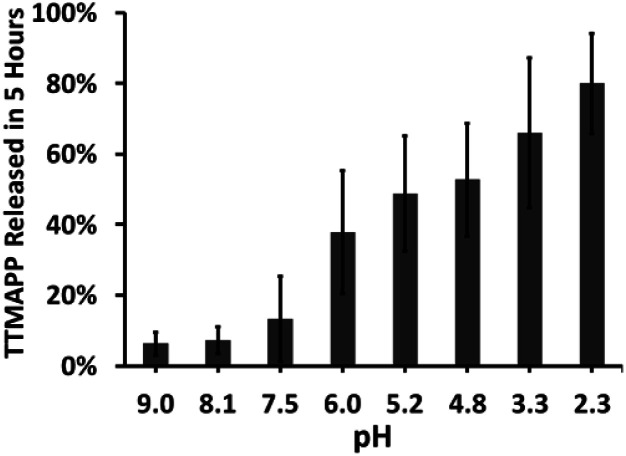
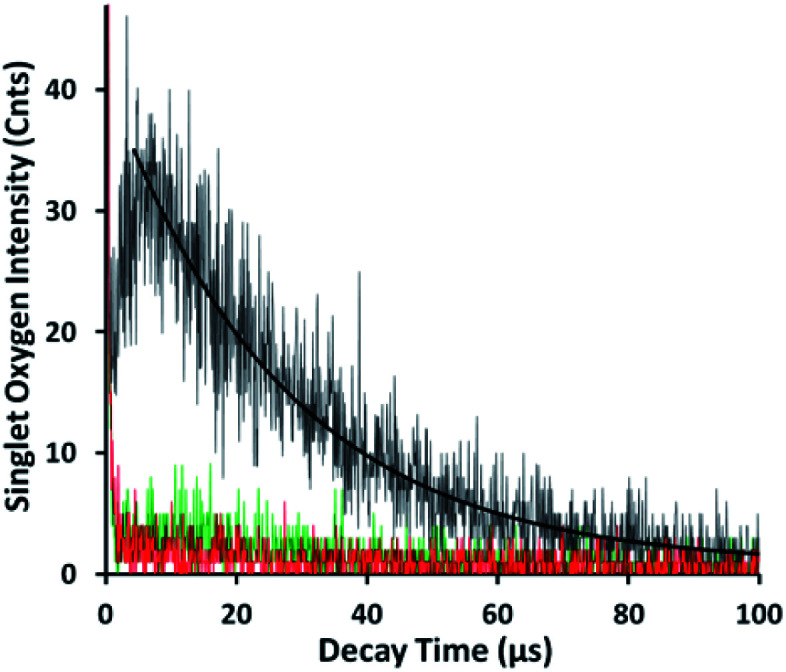
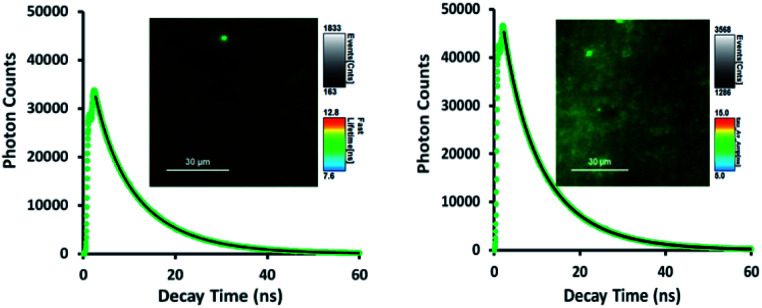
It is both challenging and desirable to have drug sensitizers released at acidic tumor pH for photodynamic therapy in cancer treatment. A pH-responsive carrier was prepared, in which fumed silica-attached 5,10,15,20-tetrakis(4-trimethylammoniophenyl)porphyrin (TTMAPP) was encapsulated into 1,2-dioleoyl--3-phosphocholine (DOPC) nanocomposite liposomes. The sizes of agglomerates were determined by dynamic light scattering to be 115 nm for silica and 295 nm for silica-TTMAPP-DOPC liposomes. Morphological changes were also found in TEM images, showing liposome formation at pH 8.5 but collapse upon silanol protonation. TTMAPP release is enhanced from 13% at pH 7.5 to 80% at pH 2.3, as determined spectrophotometrically through dialysis membranes. Fluorescence emission of TTMAPP encapsulated in the dry film of liposomes was reduced to half at pH 8.6 when compared to that at pH 5.4, while the production of singlet oxygen was quintupled at pH 5.0 compared to pH 7.6. Upon treatment of human prostate cancer cells with liposomes containing 6.7 μM, 13 μM, 17 μM and 20 μM TTMAPP, the cell viabilities were determined to be 60%, 18%, 20% and 5% at pH 5.4; 58%, 30%, 25% and 10% at pH 6.3; and 90%, 82%, 68% and 35% at pH 7.4, respectively. Light-induced apoptosis in cancerous cells was only observed in the presence of liposomes at pH 6.3 and pH 5.4 but not at pH 7.4, as indicated by chromatin condensation.
在癌症治疗的光动力疗法中,让药物敏化剂在酸性肿瘤pH值下释放既具有挑战性又令人期待。制备了一种pH响应载体,其中附着有气相二氧化硅的5,10,15,20-四(4-三甲基铵苯基)卟啉(TTMAPP)被封装到1,2-二油酰基-sn-甘油-3-磷酸胆碱(DOPC)纳米复合脂质体中。通过动态光散射测定,团聚体的尺寸对于二氧化硅为115 nm,对于二氧化硅-TTMAPP-DOPC脂质体为295 nm。在透射电子显微镜图像中也发现了形态变化,显示在pH 8.5时形成脂质体,但在硅醇质子化时崩溃。通过透析膜分光光度法测定,TTMAPP的释放从pH 7.5时的13%提高到pH 2.3时的80%。与pH 5.4时相比,封装在脂质体干膜中的TTMAPP在pH 8.6时的荧光发射降低到一半,而与pH 7.6相比,在pH 5.0时单线态氧的产生增加了四倍。用含有6.7 μM、13 μM、17 μM和20 μM TTMAPP的脂质体处理人前列腺癌细胞后,在pH 5.4时细胞活力分别为60%、18%、20%和5%;在pH 6.3时为58%、30%、25%和10%;在pH 7.4时为90%、82%、68%和35%。如通过染色质凝聚所示,仅在pH 6.3和pH 5.4存在脂质体时观察到癌细胞中的光诱导凋亡,而在pH 7.4时未观察到。