Pan Liping, Morton Jeremy, Mbulo Lazarous, Dean Anna, Ahluwalia Indu B
Global Tobacco Control Branch, Office on Smoking and Health, Centers for Disease Control and Prevention, Atlanta, Georgia, USA.
CDC Foundation, Atlanta, Georgia, USA.
EClinicalMedicine. 2022 Apr 21;47:101401. doi: 10.1016/j.eclinm.2022.101401. eCollection 2022 May.
The tobacco product landscape continues to change. No recent data for electronic cigarette (e-cigarette) use have been reported for multiple countries based on nationally representative surveys. We examined prevalence of e-cigarette use and variations by sociodemographic characteristics in 14 countries using Global Adult Tobacco Survey (GATS) data between Jan 1, 2015, and Dec 31, 2018.
GATS is a nationally representative household survey of tobacco use among adults aged ≥15 years. The analytic sample size ranged from 4347 in Senegal to 74,037 in India. Prevalence of current e-cigarette use was stratified by sociodemographic subgroups. Age-standardized prevalence was estimated according to world 2000-2025 standard population. Significant differences in adjusted prevalence across sociodemographic subgroup was determined by p value for marginal effect contrast in multivariable logistic regression models.
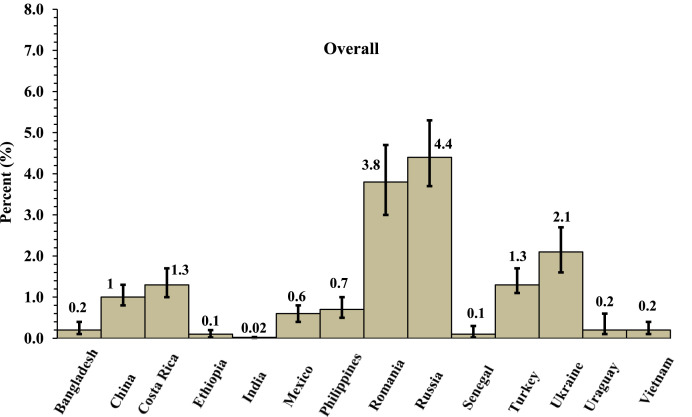
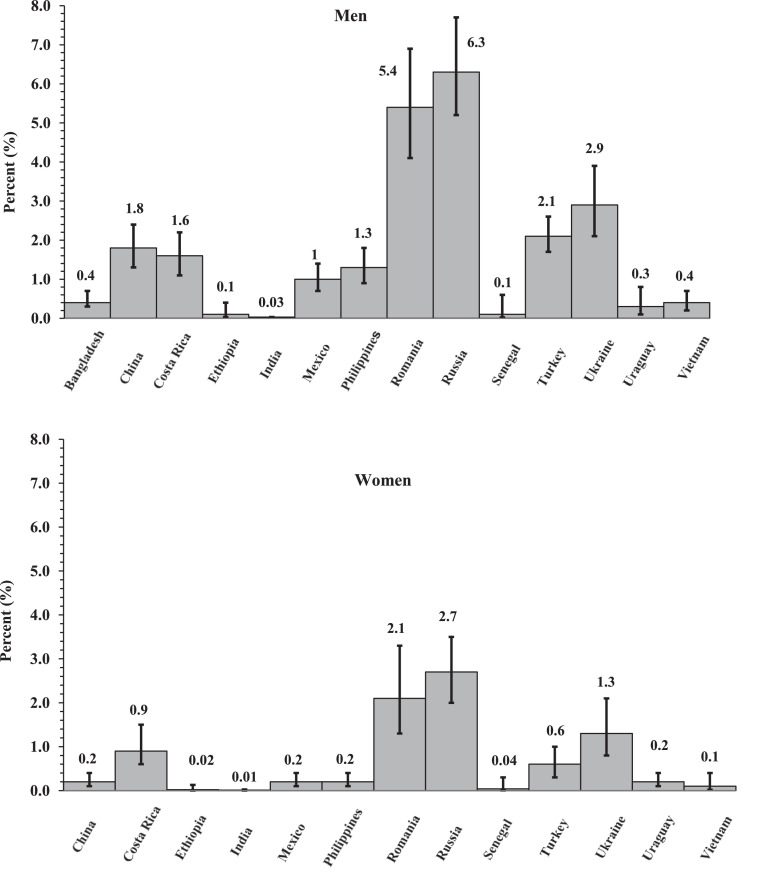
More than 50% of adults in Russia, Romania, and Ukraine and additionally more than 30% of adults in China, Costa Rica, Uruguay, Mexico, and Philippines were aware of e-cigarettes. Crude prevalence of current e-cigarette use ranged from 0.02% (95% CI 0.01%-0.04%) in India to 3.5% (2.9%-4.2%) in Russia. Prevalence was <1% in nine countries. Approximately 18.3 million adults currently used e-cigarettes across the 14 countries. Men had a significantly higher prevalence of current e-cigarette use than women in eight countries. Additionally, higher adjusted prevalence was observed in some countries among young adults aged 15‒24 years, urban residents, and adults with higher education levels and higher wealth index.
The study provides needed baseline data on e-cigarette awareness and use. Continued surveillance is essential to inform interventions and policies to prevent initiation and enhance cessation support.
None.
烟草产品格局持续变化。基于具有全国代表性的调查,尚无多个国家近期关于电子烟使用情况的数据报告。我们利用2015年1月1日至2018年12月31日期间的全球成人烟草调查(GATS)数据,研究了14个国家中电子烟的使用 prevalence 及其在社会人口学特征方面的差异。
GATS是一项针对15岁及以上成年人烟草使用情况的具有全国代表性的家庭调查。分析样本量从塞内加尔的4347人到印度的74,037人不等。当前电子烟使用者的 prevalence 按社会人口学亚组进行分层。根据世界2000 - 2025年标准人口估算年龄标准化 prevalence。通过多变量逻辑回归模型中边际效应对比的p值确定社会人口学亚组间调整后 prevalence 的显著差异。
俄罗斯、罗马尼亚和乌克兰超过50%的成年人知晓电子烟,另外中国、哥斯达黎加、乌拉圭、墨西哥和菲律宾超过30%的成年人知晓电子烟。当前电子烟使用者的粗 prevalence 从印度的0.02%(95%置信区间0.01% - 0.04%)到俄罗斯的3.5%(2.9% - 4.2%)不等。9个国家的 prevalence 低于1%。14个国家中约有1830万成年人目前使用电子烟。在8个国家,男性当前使用电子烟的 prevalence 显著高于女性。此外,在一些国家,15 - 24岁的年轻人、城市居民以及教育水平较高和财富指数较高的成年人中观察到较高的调整后 prevalence。
该研究提供了关于电子烟知晓情况和使用情况所需的基线数据。持续监测对于为预防开始使用和加强戒烟支持的干预措施及政策提供信息至关重要。
无。