Department of Experimental Cardiology, Amsterdam UMC, Amsterdam, The Netherlands.
Department of Clinical Epidemiology Biostatistics and Bioinformatics, Amsterdam UMC, Amsterdam, The Netherlands.
BMC Med. 2022 May 3;20(1):162. doi: 10.1186/s12916-022-02350-z.
Congenital long QT syndrome (LQTS) is a rare heart disease caused by various underlying mutations. Most general cardiologists do not routinely see patients with congenital LQTS and may not always recognize the accompanying ECG features. In addition, a proportion of disease carriers do not display obvious abnormalities on their ECG. Combined, this can cause underdiagnosing of this potentially life-threatening disease.
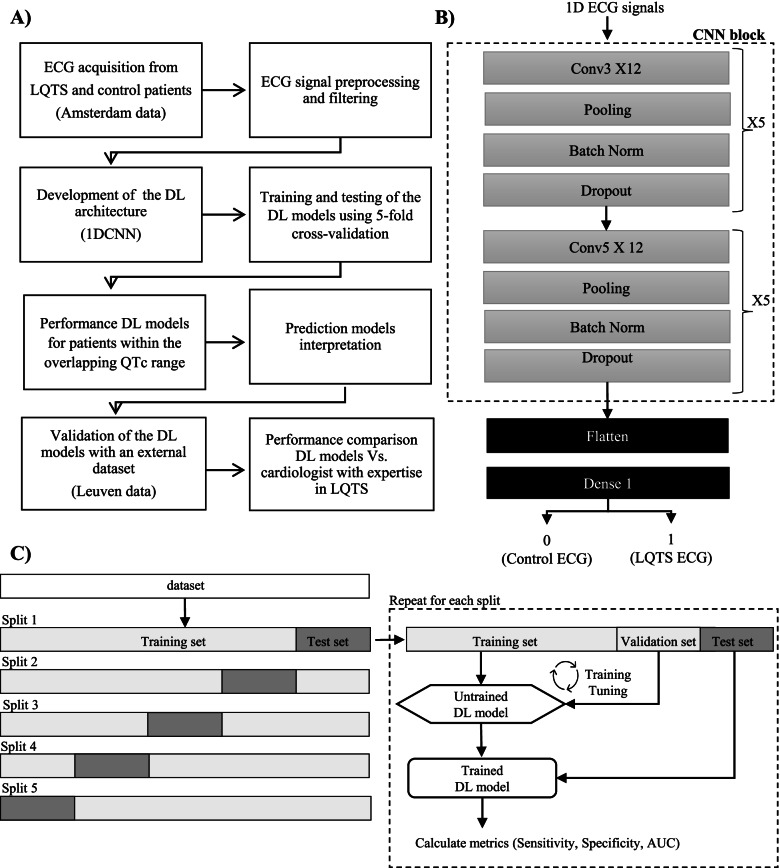
This study presents 1D convolutional neural network models trained to identify genotype positive LQTS patients from electrocardiogram as input. The deep learning (DL) models were trained with a large 10-s 12-lead ECGs dataset provided by Amsterdam UMC and externally validated with a dataset provided by University Hospital Leuven. The Amsterdam dataset included ECGs from 10000 controls, 172 LQTS1, 214 LQTS2, and 72 LQTS3 patients. The Leuven dataset included ECGs from 2200 controls, 32 LQTS1, and 80 LQTS2 patients. The performance of the DL models was compared with conventional QTc measurement and with that of an international expert in congenital LQTS (A.A.M.W). Lastly, an explainable artificial intelligence (AI) technique was used to better understand the prediction models.
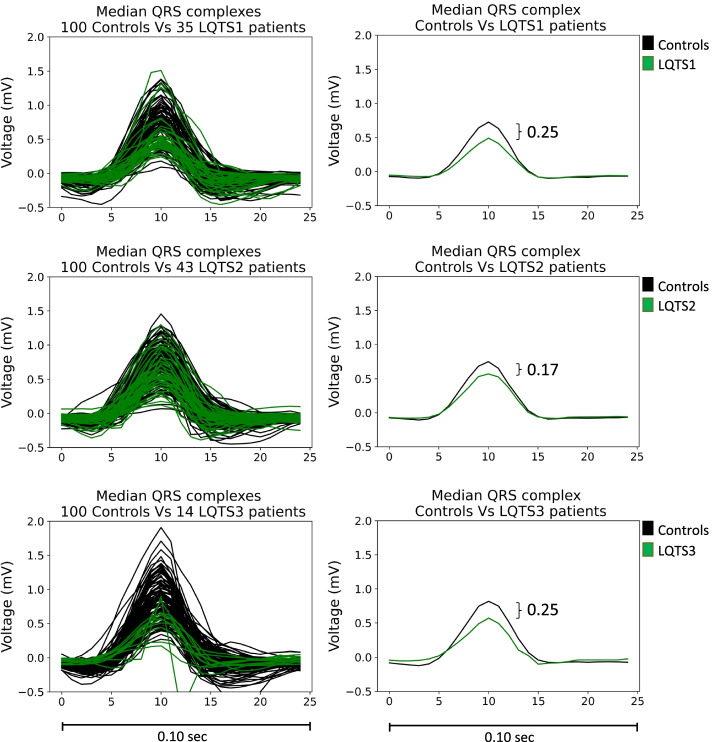
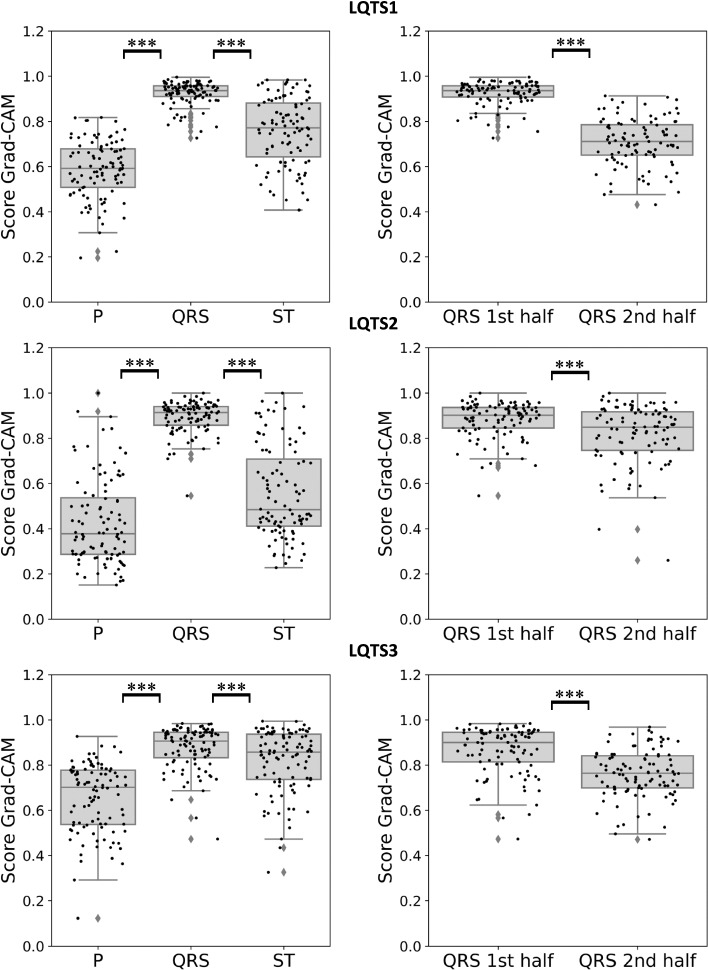
Overall, the best performing DL models, across 5-fold cross-validation, achieved on average a sensitivity of 84 ± 2%, 90 ± 2% and 87 ± 6%, specificity of 96 ± 2%, 95 ± 1%, and 92 ± 4%, and AUC of 0.90 ± 0.01, 0.92 ± 0.02, and 0.89 ± 0.03, for LQTS 1, 2, and 3 respectively. The DL models were also shown to perform better than conventional QTc measurements in detecting LQTS patients. Furthermore, the performances held up when the DL models were validated on a novel external cohort and outperformed the expert cardiologist in terms of specificity, while in terms of sensitivity, the DL models and the expert cardiologist in LQTS performed the same. Finally, the explainable AI technique identified the onset of the QRS complex as the most informative region to classify LQTS from non-LQTS patients, a feature previously not associated with this disease.
This study suggests that DL models can potentially be used to aid cardiologists in diagnosing LQTS. Furthermore, explainable DL models can be used to possibly identify new features for LQTS on the ECG, thus increasing our understanding of this syndrome.
先天性长 QT 综合征(LQTS)是一种由各种潜在突变引起的罕见心脏病。大多数普通心脏病专家不会常规接诊患有先天性 LQTS 的患者,并且可能并不总是能识别出伴随的心电图特征。此外,一部分疾病携带者的心电图并未显示出明显异常。综合起来,这可能导致这种潜在危及生命的疾病漏诊。
本研究提出了一种 1 维卷积神经网络模型,该模型接受心电图作为输入,用于识别基因型阳性的 LQTS 患者。该深度学习(DL)模型使用由阿姆斯特丹 UMC 提供的大型 10 秒 12 导联 ECG 数据集进行训练,并使用由鲁汶大学医院提供的数据集进行外部验证。阿姆斯特丹数据集包括 10000 名对照者、172 名 LQTS1、214 名 LQTS2 和 72 名 LQTS3 患者的心电图。鲁汶数据集包括 2200 名对照者、32 名 LQTS1 和 80 名 LQTS2 患者的心电图。将 DL 模型的性能与常规 QTc 测量和先天性 LQTS 国际专家(A.A.M.W.)进行了比较。最后,使用可解释的人工智能(AI)技术来更好地理解预测模型。
总体而言,在 5 折交叉验证中,表现最佳的 DL 模型平均获得了 84±2%、90±2%和 87±6%的敏感性、96±2%、95±1%和 92±4%的特异性以及 0.90±0.01、0.92±0.02 和 0.89±0.03 的 AUC,分别用于 LQTS1、2 和 3。研究还表明,DL 模型在检测 LQTS 患者方面优于常规 QTc 测量。此外,当将 DL 模型应用于新的外部队列进行验证时,其性能优于专家心脏病学家,在特异性方面表现更优,而在敏感性方面,DL 模型和专家心脏病学家在 LQTS 方面的表现相同。最后,可解释的 AI 技术确定了 QRS 波群的起始作为对非 LQTS 患者进行分类的最有信息的区域,这是以前与该疾病无关的特征。
本研究表明,DL 模型有可能用于帮助心脏病专家诊断 LQTS。此外,可解释的 DL 模型可用于确定心电图上与 LQTS 相关的新特征,从而增加我们对该综合征的理解。