Institute of Medical Sciences, School of Medicine, Medical Sciences and Nutrition, University of Aberdeen, Aberdeen, UK
Medical Statistics Team, Institute of Applied Health Sciences, School of Medicine, Medical Sciences and Nutrition, University of Aberdeen, Aberdeen, UK.
BMJ Open. 2022 May 3;12(5):e048092. doi: 10.1136/bmjopen-2020-048092.
To identify any associations between in utero exposure to five over-the-counter (non-prescription) analgesics (paracetamol, ibuprofen, aspirin, diclofenac, naproxen) and adverse neonatal outcomes.
Retrospective cohort study using the Aberdeen Maternity and Neonatal Databank.
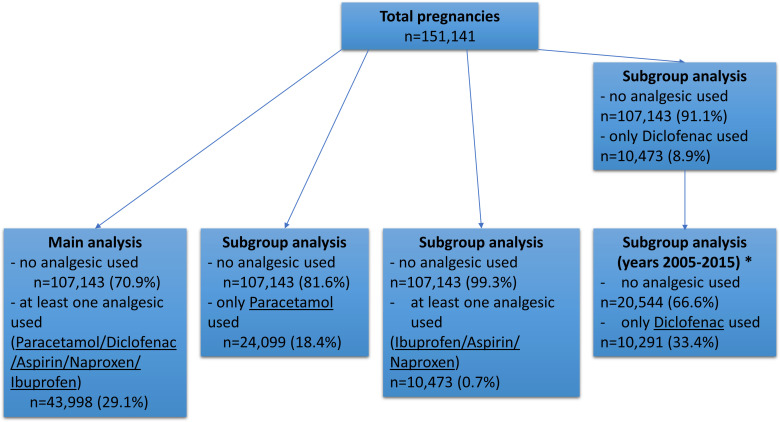
151 141 singleton pregnancies between 1985 and 2015.
Premature delivery (<37 weeks), stillbirth, neonatal death, birth weight, standardised birthweight score, neonatal unit admission, APGAR score at 1 and 5 min, neural tube and amniotic band defects, gastroschisis and, in males, cryptorchidism and hypospadias.
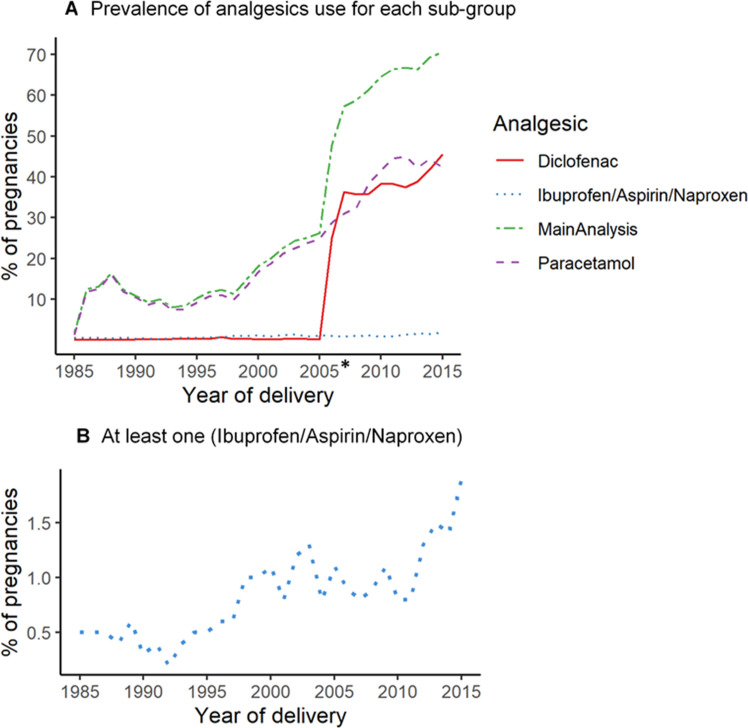
83.7% of women taking over-the-counter analgesics reported first trimester use when specifically asked about use at their first antenatal clinic visit. Pregnancies exposed to at least one of the five analgesics were significantly independently associated with increased risks for premature delivery <37 weeks (adjusted OR (aOR)=1.50, 95% CI 1.43 to 1.58), stillbirth (aOR=1.33, 95% CI 1.15 to 1.54), neonatal death (aOR=1.56, 95% CI 1.27 to 1.93), birth weight <2500 g (aOR=1.28, 95% CI 1.20 to 1.37), birth weight >4000 g (aOR=1.09, 95% CI 1.05 to 1.13), admission to neonatal unit (aOR=1.57, 95% CI 1.51 to 1.64), APGAR score <7 at 1 min (aOR=1.18, 95% CI 1.13 to 1.23) and 5 min (aOR=1.48, 95% CI 1.35 to 1.62), neural tube defects (aOR=1.64, 95% CI 1.08 to 2.47) and hypospadias (aOR=1.27, 95% CI 1.05 to 1.54 males only). The overall prevalence of over-the-counter analgesics use during pregnancy was 29.1%, however it rapidly increased over the 30-year study period, to include over 60% of women in the last 7 years of the study. This makes our findings highly relevant to the wider pregnant population.
Over-the-counter (non-prescription) analgesics consumption during pregnancy was associated with a substantially higher risk for adverse perinatal health outcomes in the offspring. The use of paracetamol in combination with other non-steroidal anti-inflammatory drugs conferred the highest risk. The increased risks of adverse neonatal outcomes associated with non-prescribed, over-the-counter, analgesics use during pregnancy indicate that healthcare guidance for pregnant women regarding analgesic use need urgent updating.
确定宫内暴露于五种非处方(非处方药)镇痛药(扑热息痛、布洛芬、阿司匹林、双氯芬酸、萘普生)与不良新生儿结局之间的任何关联。
使用阿伯丁母婴数据库的回顾性队列研究。
1985 年至 2015 年间 151141 例单胎妊娠。
早产(<37 周)、死产、新生儿死亡、出生体重、标准化出生体重评分、新生儿病房入院、1 分钟和 5 分钟时的 APGAR 评分、神经管和羊膜带缺陷、先天性脐膨出和男性隐睾症、尿道下裂。
83.7%服用非处方镇痛药的女性在首次产前检查时特别询问其在孕早期的使用情况时报告了使用情况。至少接触过五种镇痛药之一的妊娠与早产<37 周(调整后的比值比[aOR]=1.50,95%CI 1.43 至 1.58)、死产(aOR=1.33,95%CI 1.15 至 1.54)、新生儿死亡(aOR=1.56,95%CI 1.27 至 1.93)、出生体重<2500g(aOR=1.28,95%CI 1.20 至 1.37)、出生体重>4000g(aOR=1.09,95%CI 1.05 至 1.13)、新生儿病房入院(aOR=1.57,95%CI 1.51 至 1.64)、1 分钟时 APGAR 评分<7(aOR=1.18,95%CI 1.13 至 1.23)和 5 分钟时 APGAR 评分<7(aOR=1.48,95%CI 1.35 至 1.62)、神经管缺陷(aOR=1.64,95%CI 1.08 至 2.47)和男性隐睾症(aOR=1.27,95%CI 1.05 至 1.54)显著相关。怀孕期间非处方镇痛药使用的总体流行率为 29.1%,但在 30 年的研究期间迅速增加,在研究的最后 7 年中,超过 60%的女性使用了非处方镇痛药。这使得我们的研究结果与更广泛的孕妇群体密切相关。
怀孕期间使用非处方(非处方药)镇痛药与后代不良围产健康结局的风险显著增加有关。扑热息痛与其他非甾体抗炎药联合使用的风险最高。与怀孕期间非处方、非处方镇痛药使用相关的不良新生儿结局风险表明,迫切需要更新孕妇关于镇痛药使用的医疗保健指导。