Xu Yan, Zhu Wenzheng, Ge Qingfeng, Zhou Xiaoyan
School of Food Science and Engineering, Yangzhou University, No.196 Huayang West Road, Hanjiang District, Yangzhou City, 225127, Jiangsu Province, China.
Key Laboratory of Chinese Cuisine Intangible Cultural Heritage Technology Inheritance, Ministry of Culture and Tourism, Yangzhou University, Yangzhou, 225127, China.
AMB Express. 2022 May 5;12(1):49. doi: 10.1186/s13568-022-01387-w.
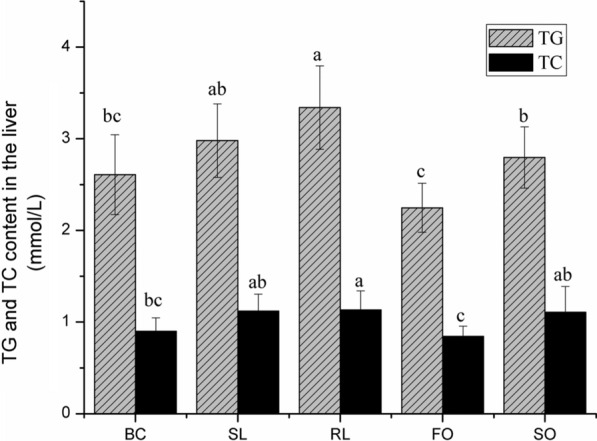
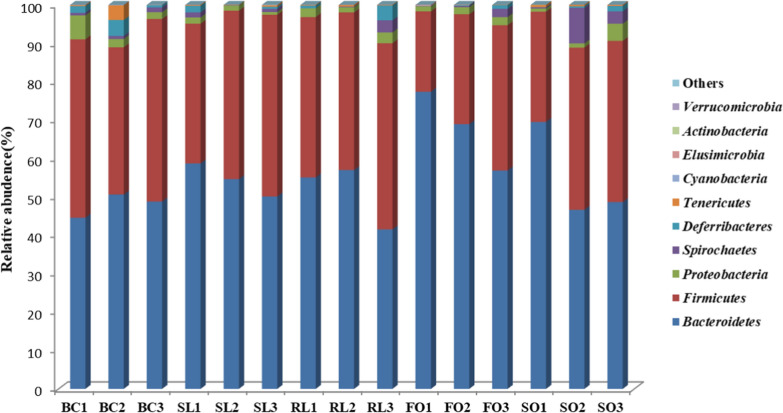
Dietary fat is an important part of human diet and has a close relationship with human health. However, it is still unclear how gut microbiota in adolescent responds to dietary fats at a normal dose. In this study, fat-free group (BC) was used as blank control group, we explored blood index and gut microbiota structure in growing rat(aged 1 months) after feeding a normal dose of 16.9% stewed lard(SL), refined lard(RL), fish oil(FO) and soybean oil(SO) for 6 weeks, respectively. The results showed that compared with RL group, SL group showed reduced fasting blood sugar and blood lipid levels and improved nutrient absorption capacity of the intestine. The blood indexes of glucose (Glu), total cholesterol (TC) and total triglyceride (TG) in FO treatment group were relatively low. The abundance of Bacteroidetes in the BC group decreased, and the abundance of Firmicutes increased. The Firmicutes/Bacteroidetes ratio of the FO group was relatively low, and the Firmicutes/Bacteroidetes ratio of the SL group and the SO group was lower than that of the RL group. The abundance of Bacteroidaceae in the SL group was increased. Research results showed that fat-free diets will increase the risk of obesity to a certain extent; compared with refined lard, stewed lard, soybean oil and fish oil can reduce the risk of obesity to a certain extent. The present study could find that the addition and types of dietary fat will affect the abundance and diversity of rat intestinal flora, and provide some information for nutritional evaluation about these dietary lipids.
膳食脂肪是人类饮食的重要组成部分,与人类健康密切相关。然而,目前仍不清楚青少年肠道微生物群对正常剂量膳食脂肪的反应。在本研究中,以无脂肪组(BC)作为空白对照组,分别用正常剂量的16.9%的炖猪油(SL)、精炼猪油(RL)、鱼油(FO)和大豆油(SO)喂养1月龄生长大鼠6周,探究其血液指标和肠道微生物群结构。结果显示,与RL组相比,SL组空腹血糖和血脂水平降低,肠道营养吸收能力提高。FO处理组的血糖(Glu)、总胆固醇(TC)和总甘油三酯(TG)血液指标相对较低。BC组拟杆菌门丰度降低,厚壁菌门丰度增加。FO组的厚壁菌门/拟杆菌门比值相对较低,SL组和SO组的厚壁菌门/拟杆菌门比值低于RL组。SL组中拟杆菌科的丰度增加。研究结果表明,无脂肪饮食在一定程度上会增加肥胖风险;与精炼猪油相比,炖猪油、大豆油和鱼油在一定程度上可降低肥胖风险。本研究发现膳食脂肪的添加量和种类会影响大鼠肠道菌群的丰度和多样性,并为这些膳食脂质的营养评价提供一些信息。