Centre for Community Medicine, All India Institute of Medical Sciences, New Delhi, India.
Indian Council Medical Research (ICMR)-National Centre for Disease Informatics and Research (NCDIR), Bengaluru, Karnataka, India.
J Hum Hypertens. 2023 May;37(5):394-404. doi: 10.1038/s41371-022-00692-y. Epub 2022 May 5.
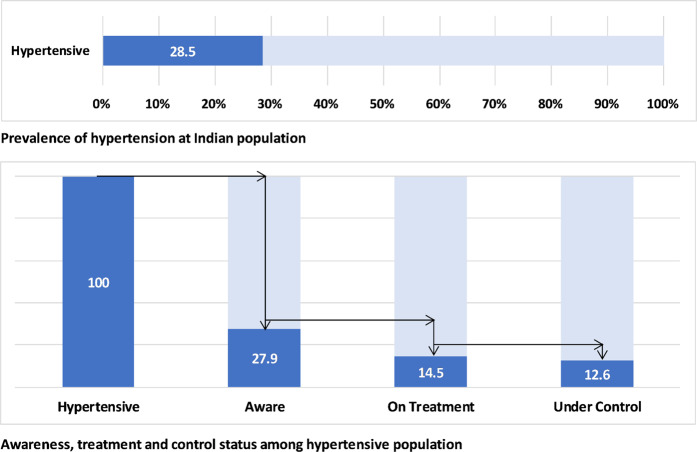
Hypertension is a major risk factor for ischemic heart disease and stroke. We estimated prevalence, awareness, treatment, and control of hypertension along with its determinants in India. We used data from the National NCD Monitoring Survey-(NNMS-2017-2018) which studied one adult (18-69 years) from a representative sample of households across India and collected information on socio-demographic variables, risk factors for NCDs and treatment practices. Blood pressure was recorded digitally and hypertension was defined as systolic blood pressure (SBP) ≥ 140 mmHg or diastolic blood pressure (DBP) ≥ 90 mmHg or currently on medications. Awareness was defined as being previously diagnosed with hypertension by a health professional; on treatment as taking a dose of medication once in the last 14 days and; control as SBP < 140 mmHg and DBP < 90 mmHg. Multivariate Logistic regression was performed to estimate determinants. Out of 10,593 adults with a blood pressure measurement (99.4%), 3017 (28.5%; 95% CI: 27.0-30.1) were found to have hypertension. Of these hypertensives, 840 (27.9%; 95% CI: 25.5-30.3) were aware, 438 (14.5%; 95% CI: 12.7-16.5) were under treatment and, 379 (12.6%; 95% CI: 11.0-14.3) were controlled. Significant determinants of awareness were being in the age group 50-69 years (aOR 2.45 95% CI: 1.63-3.69), women (1.63; 95% CI: 1.20-2.22) and from higher wealth quintiles. Those in the age group 50-69 (aOR 4.80; 95% CI: 1.74-13.27) were more likely to be under treatment. Hypertension control was poorer among urban participants (aOR 0.55; 95% CI: 0.33-0.90). Significant regional differences were noted, though without any clear trend. One-fifth of the patients were being managed at public facilities. The poor population-level hypertension control needs strengthening of hypertension services in the Universal Health Coverage package.
高血压是缺血性心脏病和中风的主要危险因素。我们估计了印度高血压的患病率、知晓率、治疗率和控制率及其决定因素。我们使用了国家非传染性疾病监测调查(NNMS-2017-2018)的数据,该调查研究了印度代表性家庭样本中的一名成年人(18-69 岁),收集了社会人口统计学变量、非传染性疾病风险因素和治疗实践方面的信息。血压是通过数字记录的,高血压定义为收缩压(SBP)≥140mmHg 或舒张压(DBP)≥90mmHg 或正在服用药物。知晓率定义为曾被卫生专业人员诊断患有高血压;治疗率定义为在过去 14 天内服用过一次药物;控制率定义为 SBP<140mmHg 和 DBP<90mmHg。我们进行了多变量逻辑回归分析以估计决定因素。在有血压测量的 10593 名成年人中(99.4%),有 3017 人(28.5%;95%CI:27.0-30.1)患有高血压。在这些高血压患者中,有 840 人(27.9%;95%CI:25.5-30.3)知晓自己的病情,有 438 人(14.5%;95%CI:12.7-16.5)正在接受治疗,有 379 人(12.6%;95%CI:11.0-14.3)得到了控制。知晓率的显著决定因素是年龄在 50-69 岁之间(调整后的比值比[aOR]为 2.45;95%CI:1.63-3.69)、女性(1.63;95%CI:1.20-2.22)和来自更高的财富五分位数。50-69 岁年龄组(aOR 为 4.80;95%CI:1.74-13.27)更有可能接受治疗。城市参与者的高血压控制较差(aOR 为 0.55;95%CI:0.33-0.90)。虽然没有明显的趋势,但我们注意到了显著的区域差异。五分之一的患者在公共设施接受管理。在全民健康覆盖方案中,需要加强高血压服务,以改善这一人群的高血压整体控制水平。