Indian Council of Medical Research - National Centre for Disease Informatics and Research, Nirmal Bhawan-ICMR Complex (II Floor), Poojanahalli, Kannamangala Post, Bengaluru, Karnataka, 562 110, India.
BMC Public Health. 2022 May 30;22(1):1069. doi: 10.1186/s12889-022-13466-5.
This study describes regional differences and determinants on key noncommunicable disease (NCD) risk factors in adults from the National NCD Monitoring Survey (NNMS) across six geographic regions of India.
The NNMS was a cross-sectional multistage cluster survey conducted in 2017-18, on a representative sample of 300 urban and 300 rural primary sampling units (PSU) covering 20 households per PSU. One adult aged 18-69 years per household was selected using the KISH grid. Globally standard survey tools were adapted for data collection. To arrive at regional estimates, the country was divided into six regions (south, north, central, west, east and northeast) based on the distribution of a national sample. The results are presented as proportion with 95% confidence intervals (CI). Univariable and multivariable logistic regression analyses were performed to identify NCD risk factor determinants significant in the regions. A p-value < 0.05 was considered for statistical significance.
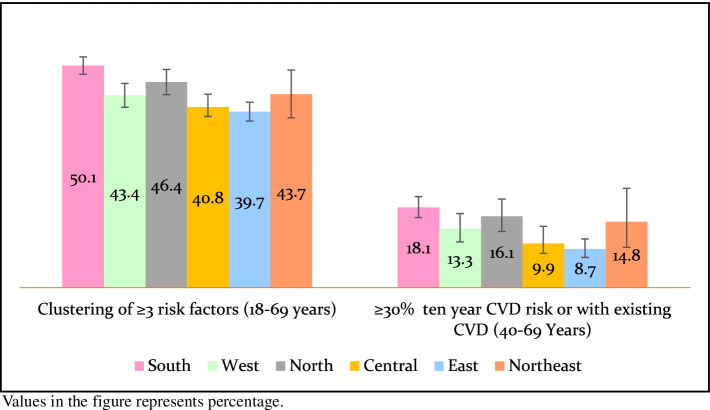
The overall survey response rate was 96.3%. The prevalence of current tobacco (45.7%) and alcohol use (22.3%) was significantly high in the northeast region. The highest proportion of adults from northern India showed low levels of physical activity (49.6%). The prevalence of metabolic risk factors - obesity (12.5%), raised fasting blood glucose (21.2%) and raised blood pressure (35.6%) was highest in south India. The prevalence of raised blood pressure was high in north India (35.2%) similar in proportion to south India. Clustering of ≥3 risk factors (50.1%) and ten-year CVD risk of ≥30% or with existing CVD (18.1%) was highest in south India when compared to other regions. Older age, urban residents, alcohol consumption and overweight/obesity were significantly associated with higher odds of raised blood pressure and raised fasting blood glucose.
The NNMS presents variations in NCD risk factors within the regions of India. It contributes to robust evidence for strengthening interventions and monitoring the progress in reducing NCDs and their associated risk factors.
本研究描述了印度六个地理区域的全国非传染性疾病监测调查(NNMS)中成年人关键非传染性疾病(NCD)风险因素的区域差异和决定因素。
NNMS 是一项于 2017-18 年进行的横断面多阶段聚类调查,对代表样本的 300 个城市和 300 个农村初级抽样单位(PSU)进行了调查,每个 PSU 覆盖 20 户家庭。每个家庭使用 KISH 网格选择一名 18-69 岁的成年人。采用全球标准调查工具进行数据收集。为了得出区域估计,根据全国样本的分布,将该国划分为六个区域(南部、北部、中部、西部、东部和东北部)。结果以比例和 95%置信区间(CI)表示。进行单变量和多变量逻辑回归分析,以确定在各区域有意义的 NCD 风险因素决定因素。p 值<0.05 被认为具有统计学意义。
总体调查应答率为 96.3%。东北部地区目前吸烟(45.7%)和饮酒(22.3%)的比例明显较高。来自印度北部的成年人中,体力活动水平最低的比例最高(49.6%)。印度南部成年人代谢风险因素——肥胖(12.5%)、空腹血糖升高(21.2%)和血压升高(35.6%)的比例最高。印度北部高血压的患病率较高(35.2%),与印度南部相似。与其他地区相比,南部印度≥3 种风险因素(50.1%)和十年 CVD 风险≥30%或存在 CVD(18.1%)的聚集率最高。与南部印度相比,年龄较大、城镇居民、饮酒和超重/肥胖与高血压和空腹血糖升高的几率更高显著相关。
NNMS 展示了印度各地区 NCD 风险因素的差异。它为加强干预措施提供了有力证据,并监测了减少 NCD 及其相关风险因素的进展情况。