Tian Rui, Zhang Boyu, Zhao Mingming, Zou Hangjin, Zhang Chuhan, Qi Yanfei, Ma Qiang
School of Public Health, Jilin University Changchun Jilin 130021 China
Department of Analytical Chemistry, College of Chemistry, Jilin University Changchun 130012 China
RSC Adv. 2019 Apr 17;9(22):12209-12217. doi: 10.1039/c9ra00505f.
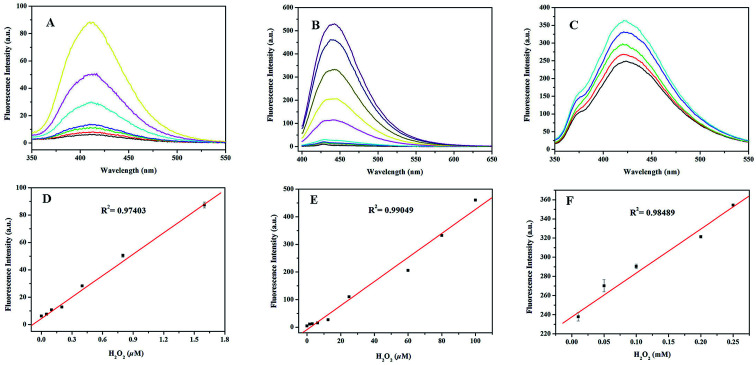
Simple, sensitive and stable fluorometric sensors based on the polyoxotungstate intrinsic peroxidase (Na[α-SiWO]) induced fluorescent enhancement of benzoic acid (BA), thiamine (TH) and 3-(4-hydroxyphenyl)propionic acid (HPPA) for the detection of hydrogen peroxide (HO) are developed for the first time. In three assays, the three non-fluorescent substrates BA, TH and HPPA were oxidized with the ·OH radicals decomposed from HO under the catalysis of Na[α-SiWO] under basic pH conditions. The optimal conditions for the detection of HO were evaluated and possible mechanisms are also discussed. The fluorescence intensity increases were linearly related to the concentration of HO in the ranges 1 × 10 to 1.6 × 10, 1.6 × 10 to 1 × 10, and 1 × 10to 2.5 × 10 M with BA, TH, and HPPA as substrates, respectively. Detection limits for the three systems were found to be 6.7 × 10, 2.2 × 10 and 9.6 × 10 M (3), respectively. The RSD values ranged from 2.57% to 4.66%, 0.82% to 4.06%, and 1.08% to 2.75%, respectively. The rates of recoveries were between 99.73% and 113.06%, 95.20% and 104.22%, and 95.28% and 128.76%, respectively. Moreover, the effects of interference were studied. The proposed work was successfully applied to the determination of HO in water and a sensitive, rapid and easy to operate assay was built, which has great potential applications in environmental science.
首次开发了基于多金属氧酸盐固有过氧化物酶(Na[α-SiWO])诱导苯甲酸(BA)、硫胺素(TH)和3-(4-羟苯基)丙酸(HPPA)荧光增强的简单、灵敏且稳定的荧光传感器,用于检测过氧化氢(HO)。在三种检测方法中,在碱性pH条件下,三种非荧光底物BA、TH和HPPA在Na[α-SiWO]的催化下,被HO分解产生的·OH自由基氧化。评估了检测HO的最佳条件,并讨论了可能的机制。以BA、TH和HPPA为底物时,荧光强度的增加分别与HO浓度在1×10至1.6×10、1.6×10至1×10和1×10至2.5×10 M范围内呈线性关系。三种体系的检测限分别为6.7×10、2.2×10和9.6×10 M(3)。相对标准偏差(RSD)值分别在2.57%至4.66%、0.82%至4.06%和1.08%至2.75%之间。回收率分别在99.73%至113.06%、95.20%至104.22%和95.28%至128.76%之间。此外,还研究了干扰效应。所提出的工作成功应用于水中HO的测定,构建了一种灵敏、快速且易于操作的检测方法,在环境科学中具有巨大的潜在应用价值。