Dommati Hitesh, Ray Saikat Sinha, Wang Jia-Chang, Chen Shiao-Shing
Department of Mechanical Engineering, National Taipei University of Technology Taiwan
Additive Manufacturing Center for Mass Customization Production, National Taipei University of Technology Taiwan.
RSC Adv. 2019 May 29;9(29):16869-16883. doi: 10.1039/c9ra00872a. eCollection 2019 May 24.
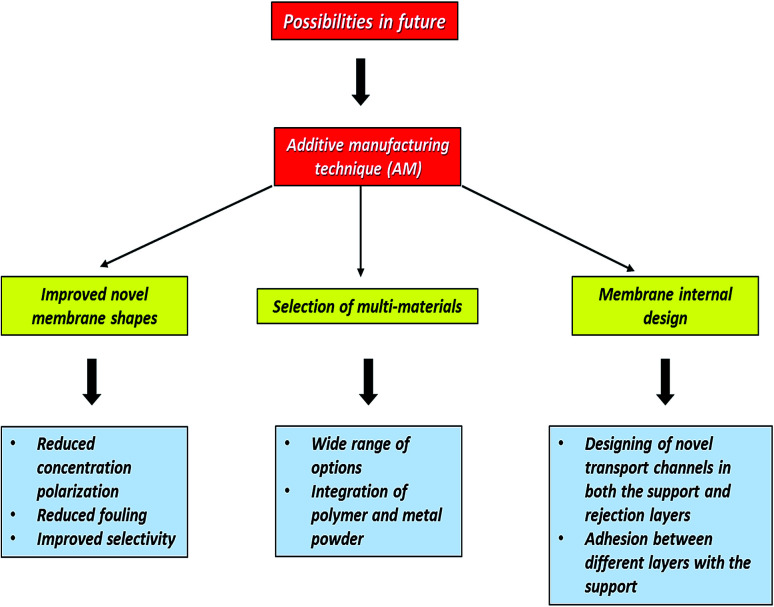
Additive manufacturing (AM), which is also commonly known as 3D printing, provides flexibility in the manufacturing of complex geometric parts at competitive prices and within a low production time. However, AM has not been used to a large extent in filtration and water treatment processes. AM results in the creation of millions of nanofibers that are sublayered on top of each other and compressed into a thin membrane. AM is a novel technique for fabricating filtration membranes with different shapes, sizes and controlled porosity, which cannot be achieved using conventional process such as electrospinning and knife casting. In this paper, we review the advantages and limitations of AM processes for fabricating ceramic membranes. Moreover, a brief background of AM processes is provided, and their future prospects are examined. Due to their potential benefits for fabrication and flexibility with different materials, AM methods are promising in the field of membrane engineering.
增材制造(AM),通常也被称为3D打印,它能够以具有竞争力的价格并在较短的生产时间内,灵活制造复杂几何形状的零件。然而,增材制造在过滤和水处理过程中的应用程度还不高。增材制造会产生数以百万计的纳米纤维,这些纳米纤维相互叠加形成子层并被压缩成薄膜。增材制造是一种制造具有不同形状、尺寸和可控孔隙率的过滤膜的新技术,这是传统工艺(如静电纺丝和刮刀法)所无法实现的。在本文中,我们回顾了用于制造陶瓷膜的增材制造工艺的优缺点。此外,还介绍了增材制造工艺的简要背景,并探讨了其未来前景。由于增材制造方法在制造方面的潜在优势以及对不同材料的适应性,它们在膜工程领域具有广阔的前景。