Shukla Durgesh, Bhadoria Sumit Singh, Bansal Manoj, Changulani Richa
Department of Community Medicine, G.R. Medical College, Gwalior, MP, India.
J Family Med Prim Care. 2022 Apr;11(4):1314-1321. doi: 10.4103/jfmpc.jfmpc_1189_21. Epub 2022 Mar 18.
Studies of pandemics in past centuries have suggested that the second wave was always more lethal and devastating as compared to the first wave. Regarding coronavirus disease (COVID) pandemic also, various speculations were made that during the second wave virus changes its nature either for age structure, gender or rural-urban differential. Present study was aimed to compare the demographic and mortality profile of COVID-19 patients during the two waves.
A total of 51,425 individuals with 16,538 cases from first wave and 34,887 cases from the second wave were included in the study. Frequency, percentage, case fatality rate (CFR) and OR (95% CI) were calculated. Level of significance was considered at 5%.
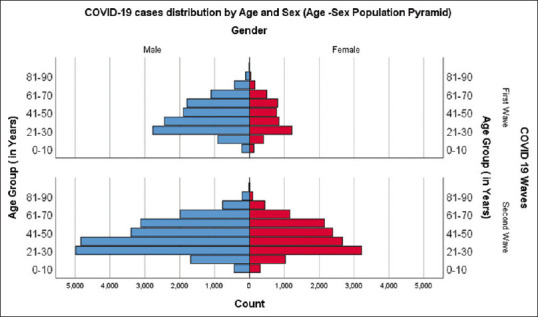
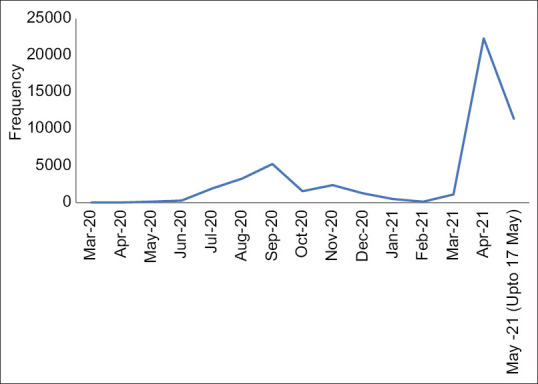
Maximum cases were observed in the age group 21-30 years (23.7%). During the first wave, 29.5% females were infected while during the second wave 38.5% females were infected. Infection in rural areas increased to 5.7% as compared to 4.8% in the first wave. Among the females, CFR increased to 37% in second wave which was 25.2% in the first wave. Disease load was at its peak in the month of April 2021.
During the second wave, infection rate and mortality were higher in females and patients residing in rural areas showing extension of community spread. Patients with age above 50 years succumbed more. Occurrence of more than two-fifth of the cases in a single month (April 2021) shows a need for better planning for the supposed third wave to tackle any unwanted situation.
过去几个世纪对大流行的研究表明,与第一波相比,第二波总是更具致命性和破坏性。关于冠状病毒病(COVID)大流行,也有各种猜测,即第二波期间病毒在年龄结构、性别或城乡差异方面改变了其特性。本研究旨在比较两波COVID-19患者的人口统计学和死亡率概况。
本研究共纳入51425人,其中第一波16538例,第二波34887例。计算频率、百分比、病死率(CFR)和OR(95%CI)。显著性水平设定为5%。
观察到最大病例数出现在21 - 30岁年龄组(23.7%)。第一波期间,29.5%的女性被感染,而第二波期间38.5%的女性被感染。农村地区的感染率从第一波的4.8%增至5.7%。在女性中,第二波的病死率增至37%,第一波为25.2%。疾病负荷在2021年4月达到峰值。
在第二波期间,女性和农村地区居民的感染率和死亡率更高,表明社区传播范围扩大。50岁以上的患者死亡更多。单月(2021年4月)出现超过五分之二的病例表明,需要为预期的第三波更好地规划,以应对任何意外情况。