Stanford Prevention Research Center, Department of Medicine, and Department of Epidemiology and Population Health, Stanford University School of Medicine, Stanford, CA, USA; Meta-Research Innovation Center at Stanford (METRICS), Stanford, CA, USA.
Meta-Research Innovation Center at Stanford (METRICS), Stanford, CA, USA; Department of Women's and Children's Health, Uppsala University, Uppsala, Sweden.
Environ Res. 2021 Apr;195:110856. doi: 10.1016/j.envres.2021.110856. Epub 2021 Feb 10.
To examine whether the age distribution of COVID-19 deaths and the share of deaths in nursing homes changed in the second versus the first pandemic wave.
We considered all countries that had at least 4000 COVID-19 deaths occurring as of January 14, 2021, at least 200 COVID-19 deaths occurring in each of the two epidemic wave periods; and which had sufficiently detailed information available on the age distribution of these deaths. We also considered countries with data available on COVID-19 deaths of nursing home residents for the two waves.
Change in the second wave versus the first wave in the proportion of COVID-19 deaths occurring in people <50 years ("young deaths") among all COVID-19 deaths and among COVID-19 deaths in people <70 years old; and change in the proportion of COVID-19 deaths in nursing home residents among all COVID-19 deaths.
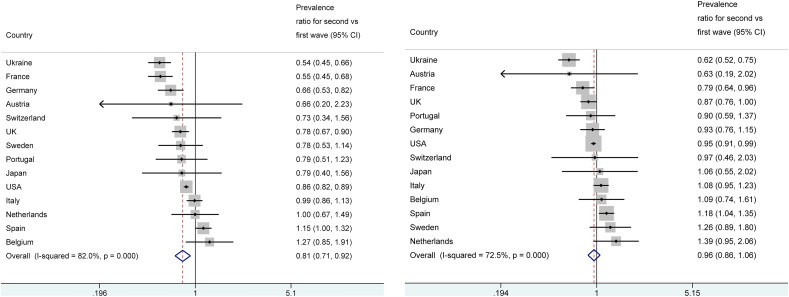
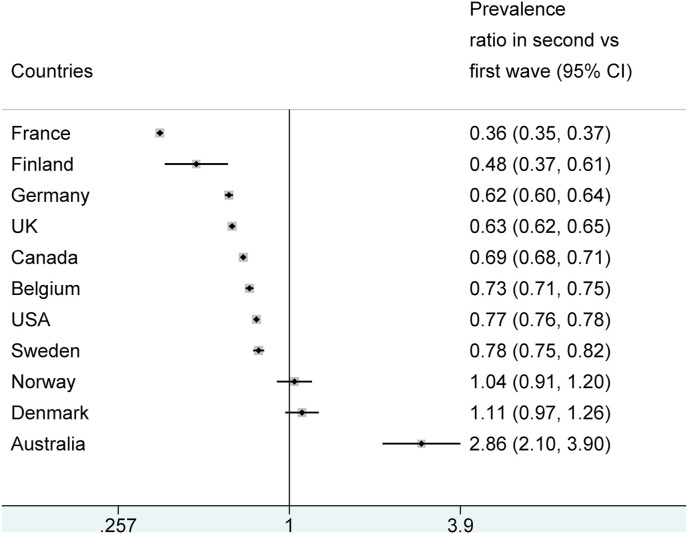
Data on age distribution were available for 14 eligible countries. Individuals <50 years old had small absolute difference in their share of the total COVID-19 deaths in the two waves across 13 high-income countries (absolute differences 0.0-0.4%). Their proportion was higher in Ukraine, but it decreased markedly in the second wave. The proportion of young deaths was lower in the second versus the first wave (summary prevalence ratio 0.81, 95% CI 0.71-0.92) with large between-country heterogeneity. The proportion of young deaths among deaths <70 years did not differ significantly across the two waves (summary prevalence ratio 0.96, 95% CI 0.86-1.06). Eligible data on nursing home COVID-19 deaths were available for 11 countries. The share of COVID-19 deaths that were accounted by nursing home residents decreased in the second wave significantly and substantially in 8 countries (prevalence ratio estimates: 0.36 to 0.78), remained the same in Denmark and Norway and markedly increased in Australia.
In the examined countries, age distribution of COVID-19 deaths has been fairly similar in the second versus the first wave, but the contribution of COVID-19 deaths in nursing home residents to total fatalities has decreased in most countries in the second wave.
研究第二波疫情与第一波疫情相比,COVID-19 死亡人数的年龄分布和养老院死亡人数占比是否发生了变化。
我们考虑了所有截至 2021 年 1 月 14 日至少有 4000 例 COVID-19 死亡病例、每一波疫情期间至少有 200 例 COVID-19 死亡病例,且有足够详细的年龄分布信息的国家。我们还考虑了在两个波次中均有养老院居民 COVID-19 死亡数据的国家。
在所有 COVID-19 死亡病例和 70 岁以下 COVID-19 死亡病例中,第二波疫情与第一波疫情相比,<50 岁(“年轻死亡”)COVID-19 死亡病例所占比例的变化;以及养老院居民 COVID-19 死亡病例在所有 COVID-19 死亡病例中的比例变化。
有 14 个符合条件的国家提供了年龄分布数据。在 13 个高收入国家中,<50 岁人群在两波疫情中的总 COVID-19 死亡病例中的绝对差异较小(绝对差异 0.0-0.4%)。乌克兰的这一比例较高,但在第二波疫情中显著下降。与第一波疫情相比,第二波疫情中年轻死亡比例较低(汇总患病率比 0.81,95%置信区间 0.71-0.92),且国家间存在较大异质性。<70 岁人群的年轻死亡比例在两波疫情中无显著差异(汇总患病率比 0.96,95%置信区间 0.86-1.06)。有 11 个国家提供了符合条件的养老院 COVID-19 死亡数据。在 8 个国家(患病率比估计值:0.36 至 0.78),养老院 COVID-19 死亡病例在第二波疫情中显著且大幅下降,而在丹麦和挪威保持不变,在澳大利亚则明显增加。
在所研究的国家中,第二波疫情与第一波疫情相比,COVID-19 死亡人数的年龄分布大致相似,但在大多数国家,第二波疫情中养老院居民 COVID-19 死亡人数占总死亡人数的比例有所下降。