Hoshino Yuki, Soma Tomoyuki, Uchida Yoshitaka, Shiko Yuki, Nakagome Kazuyuki, Nagata Makoto
Department of Respiratory Medicine, Saitama Medical University, Saitama, Japan.
Allergy Center, Saitama Medical University, Saitama, Japan.
Front Pharmacol. 2022 Apr 20;13:836635. doi: 10.3389/fphar.2022.836635. eCollection 2022.
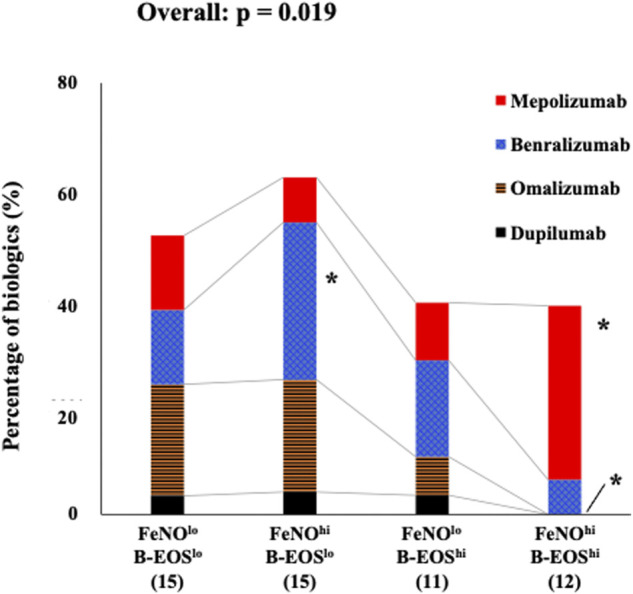
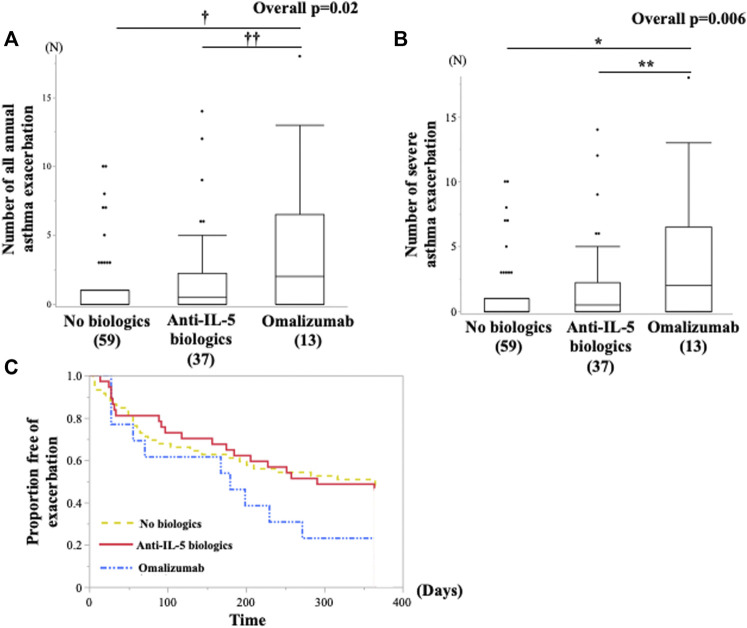
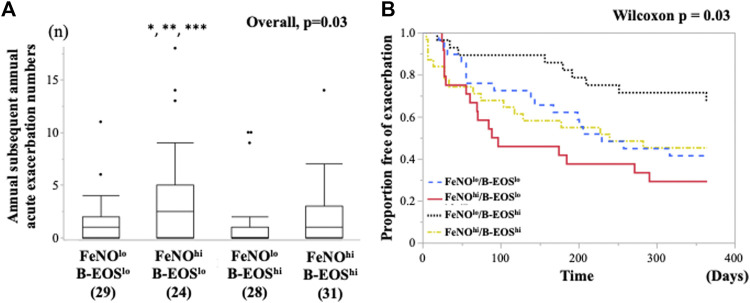
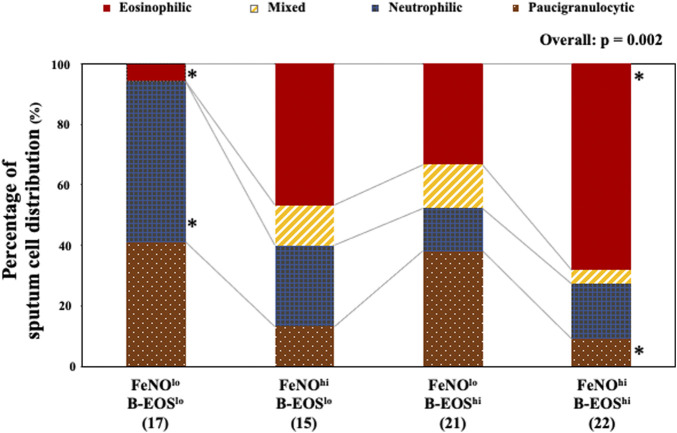
Combining a fraction of exhaled nitric oxide (FeNO) and blood eosinophil count (B-EOS) may be a useful strategy for administration of biologics such as anti-IgE or anti-IL-5 to patients with type 2 inflammatory-predominant severe asthma and is important to be elucidated considering the increasing use of biologics. This cross-sectional study analyzed the clinical data from 114 adult patients with severe asthma, who were treated at Saitama Medical University Hospital. The eligible patients were stratified into four subgroups defined by thresholds of FeNO and blood eosinophil (B-EOS) counts to detect sputum eosinophilia, using the receiver operating characteristic curve analysis. A total of 75 patients with optimal samples were stratified into four subtypes defined by thresholds of sputum eosinophilia and neutrophilia. Clinical characteristics, pattern of biologics, and distribution of sputum subtypes were analyzed in the stratified subclasses according to the FeNO and B-EOS thresholds. The asthma exacerbation (AE)-free time of the FeNO/B-EOS subgroups and any biologics treatment including anti-IgE or anti-IL-5 use were examined using the Kaplan-Meier method. The hazard ratios (HRs) for AE-free time were examined using the Cox proportional hazard model. The optimal cutoff values for prediction of sputum eosinophilia were defined as ≥2.7% wherein for FeNO as ≥27 ppb and B-EOS as ≥265/µL were considered. The high-FeNO subgroups showed significant high total IgE, compared with the low FeNO. The high-FeNO/high-B-EOS and the high-FeNO/low-B-EOS subgroups showed the largest prevalence of mepolizumab and benralizumab use among the other FeNO/B-EOS, respectively. The high-FeNO/low-B-EOS showed the largest frequency of AEs, high HR, and the shortest AE-free time, among the other FeNO/B-EOS. The sputum eosinophil-predominant subtype was the great majority in the high FeNO/high B-EOS. A diverse distribution of sputum leukocyte-predominant subtype was observed in the other FeNO/B-EOS. The subsequent AE-free time and its HR were comparable among the biologics use groups. The strategy of classifying severe asthma based on the combination of FeNO and B-EOS proposes particular refractory type 2 severe asthma and underlying airway inflammation as a feasible trait for optimal biologics use.
结合呼出一氧化氮分数(FeNO)和血液嗜酸性粒细胞计数(B-EOS),对于向以2型炎症为主的重度哮喘患者施用抗IgE或抗IL-5等生物制剂可能是一种有用的策略,考虑到生物制剂使用的增加,这一点有待阐明。这项横断面研究分析了在埼玉医科大学医院接受治疗的114例成年重度哮喘患者的临床数据。使用受试者工作特征曲线分析,将符合条件的患者根据FeNO和血液嗜酸性粒细胞(B-EOS)计数阈值分层为四个亚组,以检测痰液嗜酸性粒细胞增多情况。总共75例具有最佳样本的患者根据痰液嗜酸性粒细胞增多和中性粒细胞增多阈值分层为四种亚型。根据FeNO和B-EOS阈值,在分层亚组中分析临床特征、生物制剂模式和痰液亚型分布。使用Kaplan-Meier方法检查FeNO/B-EOS亚组的无哮喘加重(AE)时间以及包括使用抗IgE或抗IL-5在内的任何生物制剂治疗情况。使用Cox比例风险模型检查无AE时间的风险比(HRs)。预测痰液嗜酸性粒细胞增多的最佳截断值定义为≥2.7%,其中FeNO≥27 ppb且B-EOS≥265/µL被视为标准。与低FeNO组相比,高FeNO亚组显示总IgE显著升高。在其他FeNO/B-EOS亚组中,高FeNO/高B-EOS和高FeNO/低B-EOS亚组分别显示使用美泊利单抗和贝那利珠单抗的患病率最高。在其他FeNO/B-EOS亚组中,高FeNO/低B-EOS组显示AE发生频率最高、HR最高且无AE时间最短。在高FeNO/高B-EOS组中,痰液嗜酸性粒细胞为主的亚型占绝大多数。在其他FeNO/B-EOS亚组中观察到痰液白细胞为主亚型的分布多样。生物制剂使用组之间随后的无AE时间及其HR具有可比性。基于FeNO和B-EOS联合对重度哮喘进行分类的策略提出,特定难治性2型重度哮喘和潜在气道炎症是最佳生物制剂使用的可行特征。