Sun Jin, Cheng Bokai, Su Yongkang, Li Man, Ma Shouyuan, Zhang Yan, Zhang Anhang, Cai Shuang, Bao Qiligeer, Wang Shuxia, Zhu Ping
Department of Geriatrics, The Second Medical Center and National Clinical Research Center for Geriatric Diseases, Chinese PLA General Hospital, Beijing, China.
Medical School of Chinese PLA, Beijing, China.
Front Genet. 2022 Apr 20;13:869950. doi: 10.3389/fgene.2022.869950. eCollection 2022.
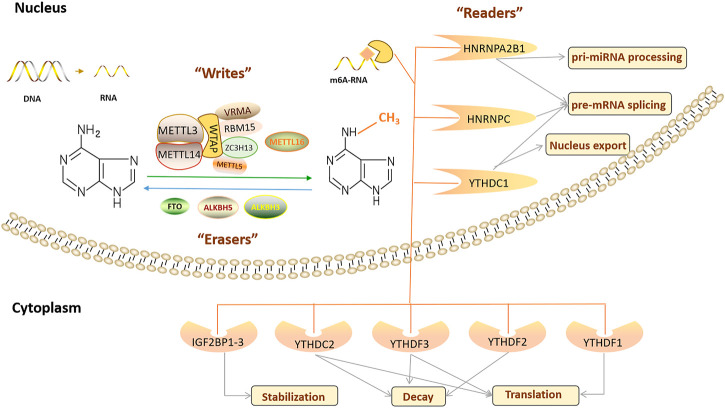
N6-methyladenosine (mA) is the most common and conserved internal eukaryotic mRNA modification. mA modification is a dynamic and reversible post-transcriptional regulatory modification, initiated by methylase and removed by RNA demethylase. mA-binding proteins recognise the mA modification to regulate gene expression. Recent studies have shown that altered mA levels and abnormal regulator expression are crucial in the ageing process and the occurrence of age-related diseases. In this review, we summarise some key findings in the field of mA modification in the ageing process and age-related diseases, including cell senescence, autophagy, inflammation, oxidative stress, DNA damage, tumours, neurodegenerative diseases, diabetes, and cardiovascular diseases (CVDs). We focused on the biological function and potential molecular mechanisms of mA RNA methylation in ageing and age-related disease progression. We believe that mA modification may provide a new target for anti-ageing therapies.
N6-甲基腺嘌呤(mA)是真核生物中最常见且保守的内部mRNA修饰。mA修饰是一种动态可逆的转录后调控修饰,由甲基化酶启动并由RNA去甲基化酶去除。mA结合蛋白识别mA修饰以调节基因表达。最近的研究表明,mA水平的改变和调节因子表达异常在衰老过程及与年龄相关疾病的发生中至关重要。在本综述中,我们总结了衰老过程及与年龄相关疾病领域中mA修饰的一些关键发现,包括细胞衰老、自噬、炎症、氧化应激、DNA损伤、肿瘤、神经退行性疾病、糖尿病和心血管疾病(CVD)。我们重点关注了mA RNA甲基化在衰老及与年龄相关疾病进展中的生物学功能和潜在分子机制。我们认为,mA修饰可能为抗衰老治疗提供新靶点。