Sarkar Prattay Guha, Pant Pragya, Kumar Jagmohan, Kumar Amit
Department of Cardiology, Rajendra Institute of Medical Sciences, Ranchi, Jharkhand, India.
Department of Nephrology, Rajendra Institute of Medical Sciences, Ranchi, Jharkhand, India.
Indian J Crit Care Med. 2022 Mar;26(3):361-375. doi: 10.5005/jp-journals-10071-24135.
Coronavirus disease-2019 (COVID-2019) pandemic continues to be a significant public health problem. Severe COVID-19 cases have a poor prognosis and extremely high mortality. Prognostic factor evidence can help healthcare providers understand the likely prognosis and identify subgroups likely to develop severe disease with increased mortality risk so that timely treatments can be initiated. This meta-analysis has been performed to evaluate the neutrophil-to-lymphocyte ratio (NLR) at admission as a prognostic factor to predict severe coronavirus disease and mortality.
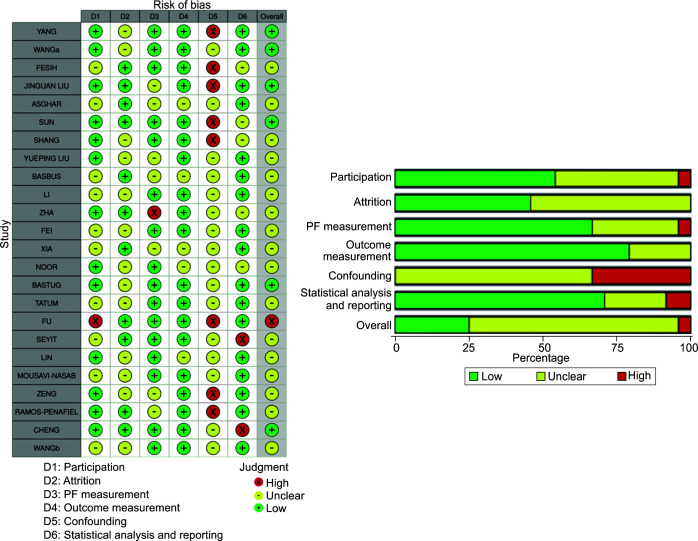
A literature search was conducted through April 30, 2021, to retrieve all published studies, including gray literature and preprints, investigating the association between NLR and severity or mortality in COVID-19 patients. Screening of studies and data extraction have been done by two authors independently. The methodological quality of the included studies was assessed by the Quality in Prognosis Studies (QUIPS) tool.
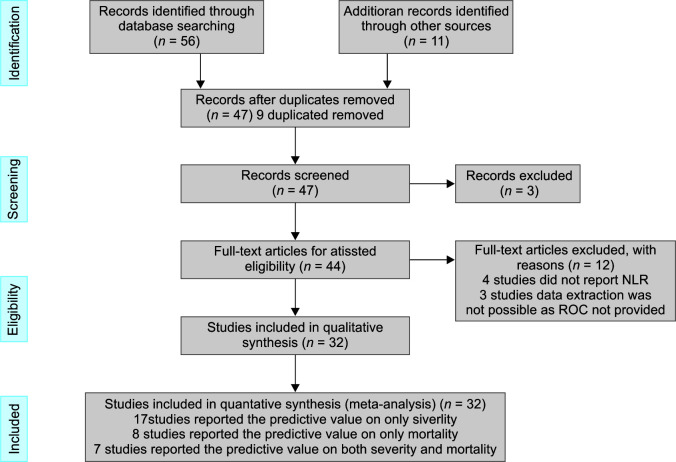
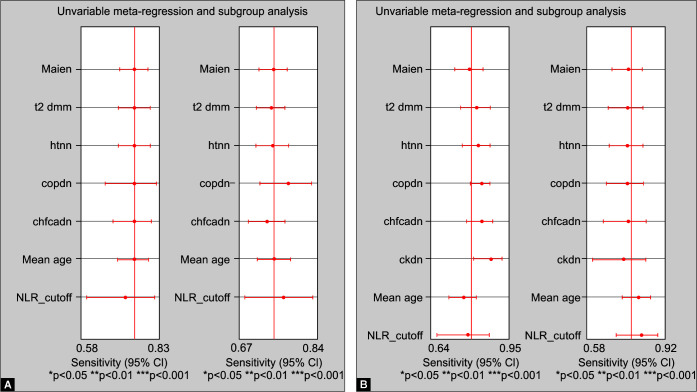
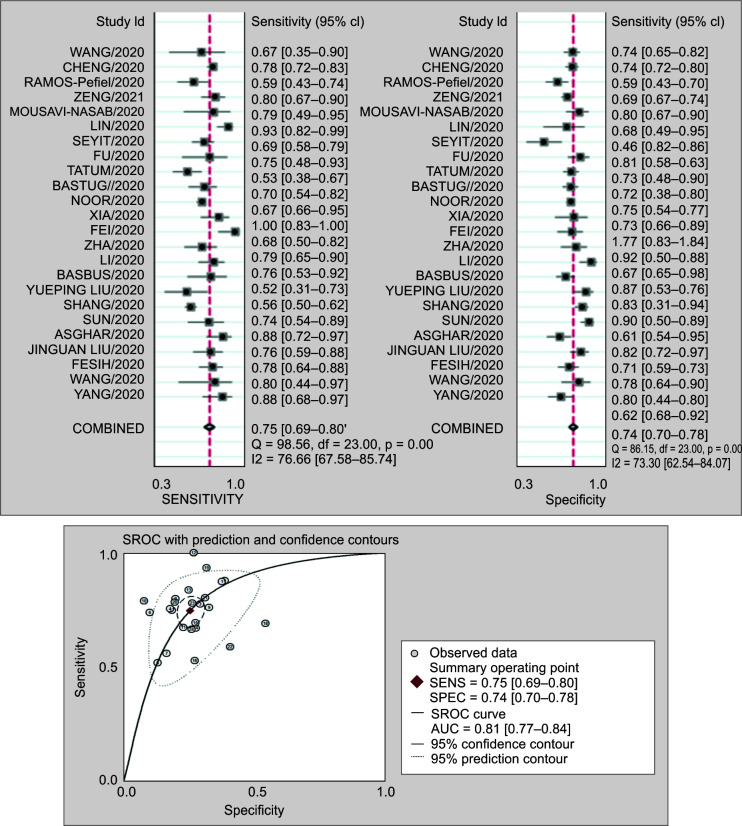
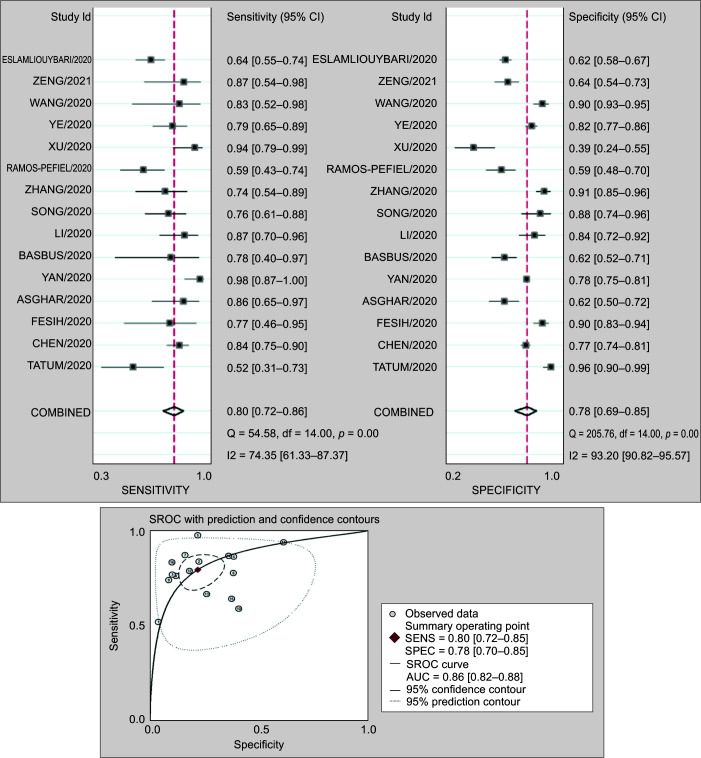
Twenty-four studies involving 4,080 patients reported the prognostic value of NLR for severe COVID-19. The pooled sensitivity (SEN), specificity (SPE), and area under the curve were 0.75 (95% CI 0.69-0.80), 0.74 (95% CI 0.70-0.78), and 0.81 (95% CI 0.77-0.84). Fifteen studies involving 4,071 patients reported the prognostic value of NLR for mortality in COVID-19. The pooled sensitivity (SEN), specificity (SPE), and area under curve were 0.80 (95% CI 0.72-0.86), 0.78 (95% CI 0.69-0.85), and 0.86 (95% CI 0.83-0.89).
The prognostic value of NLR at admission for severity and mortality in patients with COVID-19 is good. Evaluating the NLR at admission can assist treating clinicians to identify early the cases likely to worsen. This would help to conduct early triage, identify potentially high-risk cases, and start optimal monitoring and management, thus reducing the overall mortality of COVID-19.
This meta-analysis was prospectively registered on PROSPERO database (Registration Number: CRD42021247801).
Sarkar PG, Pant P, Kumar J, Kumar A. Does Neutrophil-to-lymphocyte Ratio at Admission Predict Severity and Mortality in COVID-19 Patients? A Systematic Review and Meta-analysis. Indian J Crit Care Med 2022;26(3):361-375.
2019冠状病毒病(COVID-19)大流行仍然是一个重大的公共卫生问题。重症COVID-19病例预后较差,死亡率极高。预后因素证据有助于医疗服务提供者了解可能的预后情况,并识别出可能发展为重症疾病且死亡风险增加的亚组,以便及时开始治疗。本荟萃分析旨在评估入院时的中性粒细胞与淋巴细胞比值(NLR)作为预测重症冠状病毒病和死亡率的预后因素。
通过检索截至2021年4月30日的所有已发表研究,包括灰色文献和预印本,来调查NLR与COVID-19患者病情严重程度或死亡率之间的关联。由两位作者独立进行研究筛选和数据提取。采用预后研究质量(QUIPS)工具评估纳入研究的方法学质量。
24项涉及4080例患者的研究报告了NLR对重症COVID-19的预后价值。合并敏感度(SEN)、特异度(SPE)和曲线下面积分别为0.75(95%CI 0.69-0.80)、0.74(95%CI 0.70-0.78)和0.81(95%CI 0.77-0.84)。15项涉及4071例患者的研究报告了NLR对COVID-19死亡率的预后价值。合并敏感度(SEN)、特异度(SPE)和曲线下面积分别为0.80(95%CI 0.72-0.86)、0.78(95%CI 0.69-0.85)和0.86(95%CI 0.83-0.89)。
入院时NLR对COVID-19患者病情严重程度和死亡率的预后价值良好。评估入院时的NLR可帮助临床治疗医生早期识别可能病情恶化的病例。这将有助于进行早期分诊,识别潜在的高危病例,并开始最佳的监测和管理,从而降低COVID-19的总体死亡率。
本荟萃分析已在PROSPERO数据库前瞻性注册(注册号:CRD42021247801)。
Sarkar PG, Pant P, Kumar J, Kumar A. 入院时中性粒细胞与淋巴细胞比值能否预测COVID-19患者的病情严重程度和死亡率?一项系统评价和荟萃分析。《印度重症监护医学杂志》2022;26(3):361-375。