
结合一维卷积神经网络的激光诱导荧光光谱法识别矿井突水
Identification of mine water inrush using laser-induced fluorescence spectroscopy combined with one-dimensional convolutional neural network.
作者信息
Hu Feng, Zhou Mengran, Yan Pengcheng, Li Datong, Lai Wenhao, Bian Kai, Dai Rongying
机构信息
School of Electrical and Information Engineering, Anhui University of Science and Technology No. 168 Taifeng Road Huainan 232001 PR China
出版信息
RSC Adv. 2019 Mar 8;9(14):7673-7679. doi: 10.1039/c9ra00805e. eCollection 2019 Mar 6.
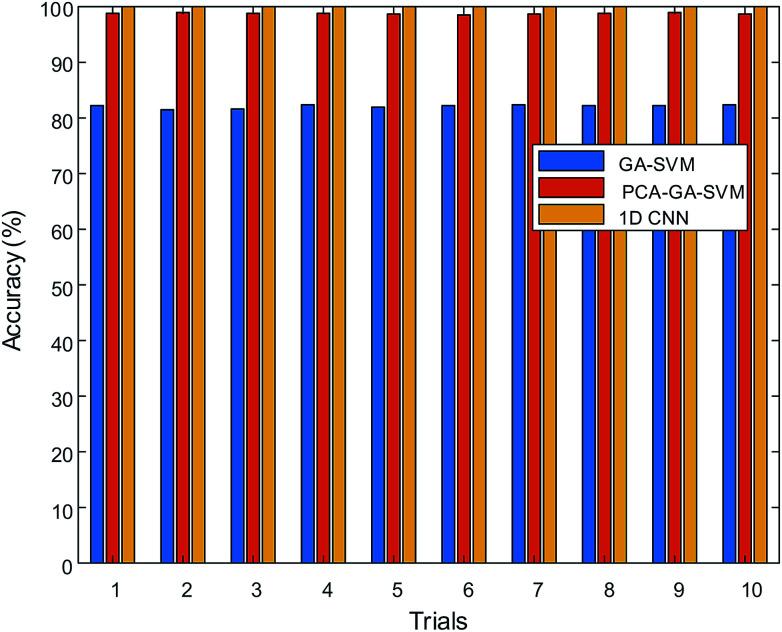
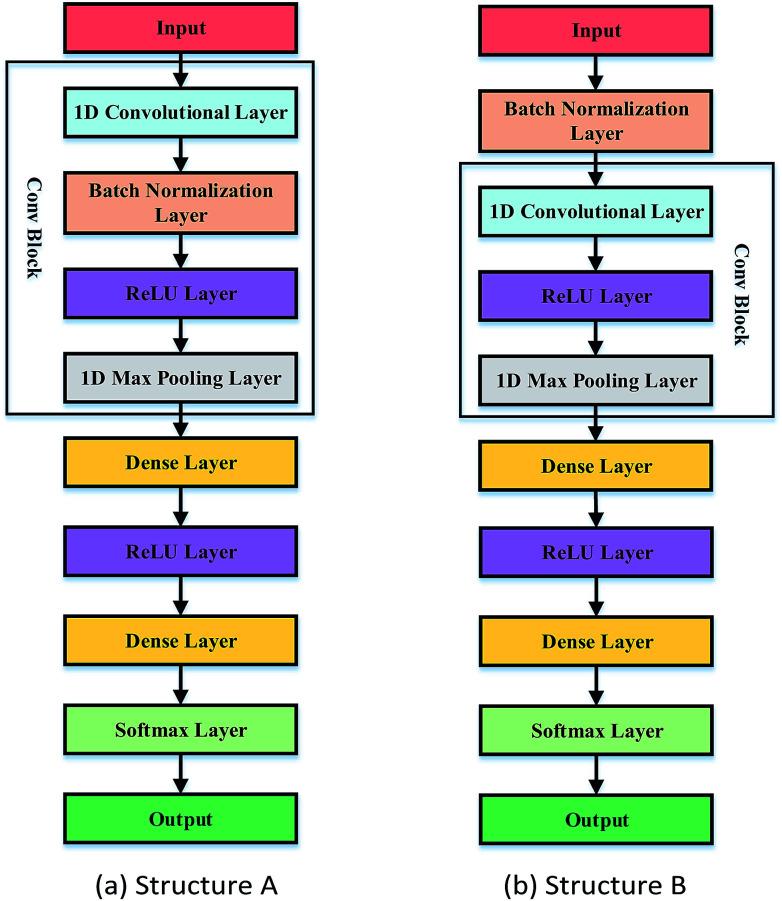
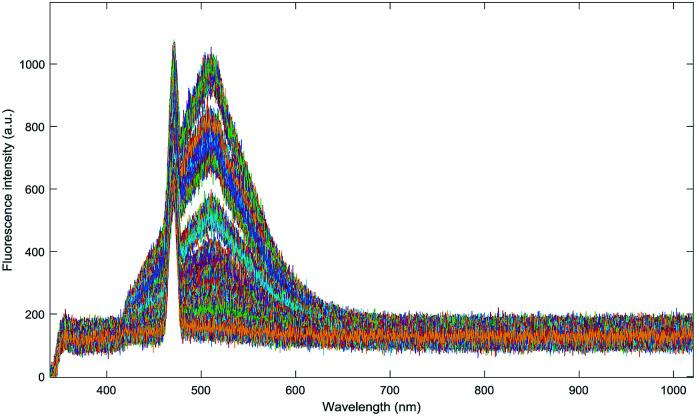
The application of laser-induced fluorescence (LIF) combined with machine learning methods can make up for the shortcomings of traditional hydrochemical methods in the accurate and rapid identification of mine water inrush in coal mines. However, almost all of these methods require preprocessing such as principal component analysis (PCA) or drawing the spectral map as an essential step. Here, we provide our solution for the classification of mine water inrush, in which a one-dimensional convolutional neural network (1D CNN) is trained to automatically identify mine water inrush according to the LIF spectroscopy without the need for preprocessing. First, the architecture and parameters of the model were optimized and the 1D CNN model containing two convolutional blocks was determined to be the best model for the identification of mine water inrush. Then, we evaluated the performance of the 1D CNN model using the LIF spectral dataset of mine water inrush containing 540 training samples and 135 test samples, and we found that all 675 samples could be accurately identified. Finally, superior classification performance was demonstrated by comparing with a traditional machine learning algorithm (genetic algorithm-support vector machine) and a deep learning algorithm (two-dimensional convolutional neural network). The results show that LIF spectroscopy combined with 1D CNN can be used for the fast and accurate identification of mine water inrush without the need for complex pretreatments.
将激光诱导荧光(LIF)与机器学习方法相结合的应用,可以弥补传统水化学方法在煤矿突水准确快速识别方面的不足。然而,几乎所有这些方法都需要进行诸如主成分分析(PCA)或绘制光谱图等预处理作为必要步骤。在此,我们提供了煤矿突水分类的解决方案,其中训练了一维卷积神经网络(1D CNN)以根据LIF光谱自动识别煤矿突水,而无需进行预处理。首先,对模型的架构和参数进行了优化,确定包含两个卷积块的1D CNN模型是识别煤矿突水的最佳模型。然后,我们使用包含540个训练样本和135个测试样本的煤矿突水LIF光谱数据集评估了1D CNN模型的性能,发现所有675个样本都能被准确识别。最后,通过与传统机器学习算法(遗传算法 - 支持向量机)和深度学习算法(二维卷积神经网络)进行比较,展示了卓越的分类性能。结果表明,LIF光谱与1D CNN相结合可用于煤矿突水的快速准确识别,而无需复杂的预处理。



 Zotero 插件