Laboratory of Molecular Imaging, Department of Radiology, The First Affiliated Hospital of Nanjing Medical University, Nanjing, Jiangsu, China.
Department of Interventional Radiology, The First Affiliated Hospital of Nanjing Medical University, Nanjing, Jiangsu, China.
J Nanobiotechnology. 2022 May 6;20(1):216. doi: 10.1186/s12951-022-01424-7.
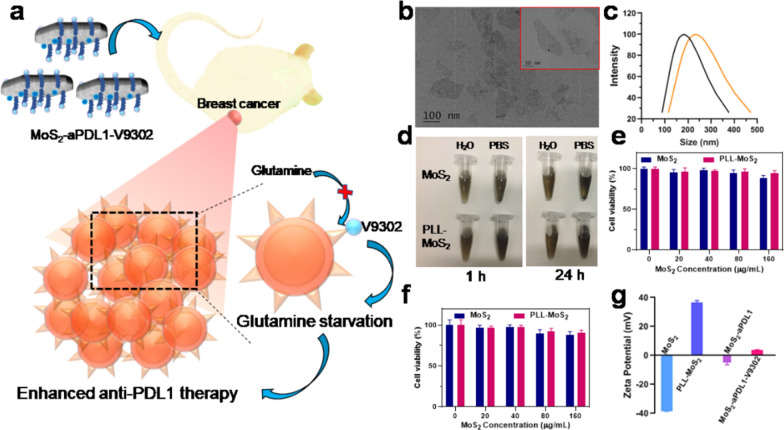
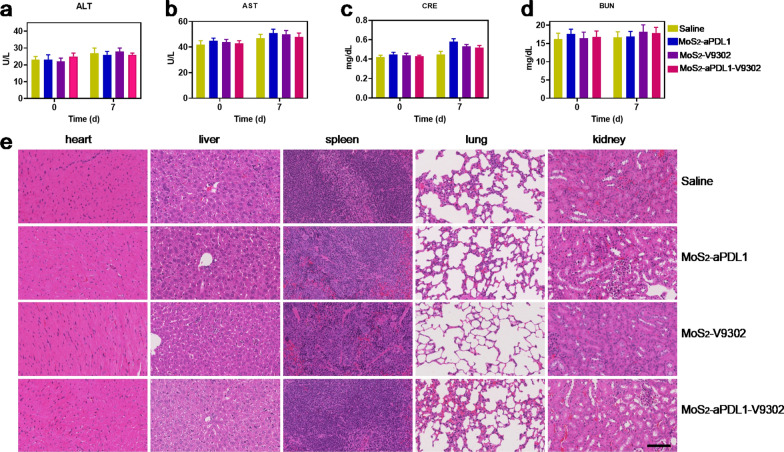
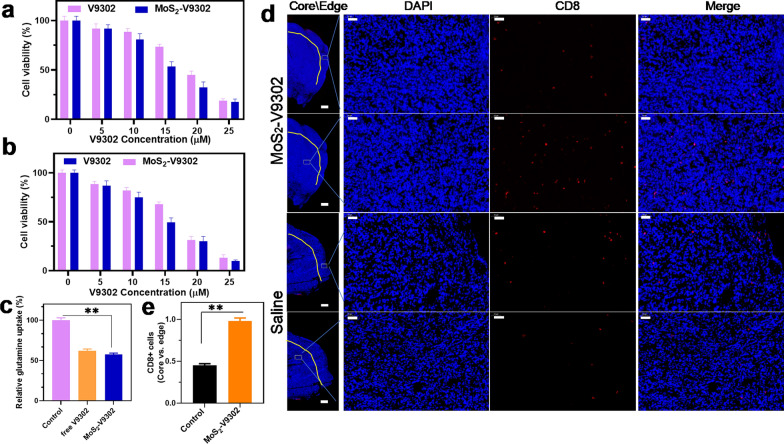
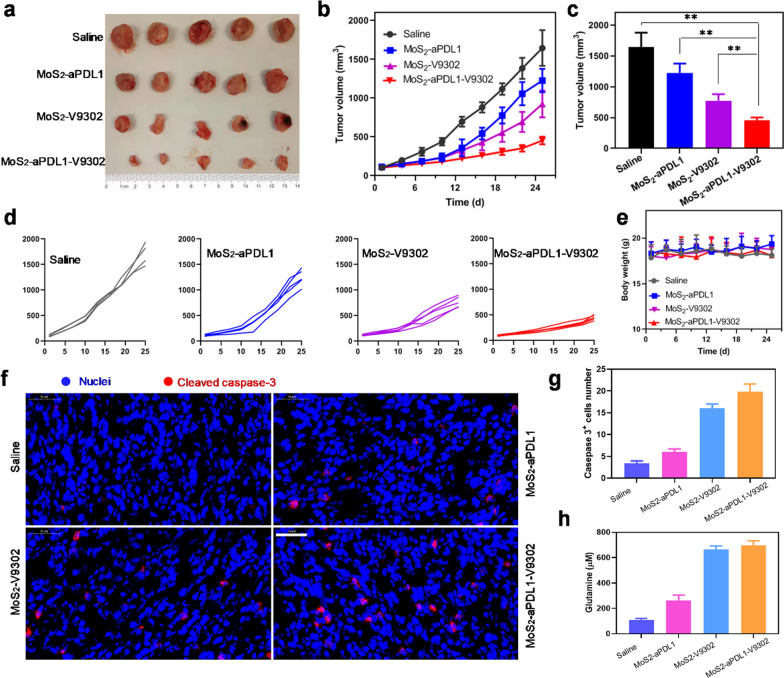
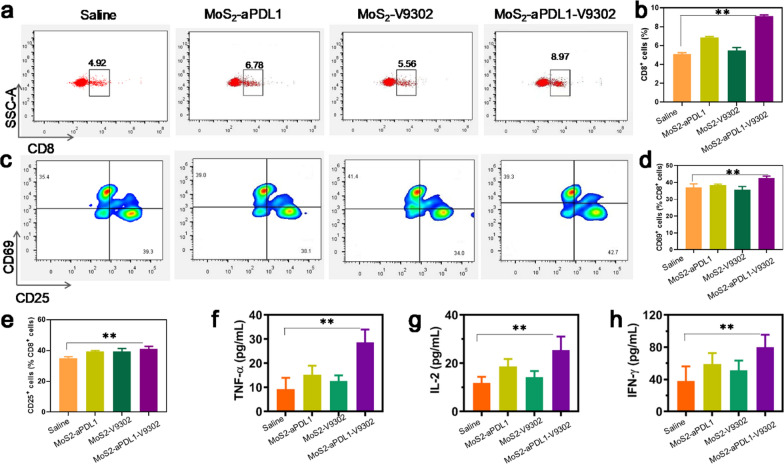
Blockade of programmed cell death 1 ligand (PD-L1) has been used to treat triple-negative breast cancer (TNBC), and various strategies are under investigation to improve the treatment response rate. Inhibition of glutamine metabolism can reduce the massive consumption of glutamine by tumor cells and meet the demand for glutamine by lymphocytes in tumors, thereby improving the anti-tumor effect on the PD-L1 blockade therapy. Here, molybdenum disulfide (MoS) was employed to simultaneously deliver anti-PDL1 antibody (aPDL1) and V9302 to boost the anti-tumor immune response in TNBC cells. The characterization results show that MoS has a dispersed lamellar structure with a size of about 181 nm and a size of 232 nm after poly (L-lysine) (PLL) modification, with high stability and biocompatibility. The loading capacity of aPDL1 and V9302 are 3.84% and 24.76%, respectively. V9302 loaded MoS (MoS-V9302) can effectively kill 4T1 cells and significantly reduce glutamine uptake of tumor cells. It slightly increases CD8 cells in the tumor and promotes CD8 cells from the tumor edge into the tumor core. In vivo studies demonstrate that the combination of aPDL1 and V9302 (MoS-aPDL1-V9302) can strongly inhibit the growth of TNBC 4T1 tumors. Interestingly, after the treatment of MoS-aPDL1-V9302, glutamine levels in tumor interstitial fluid increased. Subsequently, subtypes of cytotoxic T cells (CD8) in the tumors were analyzed according to two markers of T cell activation, CD69, and CD25, and the results reveal a marked increase in the proportion of activated T cells. The levels of cytokines in the corresponding tumor interstitial fluid are also significantly increased. Additionally, during the treatment, the body weights of the mice remain stable, the main indicators of liver and kidney function in the blood do not increase significantly, and there are no obvious lesions in the main organs, indicating low systemic toxicity. In conclusion, our study provides new insights into glutamine metabolism in the tumor microenvironment affects immune checkpoint blockade therapy in TNBC, and highlights the potential clinical implications of combining glutamine metabolism inhibition with immune checkpoint blockade in the treatment of TNBC.
阻断程序性细胞死亡配体 1(PD-L1)已被用于治疗三阴性乳腺癌(TNBC),并且正在研究各种策略来提高治疗反应率。抑制谷氨酰胺代谢可以减少肿瘤细胞对谷氨酰胺的大量消耗,并满足肿瘤淋巴细胞对谷氨酰胺的需求,从而提高 PD-L1 阻断治疗的抗肿瘤作用。在这里,二硫化钼(MoS)被用于同时递送抗 PD-L1 抗体(aPDL1)和 V9302,以增强 TNBC 细胞中的抗肿瘤免疫反应。表征结果表明,MoS 具有分散的层状结构,尺寸约为 181nm,经聚(L-赖氨酸)(PLL)修饰后尺寸为 232nm,具有高稳定性和生物相容性。aPDL1 和 V9302 的载药量分别为 3.84%和 24.76%。负载 V9302 的 MoS(MoS-V9302)可以有效杀死 4T1 细胞,并显著降低肿瘤细胞对谷氨酰胺的摄取。它略微增加了肿瘤中的 CD8 细胞,并促进 CD8 细胞从肿瘤边缘进入肿瘤核心。体内研究表明,aPDL1 和 V9302 的组合(MoS-aPDL1-V9302)可以强烈抑制 TNBC 4T1 肿瘤的生长。有趣的是,在用 MoS-aPDL1-V9302 治疗后,肿瘤间质液中的谷氨酰胺水平增加。随后,根据 T 细胞激活的两个标志物 CD69 和 CD25,分析了肿瘤中的细胞毒性 T 细胞(CD8)的亚型,结果表明激活的 T 细胞比例显著增加。相应肿瘤间质液中的细胞因子水平也显著增加。此外,在治疗过程中,小鼠的体重保持稳定,血液中肝肾功能的主要指标没有明显增加,主要器官没有明显病变,表明全身毒性低。总之,我们的研究提供了新的见解,即肿瘤微环境中的谷氨酰胺代谢会影响 TNBC 的免疫检查点阻断治疗,并强调了将谷氨酰胺代谢抑制与免疫检查点阻断联合用于治疗 TNBC 的潜在临床意义。