• 文献检索
  • 文档翻译
  • 深度研究
  • 学术资讯
  • Suppr Zotero 插件Zotero 插件
  • 邀请有礼
  • 套餐&价格
  • 历史记录
应用&插件
Suppr Zotero 插件Zotero 插件浏览器插件Mac 客户端Windows 客户端微信小程序
定价
高级版会员购买积分包购买API积分包
服务
文献检索文档翻译深度研究API 文档MCP 服务
关于我们
关于 Suppr公司介绍联系我们用户协议隐私条款
关注我们

Suppr 超能文献

核心技术专利:CN118964589B侵权必究
粤ICP备2023148730 号-1Suppr @ 2026

文献检索

告别复杂PubMed语法,用中文像聊天一样搜索,搜遍4000万医学文献。AI智能推荐,让科研检索更轻松。

立即免费搜索

文件翻译

保留排版,准确专业,支持PDF/Word/PPT等文件格式,支持 12+语言互译。

免费翻译文档

深度研究

AI帮你快速写综述,25分钟生成高质量综述,智能提取关键信息,辅助科研写作。

立即免费体验

社会经济不平等与死产率和新生儿死亡率:印度东部特别脆弱部落群体的证据。

Socioeconomic inequalities in stillbirth and neonatal mortality rates: evidence on Particularly Vulnerable Tribal Groups in eastern India.

机构信息

Department of Public Health, Erasmus MC, University Medical Centre Rotterdam, Rotterdam, The Netherlands.

Ekjut, Chakradharpur, Jharkhand, India.

出版信息

Int J Equity Health. 2022 May 6;21(1):61. doi: 10.1186/s12939-022-01655-y.

DOI:10.1186/s12939-022-01655-y
PMID:35524273
原文链接:https://pmc.ncbi.nlm.nih.gov/articles/PMC9074184/
Abstract

BACKGROUND

Tribal peoples are among the most marginalised groups worldwide. Evidence on birth outcomes in these groups is scant. We describe inequalities in Stillbirth Rate (SBR), Neonatal Mortality Rate (NMR), and uptake of maternal and newborn health services between tribal and less disadvantaged groups in eastern India, and examine the contribution of poverty and education to these inequalities.

METHODS

We used data from a demographic surveillance system covering a 1 million population in Jharkhand State (March 2017 - August 2019) to describe SBR, NMR, and service uptake. We used logistic regression analysis combined with Stata's adjrr-command to estimate absolute and relative inequalities by caste/tribe (comparing Particularly Vulnerable Tribal Groups (PVTG) and other Scheduled Tribes (ST) with the less marginalised Other Backward Class (OBC)/none, using the Indian government classification), and by maternal education and household wealth.

RESULTS

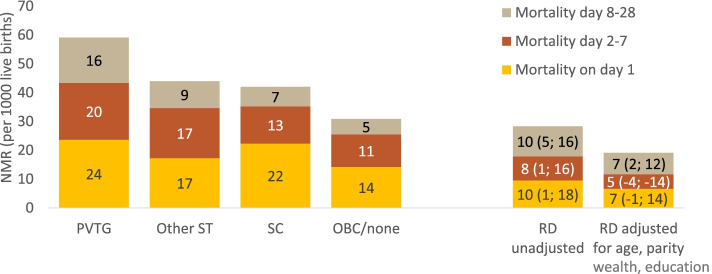
PVTGs had a higher NMR (59/1000) than OBC/none (31/1000) (rate ratio (RR): 1.92, 95%CI: 1.55-2.38). This was partly explained by wealth and education, but inequalities remained large after adjustment (adjusted RR: 1.59, 95%CI: 1.28-1.98). NMR was also higher among other STs (44/1000), but disparities were smaller (RR: 1.47, 95%CI: 1.23-1.75). There was a systematic gradient in NMR by maternal education and household wealth. SBRs were only higher in poorer groups (RR:1.56, 95%CI: 1.14-2.13). Uptake of facility-based services was low among PVTGs (e.g. institutional birth: 25% vs. 69% in OBC/none) and among poorer and less educated women. However, 65% of PVTG women with an institutional birth used a maternity vehicle vs. 34% among OBC/none. Visits from frontline workers (Accredited Social Health Activists [ASHAs]) were similar across groups, and ASHA accompaniment of institutional births was similar across caste/tribe groups, and higher among poorer and less educated women. Attendance in participatory women's groups was similar across caste/tribe groups, and somewhat higher among richer and better educated women.

CONCLUSIONS

PVTGs are highly disadvantaged in terms of birth outcomes. Targeted interventions that reduce geographical barriers to facility-based care and address root causes of high poverty and low education in PVTGs are a priority. For population-level impact, they are to be combined with broader policies to reduce socio-economic mortality inequalities. Community-based interventions reach disadvantaged groups and have potential to reduce the mortality gap.

摘要

背景

部落民族是世界上最边缘化的群体之一。关于这些群体的出生结局的证据很少。我们描述了在印度东部,部落民族和弱势群体之间的死产率(Stillbirth Rate,SBR)、新生儿死亡率(Neonatal Mortality Rate,NMR)以及母婴健康服务利用率的不平等,并探讨了贫困和教育对这些不平等的贡献。

方法

我们使用了一个人口监测系统的数据,该系统覆盖了印度恰尔康得邦(2017 年 3 月至 2019 年 8 月)的 100 万人口,用于描述 SBR、NMR 和服务利用率。我们使用了逻辑回归分析,并结合 Stata 的 adjrr-命令,根据种姓/部落(将特别脆弱的部落群体( Particularly Vulnerable Tribal Groups,PVTG)和其他在册部落( Other Scheduled Tribes,ST)与较不受影响的其他落后阶层( Other Backward Class,OBC)/无进行比较,使用印度政府的分类)和母亲教育程度和家庭财富来估计绝对和相对不平等。

结果

PVTG 的 NMR(59/1000)高于 OBC/none(31/1000)(比值比(Rate Ratio,RR):1.92,95%置信区间(Confidence Interval,CI):1.55-2.38)。这在一定程度上可以用财富和教育来解释,但调整后仍存在较大差距(调整后的 RR:1.59,95%CI:1.28-1.98)。其他 ST 的 NMR 也较高(44/1000),但差距较小(RR:1.47,95%CI:1.23-1.75)。NMR 也存在系统的梯度,与母亲的教育程度和家庭财富有关。SBR 仅在较贫困的群体中较高(RR:1.56,95%CI:1.14-2.13)。PVTG 中获得基于机构的服务的比例较低(例如,机构分娩:25%与 OBC/none 的 69%),而在较贫困和教育程度较低的妇女中更低。然而,65%的在机构分娩的 PVTG 妇女使用了产妇交通工具,而 OBC/none 的比例为 34%。基层工作者(认证社会卫生活动家(Accredited Social Health Activists,ASHA))的访问在各群体中相似,ASHA 陪同机构分娩的比例在种姓/部落群体中相似,而在较贫困和教育程度较低的妇女中更高。参与妇女参与小组的情况在各群体中相似,而在较富裕和教育程度较高的妇女中略高。

结论

PVTG 在出生结局方面处于高度不利地位。优先考虑针对减少基于机构的护理的地理障碍和解决 PVTG 中贫困和教育程度低的根本原因的针对性干预措施。为了实现人口层面的影响,需要将这些干预措施与更广泛的减少社会经济死亡率不平等的政策相结合。基于社区的干预措施可以覆盖弱势群体,并有可能缩小死亡率差距。
https://cdn.ncbi.nlm.nih.gov/pmc/blobs/189c/9074184/de5d9d34878f/12939_2022_1655_Fig1_HTML.jpg

相似文献

1
Socioeconomic inequalities in stillbirth and neonatal mortality rates: evidence on Particularly Vulnerable Tribal Groups in eastern India.社会经济不平等与死产率和新生儿死亡率:印度东部特别脆弱部落群体的证据。
Int J Equity Health. 2022 May 6;21(1):61. doi: 10.1186/s12939-022-01655-y.
2
Effect of participatory women's groups facilitated by Accredited Social Health Activists on birth outcomes in rural eastern India: a cluster-randomised controlled trial.认证社会卫生活动家促进的参与式妇女小组对印度东部农村地区分娩结果的影响:一项整群随机对照试验。
Lancet Glob Health. 2016 Feb;4(2):e119-28. doi: 10.1016/S2214-109X(15)00287-9.
3
Wealth and education-related inequalities in the utilisation of reproductive, maternal, newborn, and child health interventions within scheduled tribes in India: an analysis of Odisha and Jharkhand.印度 scheduled tribes 中生殖、孕产妇、新生儿和儿童健康干预措施利用方面的财富和教育相关不平等:奥里萨邦和贾坎德邦的分析。
BMC Public Health. 2024 Jun 17;24(1):1605. doi: 10.1186/s12889-024-18857-4.
4
How equitable is the uptake of conditional cash transfers for maternity care in India? Evidence from the Janani Suraksha Yojana scheme in Odisha and Jharkhand.印度孕产妇保健有条件现金转移的普及情况有多公平?来自奥里萨邦和贾坎德邦“贾纳尼·苏拉卡莎·尤佳娜”计划的证据。
Int J Equity Health. 2017 Mar 10;16(1):48. doi: 10.1186/s12939-017-0539-5.
5
To leave no one behind: Assessing utilization of maternal newborn and child health services by all the 13 particularly vulnerable tribal groups (PVTGs) of Odisha, India.不让任何人掉队:评估印度奥里萨邦所有 13 个特别弱势部落群体(PVTGs)的孕产妇、新生儿和儿童健康服务利用情况。
Health Res Policy Syst. 2024 Jan 22;22(1):12. doi: 10.1186/s12961-023-01101-7.
6
Is Institutional Delivery Protective Against Neonatal Mortality Among Poor or Tribal Women? A Cohort Study From Gujarat, India.机构分娩对贫困或部落妇女的新生儿死亡率有保护作用吗?一项来自印度古吉拉特邦的队列研究。
Matern Child Health J. 2017 May;21(5):1065-1072. doi: 10.1007/s10995-016-2202-y.
7
When social identities intersect: understanding inequities in growth outcomes by religion- caste and religion-tribe as intersecting strata of social hierarchy for Muslim and Hindu children in India.当社会身份交叉时:理解印度穆斯林和印度教徒儿童在宗教种姓和宗教部落这两个社会等级的交叉阶层中,因成长结果而产生的不平等。
Int J Equity Health. 2023 Jun 14;22(1):115. doi: 10.1186/s12939-023-01917-3.
8
Assessing the coverage of full antenatal care among adolescent mothers from scheduled tribe and scheduled caste communities in India.评估印度在册种姓和在册部落青少年母亲的全面产前护理覆盖率。
BMC Public Health. 2023 May 1;23(1):798. doi: 10.1186/s12889-023-15656-1.
9
Socioeconomic inequalities in adverse pregnancy outcomes in India: 2004-2019.印度不良妊娠结局中的社会经济不平等:2004 - 2019年
PLOS Glob Public Health. 2024 Sep 18;4(9):e0003701. doi: 10.1371/journal.pgph.0003701. eCollection 2024.
10
Community mobilisation with women's groups facilitated by Accredited Social Health Activists (ASHAs) to improve maternal and newborn health in underserved areas of Jharkhand and Orissa: study protocol for a cluster-randomised controlled trial.认证社会卫生活动家(ASHA)协助妇女团体进行社区动员,以改善恰尔康得邦和奥里萨邦服务不足地区的孕产妇和新生儿健康:一项整群随机对照试验的研究方案。
Trials. 2011 Jul 25;12:182. doi: 10.1186/1745-6215-12-182.

引用本文的文献

1
Socioeconomic inequalities in adverse pregnancy outcomes in India: 2004-2019.印度不良妊娠结局中的社会经济不平等:2004 - 2019年
PLOS Glob Public Health. 2024 Sep 18;4(9):e0003701. doi: 10.1371/journal.pgph.0003701. eCollection 2024.
2
Uncovering the causes and socio-demographic constructs of stillbirths and neonatal deaths in an urban slum of Karachi.揭示卡拉奇市区贫民窟中死产和新生儿死亡的原因及社会人口结构因素。
PLoS One. 2024 Apr 5;19(4):e0298120. doi: 10.1371/journal.pone.0298120. eCollection 2024.
3
Knowledge and practice of family planning among pregnant tribal women in Southern India: an observational study.

本文引用的文献

1
Effectiveness of participatory women's groups scaled up by the public health system to improve birth outcomes in Jharkhand, eastern India: a pragmatic cluster non-randomised controlled trial.公共卫生系统推广的参与式妇女小组对改善印度东部恰尔康德邦生育结局的效果:一项实用的集群非随机对照试验。
BMJ Glob Health. 2021 Nov;6(11). doi: 10.1136/bmjgh-2021-005066.
2
Using Three Delay Model to Understand the Social Factors Responsible for Neonatal Deaths Among Displaced Tribal Communities in India.运用三延迟模型理解印度部落流离失所社区新生儿死亡的社会影响因素
J Immigr Minor Health. 2021 Apr;23(2):265-277. doi: 10.1007/s10903-020-00990-y.
3
印度南部怀孕部落妇女的计划生育知识与实践:一项观察性研究。
Contracept Reprod Med. 2024 Jan 12;9(1):2. doi: 10.1186/s40834-023-00259-3.
4
Verbal autopsy to assess causes of mortality among the economically productive age group in the tribal region of Melghat, central India.在印度中部梅尔加特部落地区,采用口头尸检评估经济生产年龄组的死亡原因。
Indian J Med Res. 2023 Sep;158(3):217-254. doi: 10.4103/ijmr.ijmr_3299_21.
5
Stillbirths in India: Current Status, Challenges, and the Way Forward.印度的死产问题:现状、挑战与未来方向。
Indian J Pediatr. 2023 Dec;90(Suppl 1):63-70. doi: 10.1007/s12098-023-04807-2. Epub 2023 Aug 22.
6
Burden, Differentials and Causes of Stillbirths in India: A Systematic Review and Meta Analysis.印度死产的负担、差异和原因:系统评价和荟萃分析。
Indian J Pediatr. 2023 Dec;90(Suppl 1):54-62. doi: 10.1007/s12098-023-04749-9. Epub 2023 Aug 9.
7
Reducing infant and child mortality: assessing the social inclusiveness of child health care policies and programmes in three states of India.降低婴幼儿死亡率:评估印度三个邦儿童保健政策和方案的社会包容性。
BMC Public Health. 2023 Jun 15;23(1):1149. doi: 10.1186/s12889-023-15812-7.
8
Pregnancy outcomes among Indian women: increased prevalence of miscarriage and stillbirth during 2015-2021.印度女性的妊娠结局:2015 年至 2021 年期间,流产和死胎的发生率上升。
BMC Pregnancy Childbirth. 2023 Mar 8;23(1):150. doi: 10.1186/s12884-023-05470-3.
Effects of community health worker interventions on socioeconomic inequities in maternal and newborn health in low-income and middle-income countries: a mixed-methods systematic review.
社区卫生工作者干预措施对低收入和中等收入国家孕产妇及新生儿健康方面社会经济不平等的影响:一项混合方法的系统评价
BMJ Glob Health. 2019 Jun 16;4(3):e001308. doi: 10.1136/bmjgh-2018-001308. eCollection 2019.
4
Does the National Rural Health Mission improve the health of tribal women? Perspectives of husbands in Maharashtra, India.国家农村卫生使命是否改善了部落妇女的健康?印度马哈拉施特拉邦丈夫的观点。
Public Health. 2019 Nov;176:50-58. doi: 10.1016/j.puhe.2019.02.019. Epub 2019 Apr 5.
5
Stillbirth among women in nine states in India: rate and risk factors in study of 886,505 women from the annual health survey.印度九个邦女性的死产情况:对年度健康调查中886,505名女性的研究中的发生率及风险因素
BMJ Open. 2018 Nov 8;8(11):e022583. doi: 10.1136/bmjopen-2018-022583.
6
Underreporting of stillbirths in Pakistan: perspectives of the parents, community and healthcare providers.巴基斯坦活产儿漏报现象:父母、社区和医疗保健提供者的观点。
BMC Pregnancy Childbirth. 2018 Jul 16;18(1):302. doi: 10.1186/s12884-018-1924-9.
7
Trends and determinants of stillbirth in developing countries: results from the Global Network's Population-Based Birth Registry.发展中国家死产的趋势和决定因素:全球网络基于人群的出生登记处的结果。
Reprod Health. 2018 Jun 22;15(Suppl 1):100. doi: 10.1186/s12978-018-0526-3.
8
Risk factors of neonatal mortality and child mortality in Bangladesh.孟加拉国新生儿和儿童死亡的风险因素。
J Glob Health. 2018 Jun;8(1):010417. doi: 10.7189/jogh.08.010421.
9
Proportion of beneficiaries and factors affecting Janani Suraksha Yojana direct cash transfer scheme in Puducherry, India.印度本地治里地区贾纳尼·苏拉克沙·尤贾纳直接现金转移计划的受益比例及影响因素
J Family Med Prim Care. 2016 Oct-Dec;5(4):817-821. doi: 10.4103/2249-4863.201146.
10
State of newborn health in India.印度新生儿健康状况
J Perinatol. 2016 Dec;36(s3):S3-S8. doi: 10.1038/jp.2016.183.