Stress and Resilience Research Center, Tel Hai and University of Haifa, Israel.
ResWell - Multinational Resilience & Well-being Research Collaboration, Tel Aviv University, Israel.
J Psychiatr Res. 2022 Jul;151:311-318. doi: 10.1016/j.jpsychires.2022.04.042. Epub 2022 May 2.
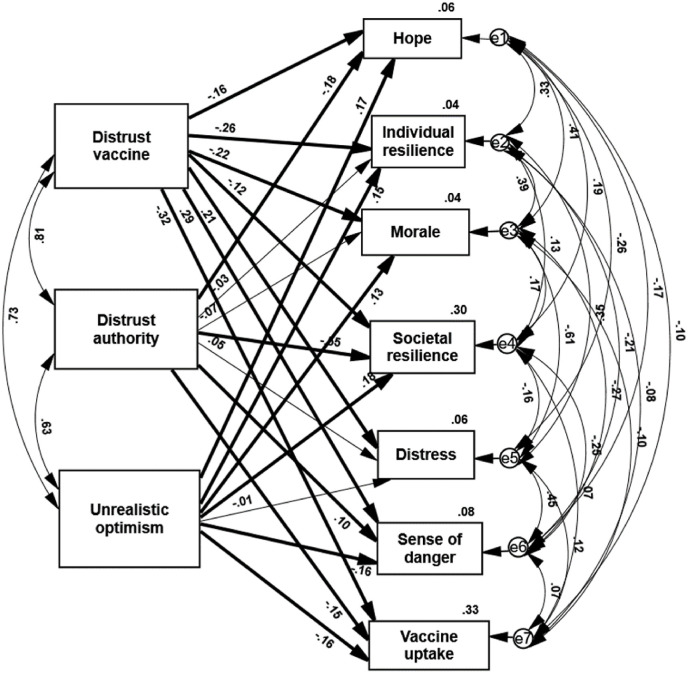
The COVID-19 vaccination campaign led to hesitancy, deferment and un-resolving resistance of certain groups or individuals worldwide. Reasons for these reactions include distrust in the COVID-19 vaccine that was developed rapidly, lack of trust in governing entities and unrealistic optimism (UO). Each of these reasons may involve claims of secret intentions or conspiracy theories. The present study examined the role of three different explanations for vaccine hesitancy and rejection, in predicting psychological coping, distress, and level of vaccine uptake, throughout the COVID-19 pandemic. Blaming the vaccine and its producers, blaming the state's authorities, and expressing criticism in UO terms, which may hint of some secret intention that underlies the vaccination request. The research was conducted on a sample of 2002 Israeli adults who responded to an anonymous questionnaire about vaccine hesitancy and psychological coping. We assumed that conspiracy theories aimed at the medical and the governing authorities, and the UO insinuations of covert intentions of these authorities, represent two different psychological processes. UO responses to adversity are aimed at reducing anxiety attributing covert intentions to the authorities and the pharmaceutical companies is an expression of anxiety. Three major hypotheses are examined. First, stronger criticism of the vaccine will be associated with a lower level of vaccination. Second, more extreme criticism of the political and the medical authorities for requesting vaccination, raised as a reason for vaccine hesitation will positively predict a higher level of anxiety and negatively predict the extent of good psychological coping. A stronger opposition to the vaccine in terms of UO will be positively associated with a greater scope of resilience and coping and will be negatively linked to indicators of distress. Results supported these hypotheses and enhanced the ongoing discussion on the contribution of UO to psychological adjustment, by illustrating its beneficial effects on this adjustment. Conspiracy Theories and Secret Intentions as Predictors of Psychological Coping and Vaccine Uptake throughout the COVID-19 Pandemic in Israel.
在全球范围内,COVID-19 疫苗接种运动导致了某些群体或个人的犹豫、延迟和未解决的抵制。这些反应的原因包括对快速开发的 COVID-19 疫苗的不信任、对管理实体的不信任以及不切实际的乐观主义(UO)。这些原因中的每一个都可能涉及对秘密意图或阴谋论的主张。本研究考察了三种不同的疫苗犹豫和拒绝的解释,在预测整个 COVID-19 大流行期间的心理应对、痛苦和疫苗接种率方面的作用。指责疫苗及其生产商、指责国家当局以及以 UO 的措辞表达批评,这可能暗示了接种请求背后的某种秘密意图。该研究对 2002 名以色列成年人进行了调查,他们对关于疫苗犹豫和心理应对的匿名问卷做出了回应。我们假设,针对医疗和政府当局的阴谋论,以及这些当局的 UO 暗示的隐蔽意图,代表了两种不同的心理过程。UO 对逆境的反应旨在通过将隐蔽意图归因于当局和制药公司来减轻焦虑,这是焦虑的一种表现。检验了三个主要假设。首先,对疫苗的更强批评将与更低的疫苗接种率相关。其次,更极端地批评政治和医疗当局要求接种疫苗,作为疫苗犹豫的一个原因,将积极预测更高水平的焦虑,并消极预测良好心理应对的程度。以 UO 的方式更强烈地反对疫苗将与更大的弹性和应对范围呈正相关,并与痛苦指标呈负相关。结果支持了这些假设,并通过说明 UO 对心理调整的有益影响,增强了关于 UO 对心理调整贡献的持续讨论。在以色列,针对 COVID-19 的大流行期间,阴谋论和秘密意图是心理应对和疫苗接种的预测指标。