Salgado Sinué, Berntsen Dorthe
Center on Autobiographical Memory Research, Department of Psychology, Aarhus University, Denmark.
Centre for Integrative Business Psychology, Department of Psychology, Aarhus University, Denmark.
J Appl Res Mem Cogn. 2021 Sep;10(3):368-380. doi: 10.1016/j.jarmac.2021.07.006. Epub 2021 Jul 21.
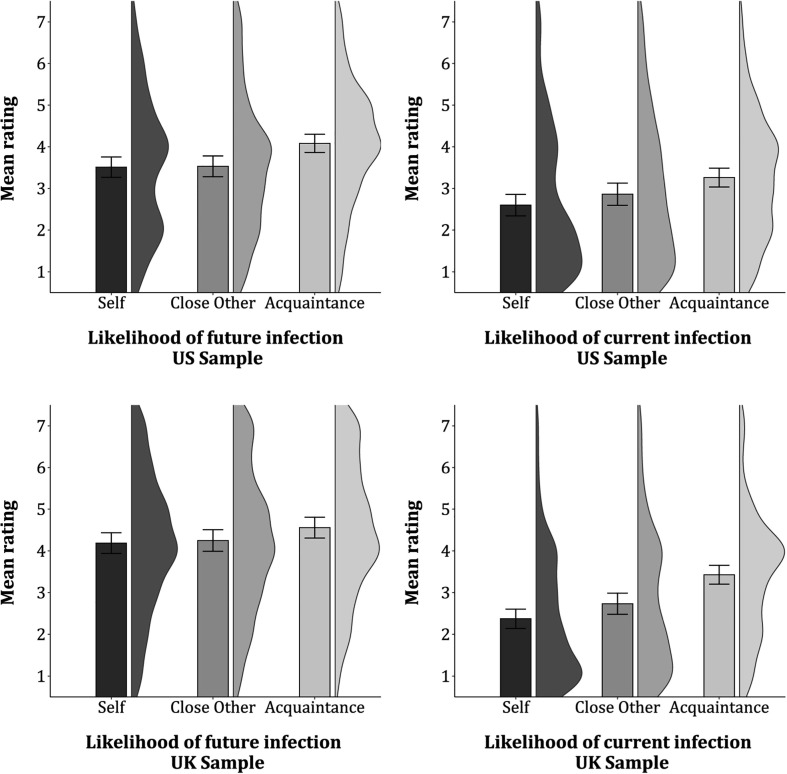
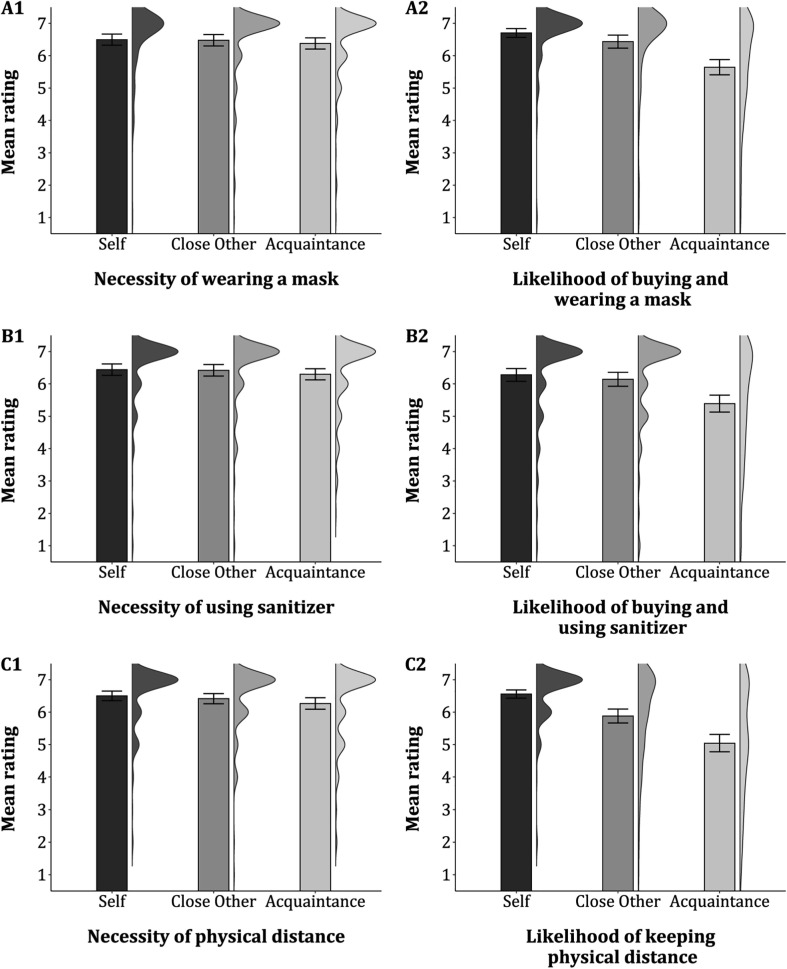
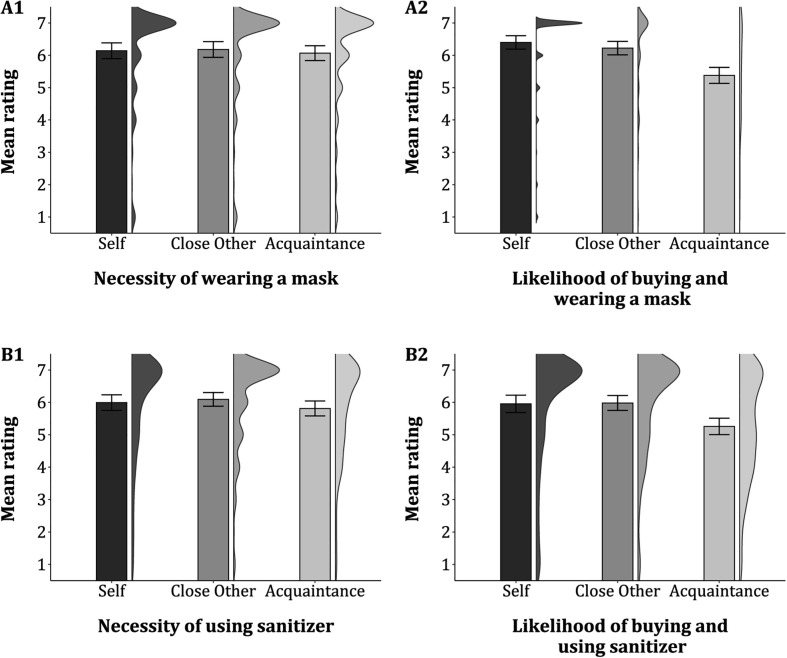
People generally believe that their own future will be better than the one of comparable others. Robust evidence documents such unrealistic optimism in many domains of life. Here, we examine how unrealistic optimism may affect people's risk assessments of COVID-19 infection as well as their attitudes regarding behaviours intended to protect against contagion. In two studies conducted in the USA ( = 160) and UK ( = 161), at different times during the pandemic, we show that participants considered the likelihood of contracting and carrying the infection lower for themselves and their close other compared to an acquaintance, while they considered the likelihood of engaging in protective behaviours higher for themselves and their close other than an acquaintance. The findings document unrealistic optimism in relation to COVID-19. Such biases are particularly critical in relation to infectious diseases, where underestimating the risk for both oneself and close others may reduce precautions and increase virus spreading.
人们普遍认为自己的未来会比情况相当的其他人更好。确凿的证据证明了生活中许多领域都存在这种不切实际的乐观态度。在此,我们研究不切实际的乐观态度如何影响人们对感染新冠病毒的风险评估,以及他们对预防感染行为的态度。在美国(N = 160)和英国(N = 161)在疫情期间的不同时间进行的两项研究中,我们发现,与熟人相比,参与者认为自己和自己亲近的人感染和携带病毒的可能性更低,而他们认为自己和自己亲近的人采取保护行为的可能性比熟人更高。这些发现证明了在新冠病毒方面存在不切实际的乐观态度。这种偏差在传染病方面尤为关键,因为低估自己和亲近他人的风险可能会减少预防措施并增加病毒传播。