Zambrano Gerardo, Sekretareva Alina, D'Alonzo Daniele, Leone Linda, Pavone Vincenzo, Lombardi Angela, Nastri Flavia
Department of Chemical Sciences, University of Napoli Federico II Via Cintia 80126 Napoli Italy
Department of Chemistry - Ångström, Uppsala University Lägerhyddsvägen 1 75120 Uppsala Sweden.
RSC Adv. 2022 May 4;12(21):12947-12956. doi: 10.1039/d2ra00811d. eCollection 2022 Apr 28.
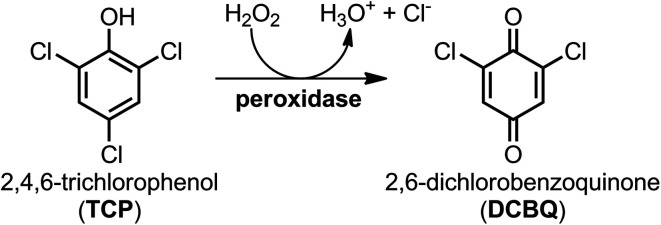
The miniaturized metalloenzyme Fe(iii)-mimochrome VIa (Fe(iii)-MC6a) acts as an excellent biocatalyst in the HO-mediated oxidative dehalogenation of the well-known pesticide and biocide 2,4,6-trichlorophenol (TCP). The artificial enzyme can oxidize TCP with a catalytic efficiency ( / = 150 000 mM s) up to 1500-fold higher than the most active natural metalloenzyme horseradish peroxidase (HRP). UV-visible and EPR spectroscopies were used to provide indications of the catalytic mechanism. One equivalent of HO fully converts Fe(iii)-MC6*a into the oxoferryl-porphyrin radical cation intermediate [(Fe(iv)[double bond, length as m-dash]O)por˙], similarly to peroxidase compound I (Cpd I). Addition of TCP to Cpd I rapidly leads to the formation of the corresponding quinone, while Cpd I decays back to the ferric resting state in the absence of substrate. EPR data suggest a catalytic mechanism involving two consecutive one-electron reactions. All results highlight the value of the miniaturization strategy for the development of chemically stable, highly efficient artificial metalloenzymes as powerful catalysts for the oxidative degradation of toxic pollutants.
小型化金属酶Fe(iii)-mimochrome VIa(Fe(iii)-MC6a)在HO介导的著名农药和杀菌剂2,4,6-三氯苯酚(TCP)的氧化脱卤反应中表现为一种出色的生物催化剂。这种人工酶氧化TCP的催化效率(/ = 150 000 mM s)比活性最高的天然金属酶辣根过氧化物酶(HRP)高出多达1500倍。利用紫外可见光谱和电子顺磁共振光谱来揭示催化机制。一当量的HO能将Fe(iii)-MC6*a完全转化为氧合铁卟啉自由基阳离子中间体[(Fe(iv)[双键,长度如m破折号]O)por˙],这与过氧化物酶化合物I(Cpd I)类似。向Cpd I中加入TCP会迅速导致相应醌的形成,而在没有底物的情况下Cpd I会衰变回到三价铁的静止状态。电子顺磁共振数据表明催化机制涉及两个连续的单电子反应。所有结果都突出了小型化策略对于开发化学稳定、高效的人工金属酶作为有毒污染物氧化降解的强大催化剂的价值。