Demro Caroline, Shen Chen, Hendrickson Timothy J, Arend Jessica L, Disner Seth G, Sponheim Scott R
Department of Psychiatry and Behavioral Sciences, University of Minnesota, Minneapolis, MN, United States.
Department of Psychology, University of Minnesota, Minneapolis, MN, United States.
Front Aging Neurosci. 2022 Apr 22;14:872867. doi: 10.3389/fnagi.2022.872867. eCollection 2022.
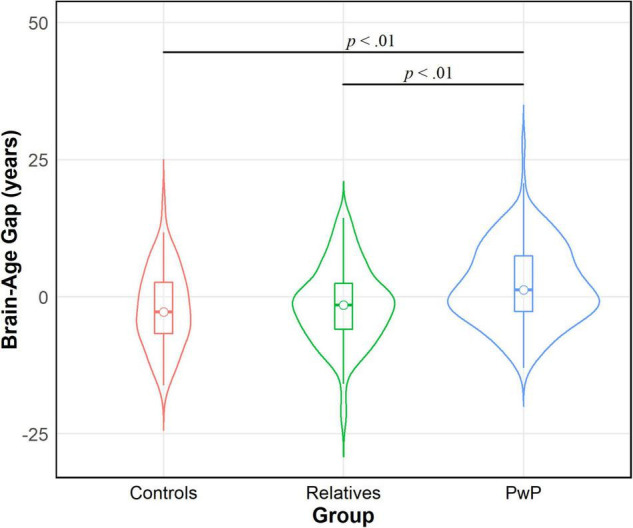
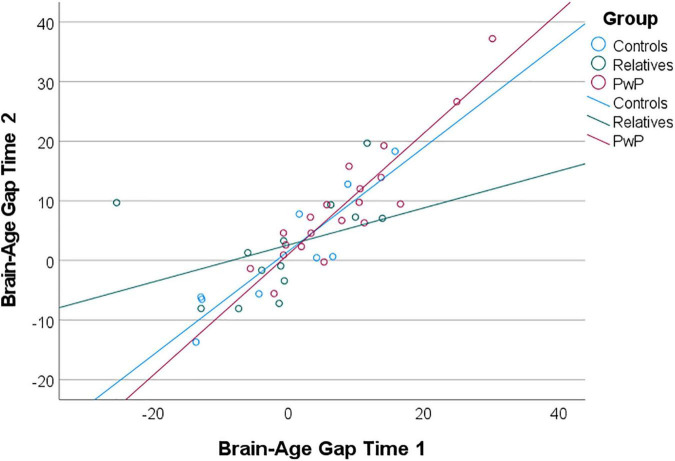
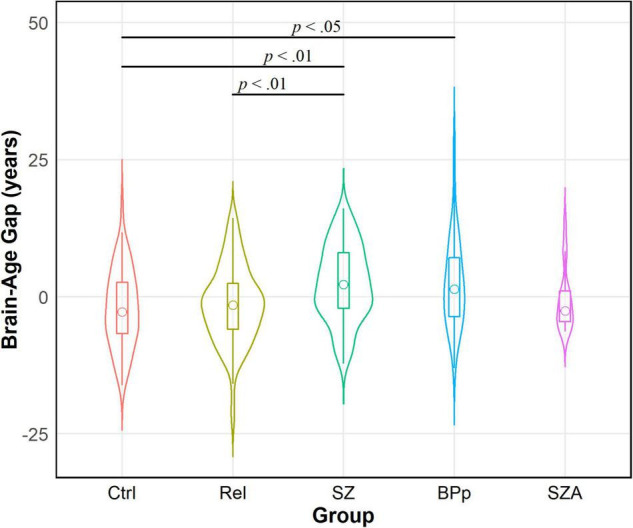
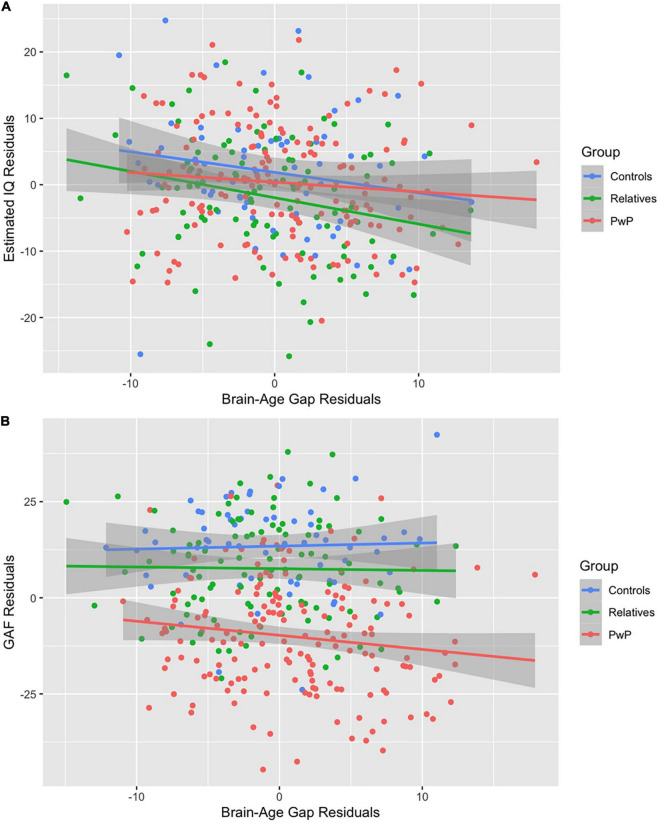
Schizophrenia is characterized by abnormal brain structure such as global reductions in gray matter volume. Machine learning models trained to estimate the age of brains from structural neuroimaging data consistently show advanced brain-age to be associated with schizophrenia. Yet, it is unclear whether advanced brain-age is specific to schizophrenia compared to other psychotic disorders, and whether evidence that brain structure is "older" than chronological age actually reflects neurodevelopmental rather than atrophic processes. It is also unknown whether advanced brain-age is associated with genetic liability for psychosis carried by biological relatives of people with schizophrenia. We used the Brain-Age Regression Analysis and Computation Utility Software (BARACUS) prediction model and calculated the residualized brain-age gap of 332 adults (163 individuals with psychotic disorders: 105 schizophrenia, 17 schizoaffective disorder, 41 bipolar I disorder with psychotic features; 103 first-degree biological relatives; 66 controls). The model estimated advanced brain-ages for people with psychosis in comparison to controls and relatives, with no differences among psychotic disorders or between relatives and controls. Specifically, the model revealed an enlarged brain-age gap for schizophrenia and bipolar disorder with psychotic features. Advanced brain-age was associated with lower cognitive and general functioning in the full sample. Among relatives, cognitive performance and schizotypal symptoms were related to brain-age gap, suggesting that advanced brain-age is associated with the subtle expressions associated with psychosis. Exploratory longitudinal analyses suggested that brain aging was not accelerated in individuals with a psychotic disorder. In sum, we found that people with psychotic disorders, irrespective of specific diagnosis or illness severity, show indications of non-progressive, advanced brain-age. These findings support a transdiagnostic, neurodevelopmental formulation of structural brain abnormalities in psychotic psychopathology.
精神分裂症的特征是大脑结构异常,如灰质体积整体减少。通过对结构神经影像数据进行训练以估计大脑年龄的机器学习模型一直显示,大脑年龄提前与精神分裂症有关。然而,与其他精神障碍相比,大脑年龄提前是否是精神分裂症所特有的,以及大脑结构“比实际年龄更老”的证据是否实际上反映了神经发育过程而非萎缩过程,目前尚不清楚。大脑年龄提前是否与精神分裂症患者的生物学亲属所携带的精神病遗传易感性有关也不清楚。我们使用了大脑年龄回归分析与计算实用软件(BARACUS)预测模型,计算了332名成年人(163名患有精神障碍的个体:105名精神分裂症患者、17名分裂情感性障碍患者、41名伴有精神病性特征的双相I型障碍患者;103名一级生物学亲属;66名对照)的残差大脑年龄差距。该模型估计,与对照组和亲属相比,患有精神病的人的大脑年龄提前,且在不同的精神障碍之间或亲属与对照组之间没有差异。具体而言,该模型显示精神分裂症和伴有精神病性特征的双相障碍患者的大脑年龄差距增大。在整个样本中,大脑年龄提前与较低的认知和总体功能相关。在亲属中,认知表现和分裂型症状与大脑年龄差距有关,这表明大脑年龄提前与与精神病相关的细微表现有关。探索性纵向分析表明,患有精神障碍的个体的大脑衰老并未加速。总之,我们发现患有精神障碍的人,无论具体诊断或疾病严重程度如何,都显示出非进行性、大脑年龄提前的迹象。这些发现支持了对精神病性精神病理学中结构性大脑异常的跨诊断、神经发育性表述。