Park Jin, Kim Jee-Eun, Song Tae-Jin
Department of Neurology, Seoul Hospital Ewha Womans University College of Medicine, Seoul, South Korea.
Front Neurol. 2022 Apr 21;13:864339. doi: 10.3389/fneur.2022.864339. eCollection 2022.
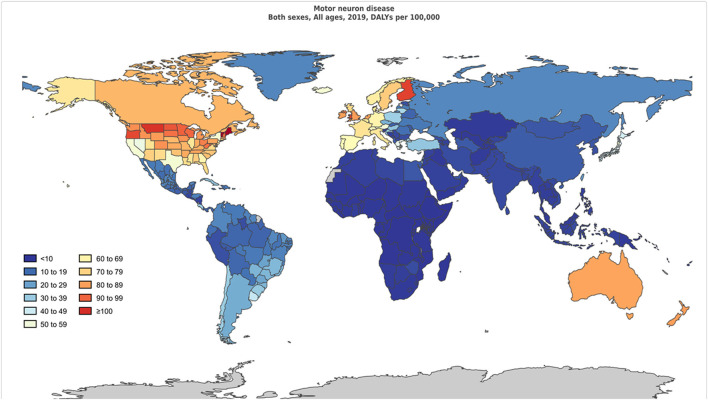
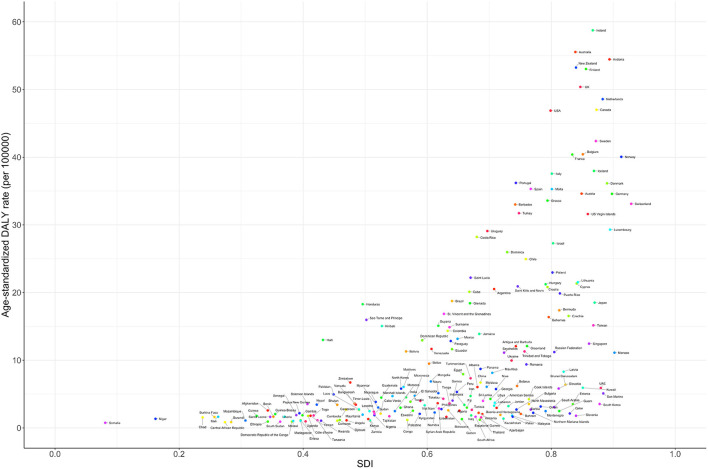
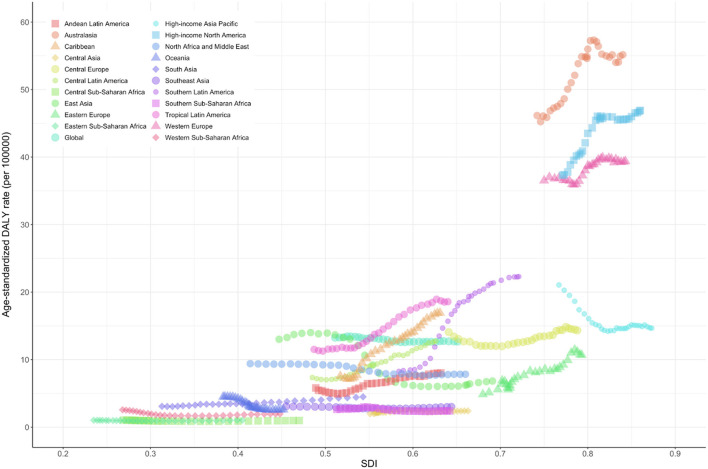
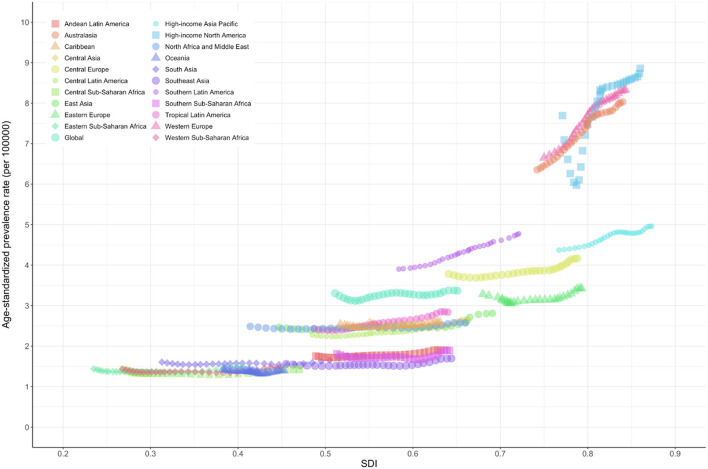
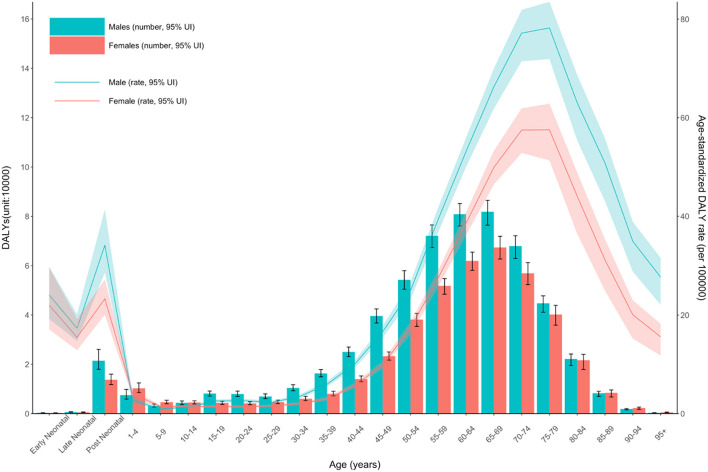
Up-to-date, accurate information on the disease burden of motor neuron disease (MND) is the cornerstone for evidence-based resource allocation and healthcare planning. We aimed to estimate the burden of MND globally from 1990 to 2019, as part of the Global Burden of Disease, Injuries and Risk Factor (GBD) study. Amyotrophic lateral sclerosis, progressive muscular atrophy, primary lateral sclerosis, pseudobulbar palsy, spinal muscular atrophy and hereditary spastic paraplegia- were included for analysis as MNDs. We measured age-standardized incidence, prevalence, death, and disability-adjusted life-years (DALYs) in 204 countries and territories worldwide from 1990 to 2019 using spatial Bayesian analyses. The effects of age, sex, and the sociodemographic index (measures of income per capita, education, and fertility) on incidence, prevalence, death, and disability-adjusted life-years due to MNDs were explored. According to 2019 GBD estimates, there were ~268,673 [95% uncertainty interval (UI), 213,893-310,663] prevalent cases and 63,700 (95% UI, 57,295-71,343) incident cases of MND worldwide. In 2019, MND caused 1,034,606 (95% UI, 979,910-1,085,401) DALYs and 39,081 (95% UI, 36,566-41,129) deaths worldwide. The age-standardized rates of prevalence, incidence, death, and DALYs for MNDs in 2019 were 3.37 (95% UI, 2.9-3.87) per 100,000 people, 0.79 (95% UI, 0.72-0.88) per 100,000 people, 0.48 (95% UI, 0.45-0.51) per 100,000 people, and 12.66 (95% UI, 11.98-13.29) per 100,000 people, respectively. The global prevalence and deaths due to MND in 2019 were increased (1.91% [95% UI, 0.61-3.42] and 12.39% [95% UI, 5.81-19.27], respectively) compared to 1990, without significant change in incidence. More than half of the prevalence and deaths due to MND occurred in three high-income regions (North America, Western Europe, and Australasia). In most cases, the prevalence, incidence, and DALYs of MNDs were high in regions with high sociodemographic index; however, in high-income East Asia, these were relatively low compared to similar sociodemographic index groups elsewhere. The burden of MND increased between 1990 and 2019. Its expected increase in the future highlights the importance of global and national healthcare planning using more objective evidence. Geographical heterogeneity in the MND burden might suggest the influences of sociodemographic status and genetic background in various regions.
关于运动神经元病(MND)疾病负担的最新、准确信息是基于证据进行资源分配和医疗保健规划的基石。作为全球疾病、伤害及风险因素负担(GBD)研究的一部分,我们旨在估算1990年至2019年全球范围内MND的负担。肌萎缩侧索硬化症、进行性肌肉萎缩、原发性侧索硬化症、假性延髓麻痹、脊髓性肌萎缩症和遗传性痉挛性截瘫被纳入分析作为MND。我们使用空间贝叶斯分析方法,对1990年至2019年全球204个国家和地区的年龄标准化发病率、患病率、死亡率和伤残调整生命年(DALYs)进行了测量。探讨了年龄、性别和社会人口学指数(人均收入、教育和生育率的衡量指标)对MND导致的发病率、患病率、死亡率和伤残调整生命年的影响。根据2019年GBD估算,全球范围内MND的患病率约为268,673例[95%不确定区间(UI),213,893 - 310,663],新发病例为63,700例(95% UI,57,295 - 71,343)。2019年,MND在全球导致1,034,606例(95% UI,979,910 - 1,085,401)伤残调整生命年和39,081例(95% UI,36,566 - 41,129)死亡。2019年MND的年龄标准化患病率、发病率、死亡率和伤残调整生命年率分别为每10万人3.37例(95% UI,2.9 - 3.87)、每10万人0.79例(95% UI,0.72 - 0.88)、每10万人0.48例(95% UI,0.45 - 0.51)和每10万人12.66例(95% UI,11.98 - 13.29)。与1990年相比,2019年全球MND的患病率和死亡人数有所增加(分别增加了1.91% [95% UI,0.61 - 3.42]和12.39% [95% UI,5.81 - 19.27]),发病率无显著变化。超过一半的MND患病率和死亡发生在三个高收入地区(北美、西欧和澳大拉西亚)。在大多数情况下,社会人口学指数较高地区的MND患病率、发病率和伤残调整生命年较高;然而,在高收入东亚地区,与其他具有相似社会人口学指数的群体相比,这些指标相对较低。1990年至2019年期间MND的负担有所增加。其未来预期的增加凸显了利用更客观证据进行全球和国家医疗保健规划的重要性。MND负担的地理异质性可能表明不同地区社会人口学状况和遗传背景的影响。