Zhang Min, Liu Kehai, Wang Mingfu
College of Food Science and Technology, Shanghai Ocean University 999 Hucheng Ring Road Shanghai 201306 China
University Hong Kong, School of Biological Sciences Pokfulam Road Hong Kong 999077 China.
RSC Adv. 2019 Oct 22;9(58):33903-33911. doi: 10.1039/c9ra04590b. eCollection 2019 Oct 18.
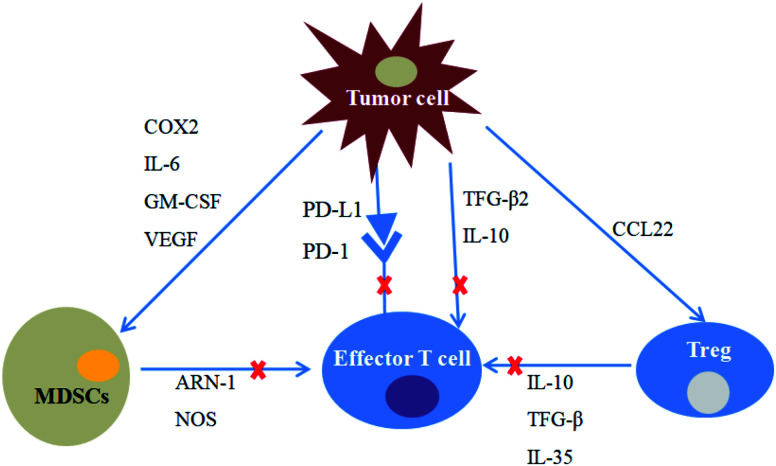
Programmed death receptor 1 (PD-1)/programmed death ligand 1 (PD-L1) blockade therapy has achieved considerable success in various tumours. However, only a fraction of patients benefit from its clinical application, and some patients might be suffer from tumour resistance against PD-1/PD-L1 blockade therapy after the original response. In this review, we summarized the main reasons that caused the low response rate of PD-/PD-L1 blockade therapy: firstly, the off-target of PD-1/PD-L1 blocking agents, which is also the main factor of the side effect of autoimmune disorders; secondly, the insufficient infiltration of T cells in a tumour microenvironment; thirdly, the low immunogenicity of tumor cells; fourth, other immunosuppressive components impairing the therapeutic efficacy of the immunotherapy based on the PD-/PD-L1 blockade, and introducing some updated the delivery system of PD-1/PD-L1 blocking agents and the combination therapy based on PD-1/PD-L1 inhibitors and other therapeutics that can complement and promote each other to achieve improved immune response.
程序性死亡受体1(PD-1)/程序性死亡配体1(PD-L1)阻断疗法在各种肿瘤中取得了显著成功。然而,只有一小部分患者能从其临床应用中获益,而且一些患者在最初有反应后可能会出现对PD-1/PD-L1阻断疗法的肿瘤耐药性。在本综述中,我们总结了导致PD-/PD-L1阻断疗法低反应率的主要原因:首先,PD-1/PD-L1阻断剂的脱靶效应,这也是自身免疫性疾病副作用的主要因素;其次,肿瘤微环境中T细胞浸润不足;第三,肿瘤细胞的免疫原性低;第四,其他免疫抑制成分削弱了基于PD-/PD-L1阻断的免疫疗法的治疗效果,并介绍了一些更新的PD-1/PD-L1阻断剂递送系统以及基于PD-1/PD-L1抑制剂与其他疗法的联合治疗,这些疗法可以相互补充和促进,以实现改善的免疫反应。