Department of Rheumatology, Ajou University School of Medicine, Suwon, South Korea.
Department of Molecular Science and Technology, Ajou University, Suwon, South Korea.
Front Immunol. 2022 Apr 22;13:886209. doi: 10.3389/fimmu.2022.886209. eCollection 2022.
This study aimed to elucidate the potential of serum, urine, and saliva S100 calcium-binding protein A8 protein (S100A8) levels as biomarkers for systemic lupus erythematosus (SLE).
Serum, urine, and saliva samples were obtained from 249 patients with SLE from the Ajou lupus cohort and 52 age- and sex-matched healthy controls (HCs). The concentrations of S100A8 were quantified using an ELISA, and a receiver operating characteristic curve was used to analyze whether they may be used as biomarkers for diagnosing SLE.
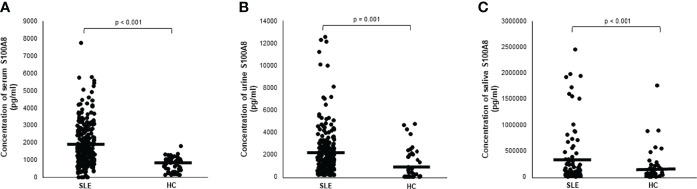
Among 249 SLE patients included in our study, the mean SLE disease activity index (SLEDAI)-2K was 7.16 ± 5.61, and the number of patients with lupus flare was 11. Patients with SLE showed a 2.7-fold increase in serum S100A8 levels compared with that in HCs (1,890.6 vs. 709 pg/ml, p < 0.001). In urine and saliva, the average S100A8 levels were significantly higher in patients with SLE compared with those in HCs (urine, 2,029.4 vs. 1,096.7 pg/ml, p = 0.001; saliva, 290,496.3 vs. 47,742 pg/ml, p < 0.001). For SLE diagnosis, the area under the receiver operating characteristic curve was 0.831 for serum S100A8 (95% CI, 0.765-0.897), 0.751 for urine S100A8 (95% CI, 0.648-0.854), and 0.729 for salivary S100A8 (95% CI, 0.646-0.812). Pearson's correlation analysis showed that S100A8 in serum, urine, and saliva was significantly associated with the SLEDAI (r = 0.267, p < 0.001; r = 0.274, p < 0.001; and r = 0.629, p < 0.001, respectively). Among the clinical manifestations, nephritis was the most influential factor related to SLE in the concentration of S100A8 in serum, urine, and saliva.
This is the first study to show that the expression of S100A8 in serum, urine, and saliva is significantly higher in patients with SLE than in HCs and is associated with disease activity markers. Therefore, we suggest that S100A8 protein could be a potential biomarker for SLE.
本研究旨在阐明血清、尿液和唾液 S100 钙结合蛋白 A8 蛋白(S100A8)水平作为系统性红斑狼疮(SLE)生物标志物的潜力。
从 Ajou 狼疮队列中获得了 249 例 SLE 患者和 52 名年龄和性别匹配的健康对照者(HCs)的血清、尿液和唾液样本。使用 ELISA 定量 S100A8 的浓度,并使用受试者工作特征曲线分析它们是否可用于诊断 SLE。
在纳入本研究的 249 例 SLE 患者中,平均 SLE 疾病活动指数(SLEDAI)-2K 为 7.16±5.61,狼疮发作患者为 11 例。与 HCs 相比,SLE 患者的血清 S100A8 水平升高了 2.7 倍(1890.6 vs. 709 pg/ml,p<0.001)。在尿液和唾液中,SLE 患者的 S100A8 水平明显高于 HCs(尿液,2029.4 vs. 1096.7 pg/ml,p=0.001;唾液,290496.3 vs. 47742 pg/ml,p<0.001)。对于 SLE 诊断,血清 S100A8 的受试者工作特征曲线下面积为 0.831(95%CI,0.765-0.897),尿液 S100A8 为 0.751(95%CI,0.648-0.854),唾液 S100A8 为 0.729(95%CI,0.646-0.812)。Pearson 相关分析表明,血清、尿液和唾液中的 S100A8 与 SLEDAI 显著相关(r=0.267,p<0.001;r=0.274,p<0.001;r=0.629,p<0.001)。在临床表现中,肾炎是与 SLE 患者血清、尿液和唾液中 S100A8 浓度相关的最具影响力的因素。
这是第一项表明 SLE 患者血清、尿液和唾液中 S100A8 表达明显高于 HCs 并与疾病活动标志物相关的研究。因此,我们建议 S100A8 蛋白可能是 SLE 的潜在生物标志物。