Tao Wenhui, Zhao Dongyang, Li Guanting, Li Lingxiao, Li Songhao, Ye Hao, Tian Chutong, Lu Yutong, Li Shuying, Sun Yinghua, He Zhonggui, Sun Jin
Department of Pharmaceutics, Wuya College of Innovation, Shenyang Pharmaceutical University, Shenyang 110016, China.
Department of Pharmaceutical and Engineering, College of Pharmaceutical and Engineering, Shenyang Pharmaceutical University, Shenyang 110016, China.
Acta Pharm Sin B. 2022 Mar;12(3):1487-1499. doi: 10.1016/j.apsb.2021.08.010. Epub 2021 Aug 12.
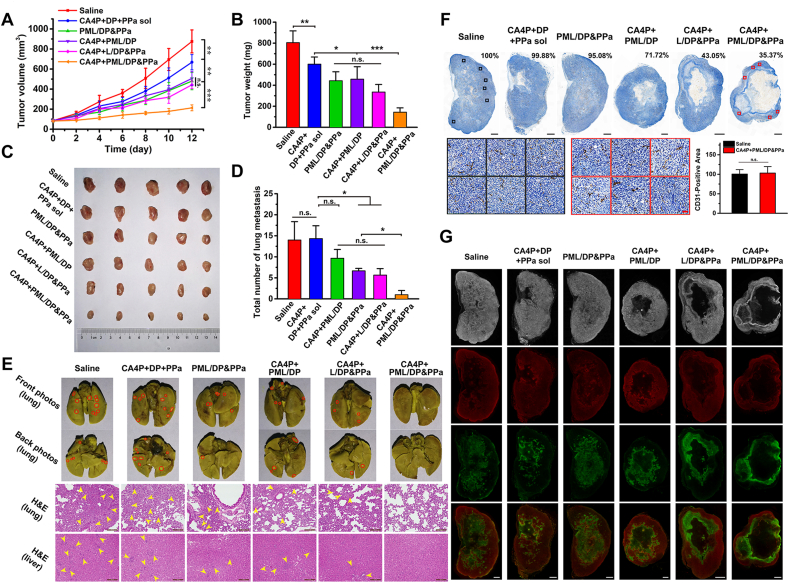
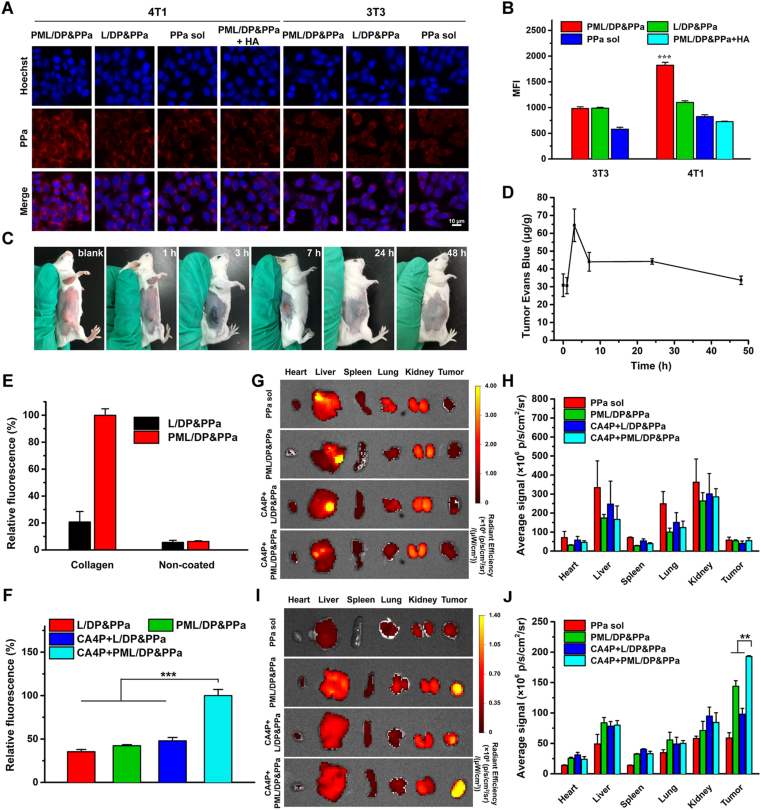
The unique characteristics of the tumor microenvironment (TME) could be exploited to develop antitumor nanomedicine strategies. However, in many cases, the actual therapeutic effect is far from reaching our expectations due to the notable tumor heterogeneity. Given the amplified characteristics of TME regulated by vascular disrupting agents (VDAs), nanomedicines may achieve unexpected improved efficacy. Herein, we fabricate platelet membrane-fusogenic liposomes (PML/DP&PPa), namely "platesomes", which actively load the hypoxia-activated pro-prodrug DMG-PR104A (DP) and physically encapsulate the photosensitizer pyropheophorbide a (PPa). Considering the different stages of tumor vascular collapse and shutdown induced by a VDA combretastatin-A4 phosphate (CA4P), PML/DP&PPa is injected 3 h after intraperitoneal administration of CA4P. First, CA4P-mediated tumor hemorrhage amplifies the enhanced permeation and retention (EPR) effect, and the platesome-biological targeting further promotes the tumor accumulation of PML/DP&PPa. Besides, CA4P-induced vascular occlusion inhibits oxygen supply, followed by photodynamic therapy-caused acute tumor hypoxia. This prolonged extreme hypoxia contributes to the complete activation of DP and then high inhibitory effect on tumor growth and metastasis. Thus, such a combining strategy of artificially-regulated TME and bio-inspired platesomes pronouncedly improves tumor drug delivery and boosts tumor hypoxia-selective activation, and provides a preferable solution to high-efficiency cancer therapy.
肿瘤微环境(TME)的独特特征可被用于开发抗肿瘤纳米药物策略。然而,在许多情况下,由于显著的肿瘤异质性,实际治疗效果远未达到我们的预期。鉴于血管破坏剂(VDAs)调节的TME的放大特征,纳米药物可能会实现意想不到的疗效提升。在此,我们制备了血小板膜融合脂质体(PML/DP&PPa),即“板状脂质体”,其主动负载缺氧激活的前体药物DMG-PR104A(DP)并物理包裹光敏剂焦脱镁叶绿酸a(PPa)。考虑到磷酸考布他汀-A4(CA4P)诱导的肿瘤血管塌陷和关闭的不同阶段,在腹腔注射CA4P后3小时注射PML/DP&PPa。首先,CA4P介导的肿瘤出血放大了增强的渗透和滞留(EPR)效应,并且板状脂质体的生物靶向性进一步促进了PML/DP&PPa在肿瘤中的积累。此外,CA4P诱导的血管闭塞抑制了氧气供应,随后光动力疗法导致急性肿瘤缺氧。这种长期的极端缺氧有助于DP的完全激活,进而对肿瘤生长和转移产生高度抑制作用。因此,这种人工调节TME与仿生板状脂质体的联合策略显著改善了肿瘤药物递送并增强了肿瘤缺氧选择性激活,为高效癌症治疗提供了更好的解决方案。