Department of Periodontics and Oral Medicine, University of Michigan School of Dentistry, Ann Arbor, Michigan, USA.
Department of Periodontics, University of Louisville School of Dentistry, Louisville, Kentucky, USA.
J Periodontol. 2022 Sep;93(9):1273-1282. doi: 10.1002/JPER.21-0723. Epub 2022 Jun 21.
The amount of initial physiological bone remodeling (IPBR) after implant placement varies and the ways it may play a role in peri-implantitis development remains unknown. The aim of this retrospective study was to investigate the association between the amount of IPBR during the first year of implant placement and incidence of peri-implantitis as well as the pattern of progressive bone loss.
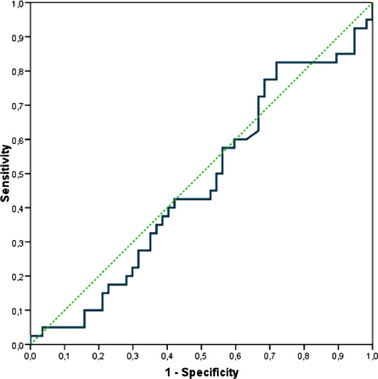
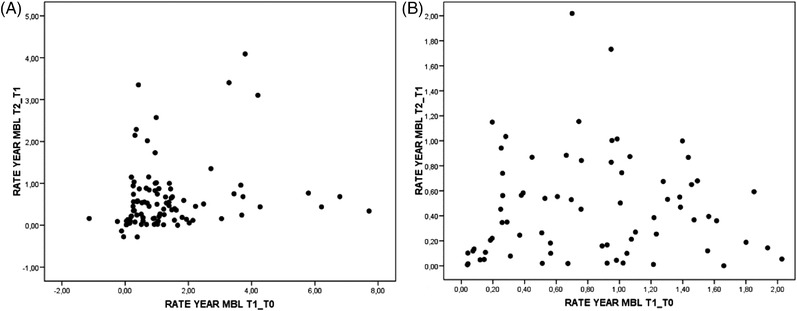
Clinical and radiographic documentation of implants at the time of implant placement (T0), 1 year ± 6 months after crown placement (T1), and at a ≥2-year follow-up from implant placement (T2) were retrospectively collected. IPBR was defined as the bone loss occurring from implant placement to the end of the bone remodeling (T1). Cases were grouped into those diagnosed with (test) or without peri-implantitis (PIm) (control). Linear regression model under generalized estimation equation approach was estimated to assess correlation between marginal bone loss (MBL) rates in both periods (T1-T0) and (T2-T1). Receiver operating characteristics curve was estimated to explore an optimal cut-off point of T1-T0 MBL to discriminate between PIm and no-PIm implants.
A total of 45 patients receiving 57 implants without PIm and 40 with PIm were included. There were no associations between PIm and IPBR (p > 0.05), nor between BML of (T2-T1) and (T1-T0). However, arch and total follow-up showed significant influence on the probability of PIm. Splinted implants showed an MBL rate of 0.60-mm/year higher than non-splinted implants (p < 0.001) from T1 to T2.
No statistically significant association was found between IPBR and incidence of peri-implantitis.
种植体植入后初始生理骨改建(IPBR)的量存在差异,其在种植体周围炎发展中的作用方式尚不清楚。本回顾性研究旨在探讨种植体植入后第一年的 IPBR 量与种植体周围炎的发生以及进行性骨丧失模式之间的关系。
回顾性收集种植体植入时(T0)、冠修复后 1 年±6 个月(T1)和种植体植入后≥2 年随访时(T2)的临床和影像学资料。IPBR 定义为从种植体植入到骨改建结束(T1)时发生的骨丢失。将病例分为诊断为(试验)或无种植体周围炎(PIm)(对照)。采用广义估计方程方法下的线性回归模型来评估两个时期(T1-T0)和(T2-T1)的边缘骨丢失(MBL)率之间的相关性。绘制受试者工作特征曲线以探索 T1-T0 MBL 的最佳截断值,以区分 PIm 和非 PIm 种植体。
共纳入 45 例无 PIm 患者的 57 枚种植体和 40 例有 PIm 患者的 40 枚种植体。PIm 与 IPBR 之间无相关性(p>0.05),(T2-T1)和(T1-T0)的 BML 之间也无相关性。然而,弓和总随访时间对 PIm 的发生概率有显著影响。从 T1 到 T2,夹板固定种植体的 MBL 率比非夹板固定种植体高 0.60mm/年(p<0.001)。
未发现 IPBR 与种植体周围炎的发生之间存在统计学显著相关性。