Behavioural and Clinical Neuroscience Institute, Department of Psychology, University of Cambridge, Cambridge, UK.
Department of Psychology, School of Medical and Life Sciences, Sunway University, Petaling Jaya, Malaysia.
J Child Psychol Psychiatry. 2022 Dec;63(12):1591-1601. doi: 10.1111/jcpp.13628. Epub 2022 May 10.
Computational research had determined that adults with obsessive-compulsive disorder (OCD) display heightened action updating in response to noise in the environment and neglect metacognitive information (such as confidence) when making decisions. These features are proposed to underlie patients' compulsions despite the knowledge they are irrational. Nonetheless, it is unclear whether this extends to adolescents with OCD as research in this population is lacking. Thus, this study aimed to investigate the interplay between action and confidence in adolescents with OCD.
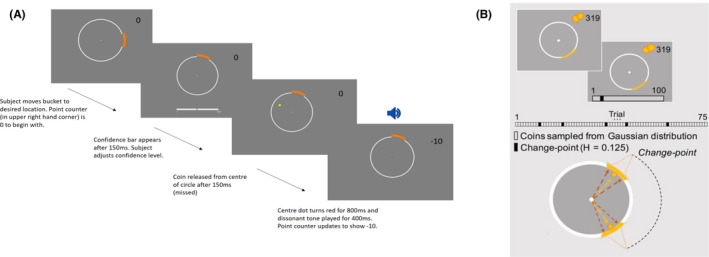
Twenty-seven adolescents with OCD and 46 controls completed a predictive-inference task, designed to probe how subjects' actions and confidence ratings fluctuate in response to unexpected outcomes. We investigated how subjects update actions in response to prediction errors (indexing mismatches between expectations and outcomes) and used parameters from a Bayesian model to predict how confidence and action evolve over time. Confidence-action association strength was assessed using a regression model. We also investigated the effects of serotonergic medication.
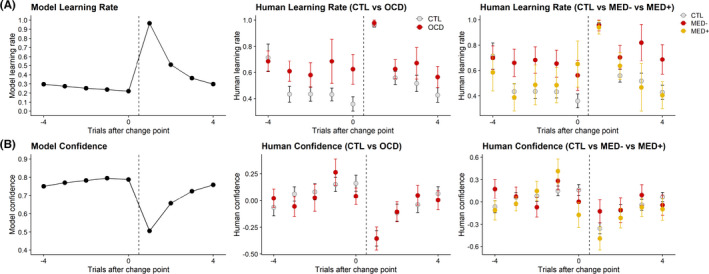
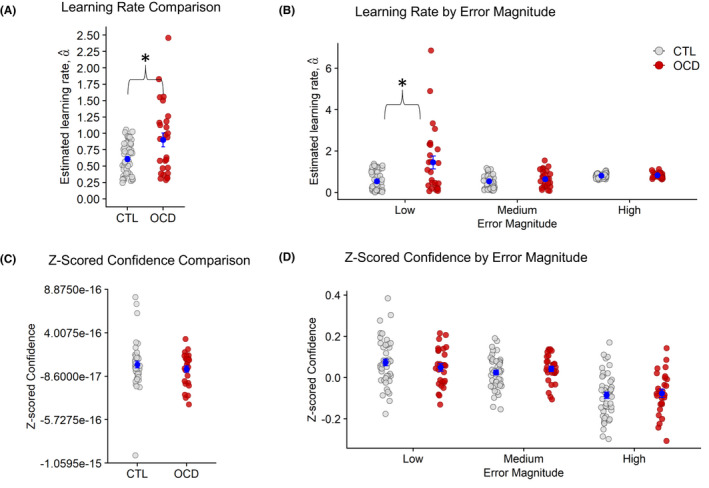
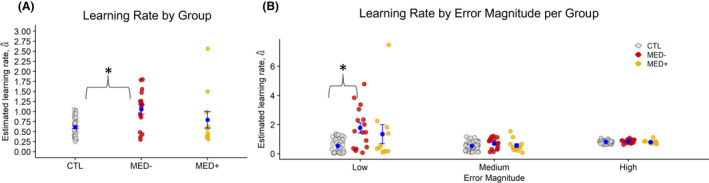
Adolescents with OCD showed significantly increased learning rates, particularly following small prediction errors. Results were driven primarily by unmedicated patients. Confidence ratings appeared equivalent between groups, although model-based analysis revealed that patients' confidence was less affected by prediction errors compared to controls. Patients and controls did not differ in the extent to which they updated actions and confidence in tandem.
Adolescents with OCD showed enhanced action adjustments, especially in the face of small prediction errors, consistent with previous research establishing 'just-right' compulsions, enhanced error-related negativity, and greater decision uncertainty in paediatric-OCD. These tendencies were ameliorated in patients receiving serotonergic medication, emphasising the importance of early intervention in preventing disorder-related cognitive deficits. Confidence ratings were equivalent between young patients and controls, mirroring findings in adult OCD research.
计算研究已经确定,患有强迫症(OCD)的成年人在环境噪声中表现出更高的动作更新,并且在做出决策时忽略元认知信息(如信心)。这些特征被认为是患者强迫行为的基础,尽管他们知道这些行为是不合理的。然而,目前尚不清楚这是否适用于患有 OCD 的青少年,因为该人群的研究还很缺乏。因此,本研究旨在调查青少年 OCD 患者的动作和信心之间的相互作用。
27 名患有 OCD 的青少年和 46 名对照组完成了一项预测推理任务,旨在探究受试者的动作和信心评分如何响应意外结果而波动。我们研究了受试者如何响应预测误差更新动作(表示期望与结果之间的不匹配),并使用贝叶斯模型的参数来预测信心和动作如何随时间演变。使用回归模型评估信心-动作关联强度。我们还研究了 5-羟色胺能药物的影响。
患有 OCD 的青少年表现出明显增加的学习率,尤其是在小的预测误差之后。结果主要由未经药物治疗的患者驱动。两组之间的信心评分似乎相等,尽管基于模型的分析显示,与对照组相比,患者的信心受预测误差的影响较小。患者和对照组在同步更新动作和信心的程度上没有差异。
青少年 OCD 患者表现出增强的动作调整,尤其是在面对小的预测误差时,这与先前研究中建立的“恰到好处”的强迫行为、增强的错误相关负性和儿童 OCD 中更大的决策不确定性一致。接受 5-羟色胺能药物治疗的患者这些趋势得到改善,强调了早期干预对于预防与疾病相关的认知缺陷的重要性。青少年患者和对照组的信心评分相等,反映了成人 OCD 研究中的发现。