Department of Social Psychology, Goethe University Frankfurt, Frankfurt am Main, Germany
School of Psychology, University of Queensland, Brisbane, Queensland, Australia.
BMJ Open. 2022 May 10;12(5):e054980. doi: 10.1136/bmjopen-2021-054980.
To investigate whether citizens' adherence to health-protective non-pharmaceutical interventions (NPIs) during the COVID-19 pandemic is predicted by identity leadership, wherein leaders are perceived to create a sense of shared national identity.
Observational two-wave study. Hypotheses testing was conducted with structural equation modelling.
Data collection during the COVID-19 pandemic in China, Germany, Israel and the USA in April/May 2020 and four weeks later.
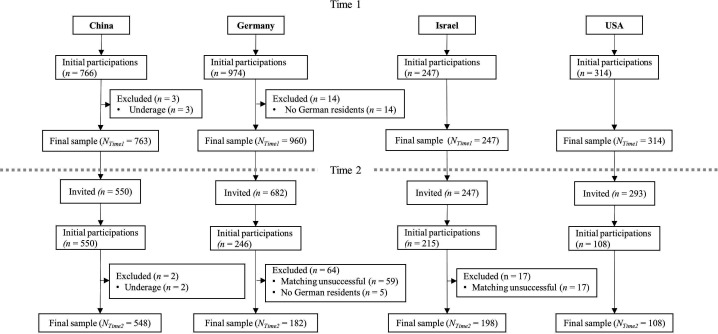
Adults in China (n=548, 66.6% women), Germany (n=182, 78% women), Israel (n=198, 51.0% women) and the USA (n=108, 58.3% women).
Identity leadership (assessed by the four-item Identity Leadership Inventory Short-Form) at Time 1, perceived shared national identification (PSNI; assessed with four items) and adherence to health-protective NPIs (assessed with 10 items that describe different health-protective interventions; for example, wearing face masks) at Time 2.
Identity leadership was positively associated with PSNI (95% CI 0.11 to 0.30, p<0.001) in all countries. This, in turn, was related to more adherence to health-protective NPIs in all countries (95% CI 0.03 to 0.36, 0.001≤≤0.017) except Israel (95% CI -0.03 to 0.27, p=0.119). In Germany, the more people saw Chancellor Merkel as engaging in identity leadership, the they adhered to health-protective NPIs (95% CI 0.04 to 0.18, p=0.002). In the USA, in contrast, the more people perceived President Trump as engaging in identity leadership, the they adhered to health-protective NPIs (95% CI -0.17 to -0.04, p=0.002).
National leaders can make a difference by promoting a sense of shared identity among their citizens because people are more inclined to follow health-protective NPIs to the extent that they feel part of a united 'us'. However, the content of identity leadership (perceptions of what it means to be a nation's citizen) is essential, because this can also encourage people to disregard such recommendations.
研究在 COVID-19 大流行期间,公民是否遵守健康保护非药物干预措施(NPIs),这可以通过身份领导来预测,即领导者被认为能够营造出一种共同的国家认同感。
观察性两波研究。通过结构方程模型进行假设检验。
在中国、德国、以色列和美国于 2020 年 4/5 月和 4 周后收集 COVID-19 大流行数据。
中国(n=548,66.6%女性)、德国(n=182,78%女性)、以色列(n=198,51.0%女性)和美国(n=108,58.3%女性)的成年人。
在第 1 时间评估身份领导(由四项身份领导清单短表评估)、感知的共同国家认同(PSNI;由四项评估项目评估)和第 2 时间对健康保护 NPI 的遵守情况(由描述不同健康保护干预措施的 10 项评估项目评估;例如,戴口罩)。
在所有国家,身份领导与 PSNI 呈正相关(95%CI 0.11 至 0.30,p<0.001)。这反过来又与所有国家对健康保护 NPI 的遵守程度相关(95%CI 0.03 至 0.36,0.001≤≤0.017),除了以色列(95%CI -0.03 至 0.27,p=0.119)。在德国,人们越认为总理默克尔从事身份领导,他们就越遵守健康保护 NPI(95%CI 0.04 至 0.18,p=0.002)。相比之下,在美国,人们越认为总统特朗普从事身份领导,他们就越遵守健康保护 NPI(95%CI -0.17 至 -0.04,p=0.002)。
国家领导人可以通过促进公民之间的共同认同感来发挥作用,因为人们更倾向于遵守健康保护 NPI,以他们作为一个团结的“我们”的一部分。然而,身份领导的内容(对成为一个国家公民的意义的理解)是至关重要的,因为这也可以鼓励人们忽视这些建议。