Ruble Shannon, Payne Karissa, Kramer Cassandra, West Lexe, Ness Halle, Erickson Greg, Scott Alyssa, Diehl Maria M
Department of Psychological Sciences, Kansas State University, Manhattan, KS, 66506, USA.
Neurobiol Stress. 2024 Dec 5;34:100702. doi: 10.1016/j.ynstr.2024.100702. eCollection 2025 Jan.
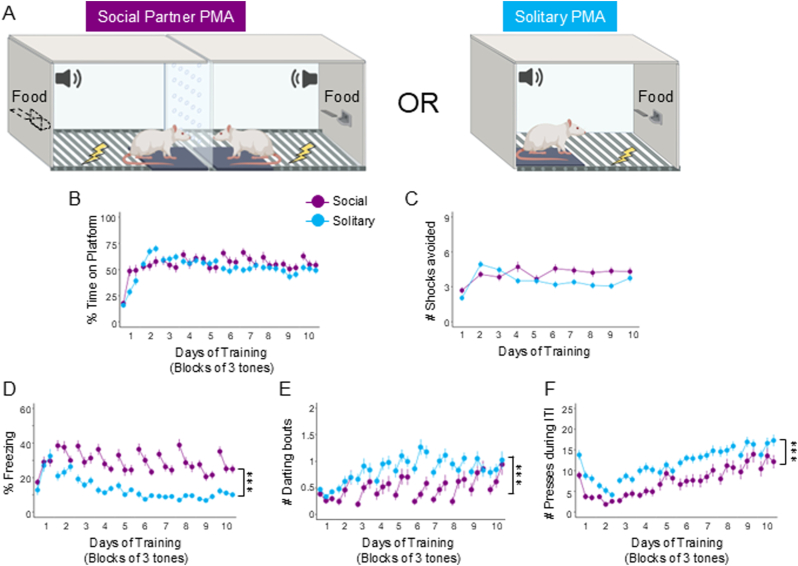
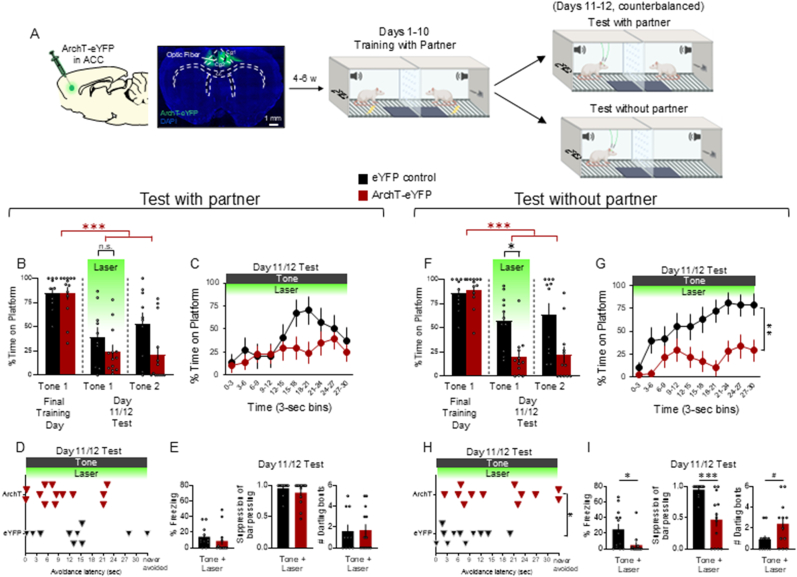
Actively avoiding danger is necessary for survival. Most research on active avoidance has focused on the behavioral and neurobiological processes when individuals learn to avoid alone, within a solitary context. Therefore, little is known about how social context affects active avoidance. Using a modified version of the platform-mediated avoidance task in rats, we investigated whether the presence of a social partner attenuates conditioned freezing and enhances avoidance compared to avoidance in a solitary context. Rats spent a similar amount of time avoiding during either context; however, rats trained in the social context exhibited greater freezing as well as lower rates of darting and food seeking compared to rats trained in the solitary context. In addition, we observed higher levels of avoidance in females compared to males in the solitary context, but this sex difference was not present in rats trained in the social context. To gain greater mechanistic insight, we optogenetically inactivated glutamatergic projection neurons in the anterior cingulate cortex (ACC) following avoidance training in either context. After avoidance was learned in a social context, photoinactivation of ACC reduced expression of avoidance during a test when the social partner was absent, but not when the partner was present. Our findings suggest a novel contribution of the ACC in avoidance that is learned with a social partner, which has translational implications for understanding ACC dysfunction in those suffering from trauma-related disorders.
积极避险对生存至关重要。大多数关于积极避险的研究都集中在个体独自学习避险时的行为和神经生物学过程,即在孤立的情境中。因此,对于社会环境如何影响积极避险知之甚少。我们使用大鼠平台介导的避险任务的改良版本,研究了与孤立情境下的避险相比,社交伙伴的存在是否会减弱条件性僵立反应并增强避险行为。在两种情境下,大鼠用于避险的时间相似;然而,与在孤立情境下训练的大鼠相比,在社交情境下训练的大鼠表现出更强的僵立反应,以及更低的突进和觅食率。此外,我们观察到在孤立情境下雌性大鼠的避险水平高于雄性大鼠,但在社交情境下训练的大鼠中不存在这种性别差异。为了更深入了解其机制,我们在两种情境下进行避险训练后,用光遗传学方法使前扣带回皮质(ACC)中的谷氨酸能投射神经元失活。在社交情境下学会避险后,当社交伙伴不在场时,对ACC进行光灭活会降低测试期间的避险表现,但当伙伴在场时则不会。我们的研究结果表明,ACC在与社交伙伴一起学习的避险中具有新的作用,这对于理解创伤相关障碍患者的ACC功能障碍具有转化意义。