Labouta Hagar I, Gomez-Garcia M Juliana, Sarsons Christopher D, Nguyen Trinh, Kennard Jacob, Ngo Wayne, Terefe Kaisha, Iragorri Nicolas, Lai Patrick, Rinker Kristina D, Cramb David T
Department of Chemistry, Faculty of Science, University of Calgary Canada
Biomedical Engineering, University of Calgary Canada
RSC Adv. 2018 Feb 16;8(14):7697-7708. doi: 10.1039/c7ra13438j. eCollection 2018 Feb 14.
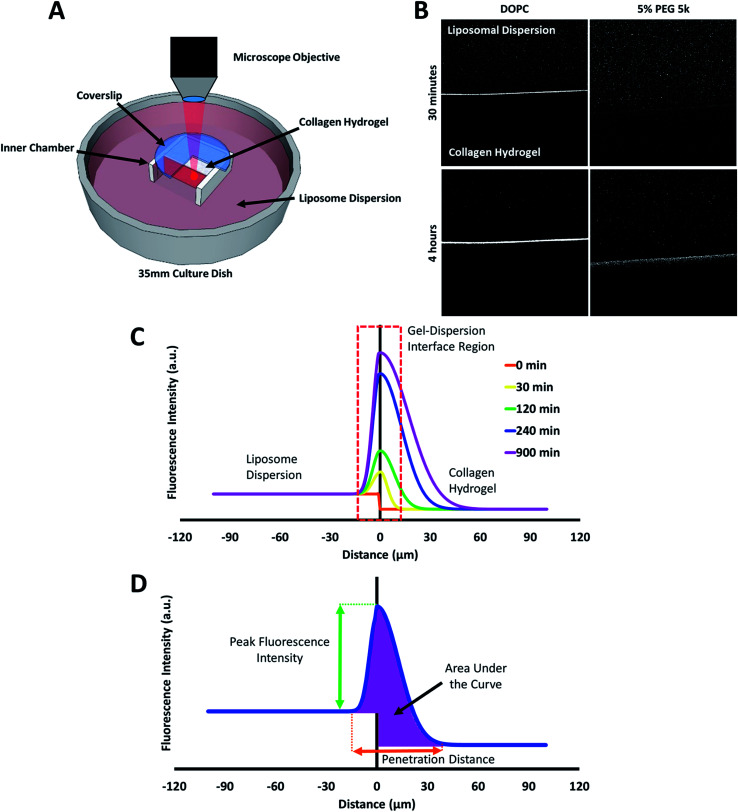
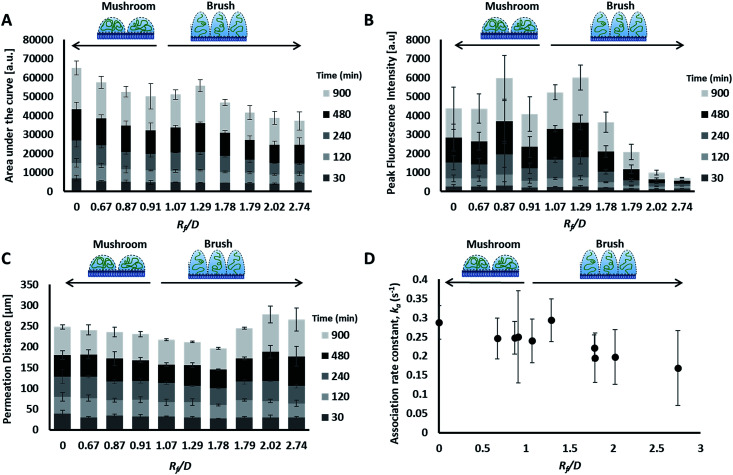
The effect of surface PEGylation on nanoparticle transport through an extracellular matrix (ECM) is an important determinant for tumor targeting success. Fluorescent stealth liposomes (base lipid DOPC) were prepared incorporating different proportions of PEG-grafted lipids (2.5, 5 and 10% of the total lipid content) for a series of PEG molecular weights (1000, 2000 and 5000 Da). The ECM was modelled using a collagen matrix. The kinetics of PEGylated liposome adhesion to and transport in collagen matrices were tracked using fluorescence correlation spectroscopy (FCS) and confocal microscopy, respectively. Generalized least square regressions were used to determine the temporal correlations between PEG molecular weight, surface density and conformation, and the liposome transport in a collagen hydrogel over 15 hours. PEG conformation determined the interaction of liposomes with the collagen hydrogel and their transport behaviour. Interestingly, liposomes with mushroom PEG conformation accumulated on the interface of the collagen hydrogel, creating a dense liposomal front with short diffusion distances into the hydrogels. On the other hand, liposomes with dense brush PEG conformation interacted to a lesser extent with the collagen hydrogel and diffused to longer distances. In conclusion, a better understanding of PEG surface coating as a modifier of transport in a model ECM matrix has resulted. This knowledge will improve design of future liposomal drug carrier systems.
表面聚乙二醇化对纳米颗粒通过细胞外基质(ECM)转运的影响是肿瘤靶向成功的一个重要决定因素。制备了荧光隐形脂质体(基础脂质为二油酰磷脂酰胆碱),其中掺入了不同比例的聚乙二醇接枝脂质(占总脂质含量的2.5%、5%和10%),用于一系列聚乙二醇分子量(1000、2000和5000道尔顿)。使用胶原蛋白基质模拟细胞外基质。分别使用荧光相关光谱法(FCS)和共聚焦显微镜跟踪聚乙二醇化脂质体在胶原蛋白基质中的黏附动力学和转运情况。使用广义最小二乘回归来确定聚乙二醇分子量、表面密度和构象与胶原蛋白水凝胶中脂质体在15小时内的转运之间的时间相关性。聚乙二醇构象决定了脂质体与胶原蛋白水凝胶的相互作用及其转运行为。有趣的是,具有蘑菇状聚乙二醇构象的脂质体聚集在胶原蛋白水凝胶的界面上,形成了一个致密的脂质体前沿,向水凝胶内的扩散距离较短。另一方面,具有致密刷状聚乙二醇构象的脂质体与胶原蛋白水凝胶的相互作用较小,扩散到更长的距离。总之,已经对聚乙二醇表面涂层作为模型细胞外基质中转运调节剂有了更好的理解。这一知识将改进未来脂质体药物载体系统的设计。