Watanabe Taichi, Iso Yoshiki, Isobe Tetsuhiko, Sasaki Hirokazu
Department of Applied Chemistry, Faculty of Science and Technology, Keio University 3-14-1 Hiyoshi, Kohoku-ku Yokohama 223-8522 Japan
Shoei Chemical Inc. 2-1-1 Nishi-Shinjuku Shinjuku-ku Tokyo 163-0443 Japan.
RSC Adv. 2018 Jul 17;8(45):25526-25533. doi: 10.1039/c8ra04830d. eCollection 2018 Jul 16.
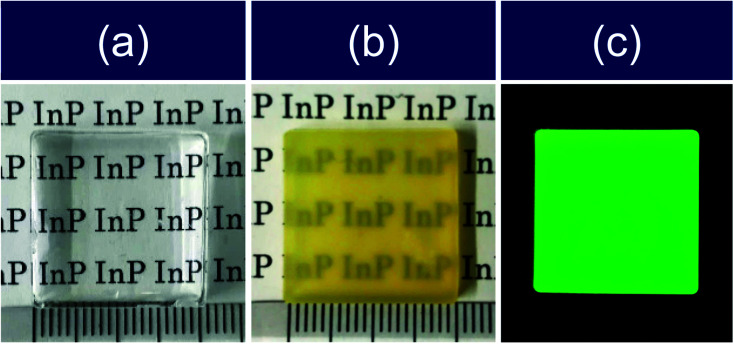
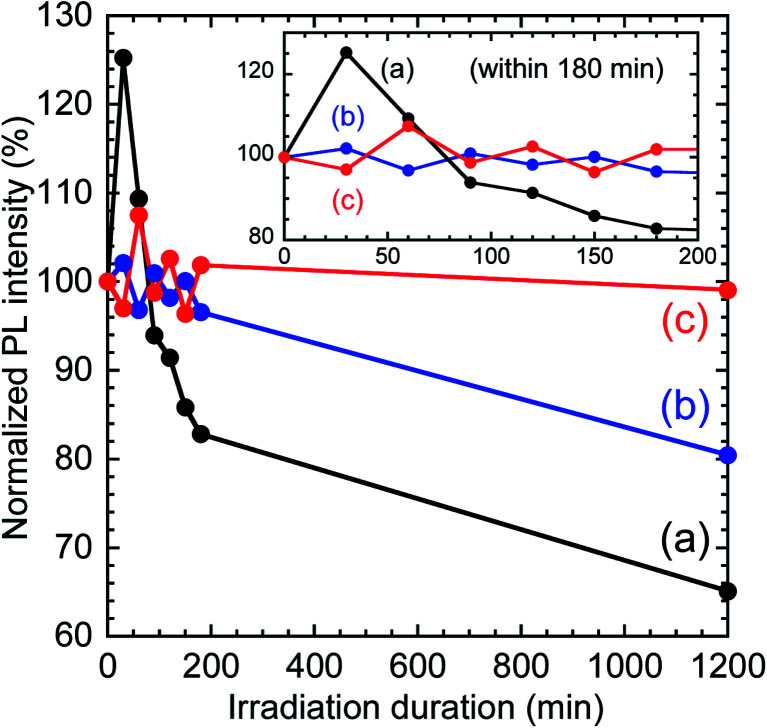
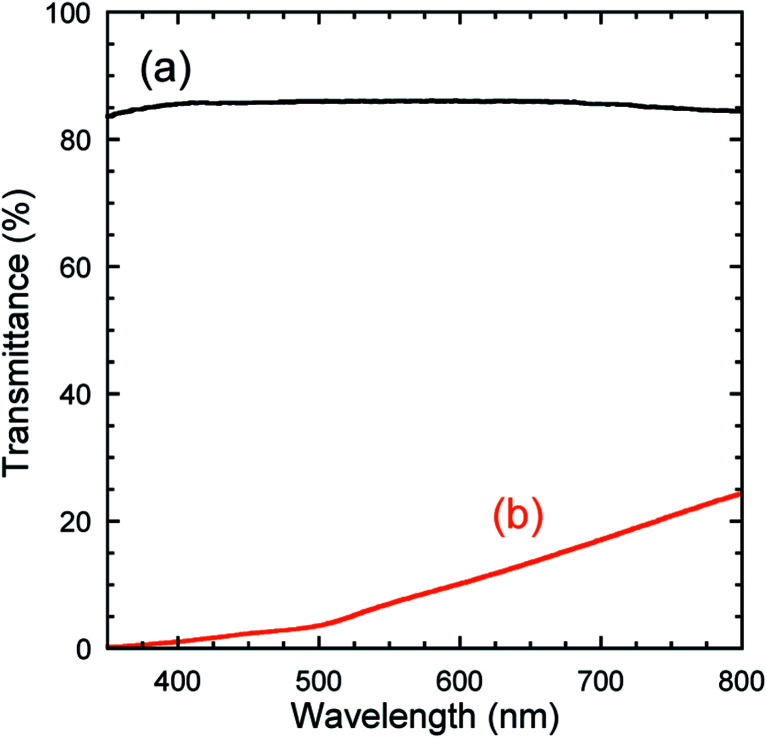
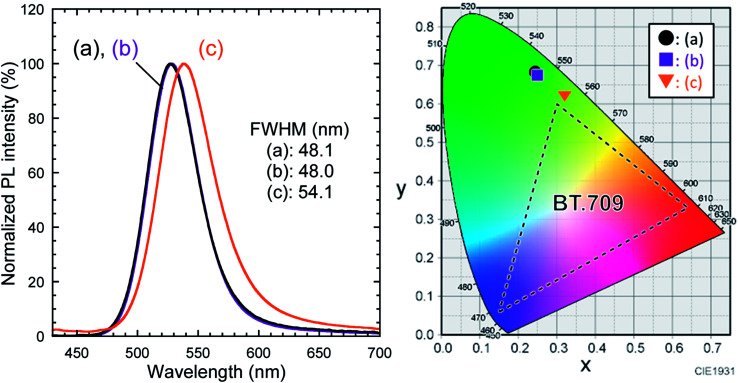
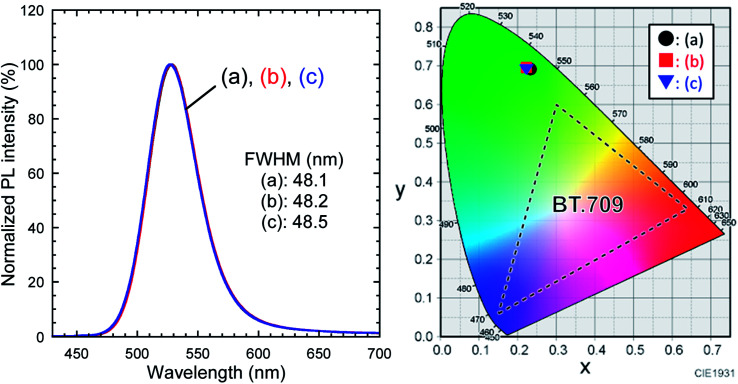
In this work, green-emitting InP/ZnS quantum dots (QDs) modified with 1-dodecanethiol were embedded into silica by two methods to improve their photostability while maintaining a high photoluminescence quantum yield (PLQY) and a color coordinate. A monolithic QD-silica composite prepared by a non-aqueous route with tetraethyl orthosilicate and lactic acid featured low transparency, a loss of the color purity of green, and a PLQY of 1.6%, which was considerably lower than that of the original QDs (67%). The decrease of the PLQY was attributed to QD aggregation in the sol-gel process and degradation of the QDs by the acid. The alternative method involved stirring a toluene dispersion of the QDs with tetramethyl orthosilicate (TMOS) for 20 h or 7 days. The PLQY of the TMOS-modified InP/ZnS QDs (20 h) was 62%, which was only slightly lower than that of the original QDs. The PLQY decreased to 52% when the duration of aging was prolonged to 7 days. This decrease was attributed to desorption of surface modifiers from the QD surface and oxidative degradation by oxygen dissolved in toluene. Herein, the color coordinate was maintained stably. Photostability was evaluated by continuous irradiation of the samples by a blue light emitting diode. The decrease of photoluminescence (PL) intensity was suppressed by the silica encapsulation. In particular, the PL intensity of the TMOS-modified InP/ZnS QD sample (7 d) maintained 99% of its initial intensity. Silica encapsulation of InP/ZnS QDs prevented contact of the QDs with oxygen in the air, resulting in improved photostability.
在本工作中,用1-十二烷硫醇修饰的发射绿光的InP/ZnS量子点(QDs)通过两种方法嵌入二氧化硅中,以提高其光稳定性,同时保持高光致发光量子产率(PLQY)和色坐标。用正硅酸乙酯和乳酸通过非水路线制备的整体式QD-二氧化硅复合材料具有低透明度、绿色色纯度损失以及1.6%的PLQY,这比原始量子点(67%)的PLQY低得多。PLQY的降低归因于溶胶-凝胶过程中量子点的聚集以及酸对量子点的降解。另一种方法是将量子点的甲苯分散体与正硅酸甲酯(TMOS)搅拌20小时或7天。TMOS修饰的InP/ZnS量子点(20小时)的PLQY为62%,仅略低于原始量子点。当老化时间延长至7天时,PLQY降至52%。这种降低归因于表面改性剂从量子点表面的解吸以及溶解在甲苯中的氧气的氧化降解。在此,色坐标保持稳定。通过用蓝色发光二极管连续照射样品来评估光稳定性。二氧化硅封装抑制了光致发光(PL)强度的降低。特别是,TMOS修饰的InP/ZnS量子点样品(7天)的PL强度保持其初始强度的99%。InP/ZnS量子点的二氧化硅封装防止了量子点与空气中的氧气接触,从而提高了光稳定性。