Lu Peng, Hu Xueli, Li Yujie, Zhang Meng, Liu Xiaoping, He Youzhou, Dong Fan, Fu Min, Zhang Zhi
College of Urban Construction and Environmental Engineering, Chongqing University Chongqing 400045 China
College of Environment and Resources, Chongqing Technology and Business University, Chongqing Key Laboratory of Catalysis and New Environmental Materials Chongqing 400067 China.
RSC Adv. 2018 Feb 7;8(12):6315-6325. doi: 10.1039/c7ra11565b. eCollection 2018 Feb 6.
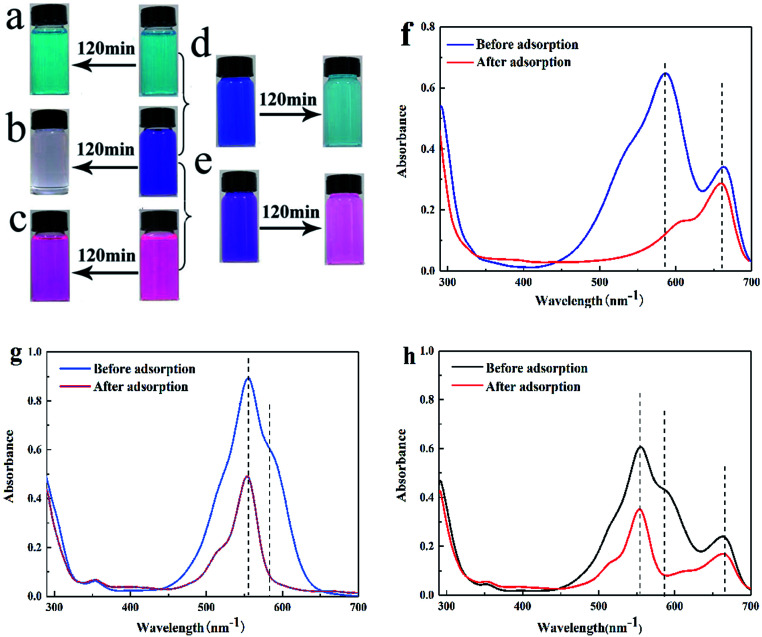
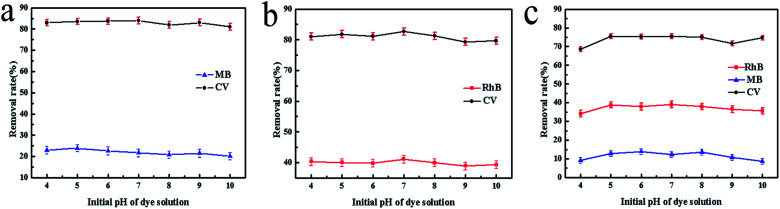
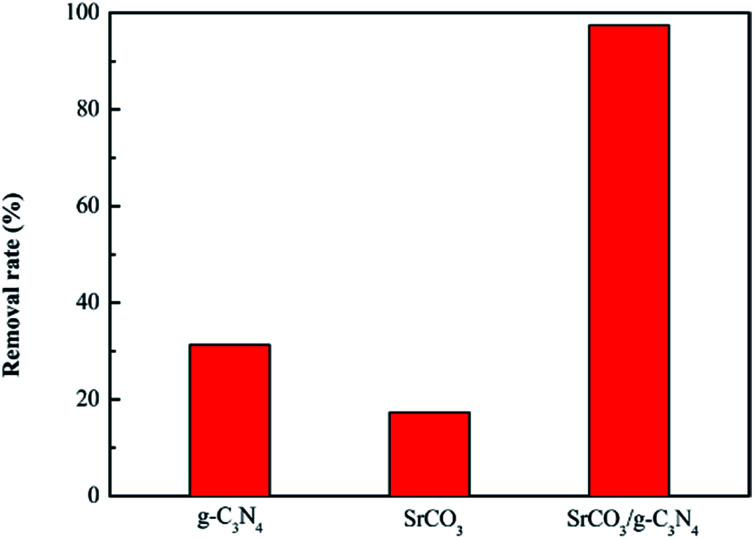
A novel kind of nanoparticle SrCO/g-CN was prepared using strontium carbonate (SrCO) and melamine (CHN) as raw materials one-step calcination. The formation of SrCO/g-CN was confirmed from the X-ray diffraction (XRD), Fourier transform infrared spectra (FT-IR), Scanning Electron Microscopy (SEM), Transmission Electron Microscopy (TEM), Brunauer-Emmett-Teller (BET) and X-ray photoelectron spectroscopy (XPS) analysis. Its selective adsorption performance was evaluated towards crystal violet (CV), rhodamine B (RhB) and methylene blue (MB). The results showed that the SrCO/g-CN had selective adsorption ability of CV. Furthermore, adsorption measurements of CV were conducted to investigate the influences of contact time, initial concentration, initial dye solution pH value and adsorbent dosage. The maximum removal rate of CV was 98.56% when the initial concentration was 1600 mg L. The kinetic study indicated the adsorption of CV followed the pseudo-second-second model well. The adsorption efficiency of SrCO/g-CN was greater (97.46%) than that of g-CN (31.30%) and SrCO (17.30%). It could be deduced that the synergistic effect of conjugation interaction of g-CN and the electrostatic attraction of SrCO might be the main driving force for the superb adsorption of CV.
以碳酸锶(SrCO)和三聚氰胺(CHN)为原料,通过一步煅烧制备了一种新型纳米颗粒SrCO/g-CN。通过X射线衍射(XRD)、傅里叶变换红外光谱(FT-IR)、扫描电子显微镜(SEM)、透射电子显微镜(TEM)、布鲁诺尔-埃米特-泰勒(BET)和X射线光电子能谱(XPS)分析证实了SrCO/g-CN的形成。评估了其对结晶紫(CV)、罗丹明B(RhB)和亚甲基蓝(MB)的选择性吸附性能。结果表明,SrCO/g-CN对CV具有选择性吸附能力。此外,进行了CV的吸附测量,以研究接触时间、初始浓度、初始染料溶液pH值和吸附剂用量的影响。当初始浓度为1600 mg/L时,CV的最大去除率为98.56%。动力学研究表明,CV的吸附很好地遵循准二级模型。SrCO/g-CN的吸附效率(97.46%)高于g-CN(31.30%)和SrCO(17.30%)。可以推断,g-CN的共轭相互作用和SrCO的静电吸引的协同效应可能是CV优异吸附的主要驱动力。