Molecular Biotechnology, Department of Bioproducts and Biosystems, School of Chemical Engineering, Aalto University, 02150 Espoo, Finland.
Food Chemistry and Food Development, Department of Life Technologies, University of Turku, 20500 Turku, Finland.
J Agric Food Chem. 2022 May 25;70(20):6191-6201. doi: 10.1021/acs.jafc.1c08029. Epub 2022 May 11.
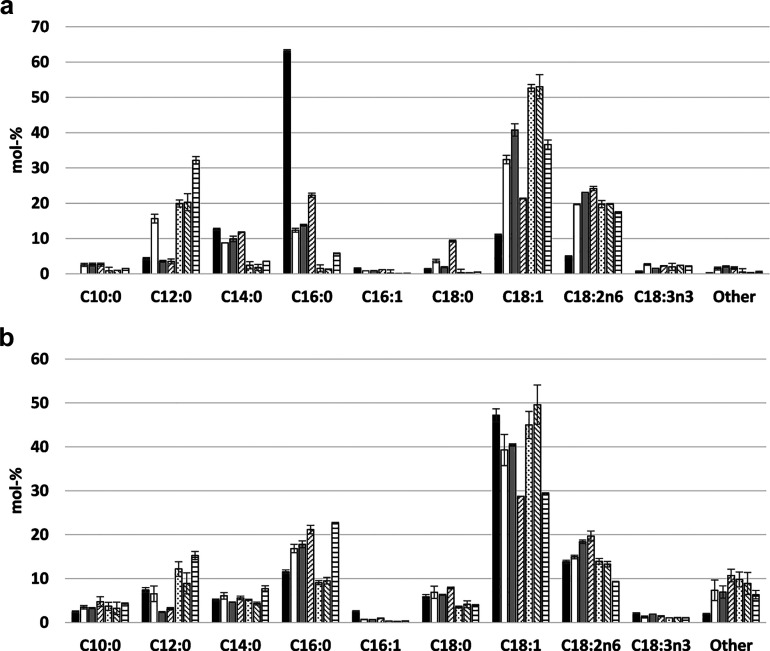
The similarity of the fat fraction in infant formulas rich in either bovine milk fat (MF) or vegetable oil (VO) to breast milk was evaluated by analyzing their lipid composition. Milk fat-rich formulas were highly similar (average similarity index 0.68) to breast milk compared to the VO-rich formulas (average similarity index 0.56). The highest difference in the indices was found in the contents of cholesterol (0.66 vs 0.28 in MF- and VO-rich formulas, respectively, on average) and polar lipids (0.84 vs 0.53), the positional distribution of fatty acids in the -2 position of triacylglycerols (0.53 vs 0.28), and fatty acid composition (0.72 vs 0.54). The VO-based formulas were superior in similarity in - 6 PUFA. Thus, the addition of bovine MF fractions is an effective way to increase the similarity between the lipid composition of infant formulas and human milk.
通过分析脂质组成,评估富含牛乳脂肪(MF)或植物油(VO)的婴儿配方奶粉中的脂肪分数与母乳的相似性。与富含 VO 的配方奶相比,富含 MF 的配方奶与母乳的相似性更高(平均相似指数为 0.68)。在指数方面,差异最大的是胆固醇含量(MF 和 VO 丰富的配方奶分别为 0.66 和 0.28,平均)和极性脂质(0.84 和 0.53)、甘油三酯 -2 位脂肪酸的位置分布(0.53 和 0.28)以及脂肪酸组成(0.72 和 0.54)。基于 VO 的配方在 -6PUFA 方面具有更高的相似性。因此,添加牛乳 MF 馏分是提高婴儿配方奶粉与母乳脂质组成相似性的有效方法。