D'Arcy Sutherland Cardiothoracic Surgical Unit, Royal Adelaide Hospital, North terrace, Adelaide, SA, 5000, Australia.
Health and Medical Sciences, University of Adelaide, Adelaide, Australia.
J Cardiothorac Surg. 2022 May 11;17(1):113. doi: 10.1186/s13019-022-01876-w.
Our objective was to report on the prospective outcomes in the areas of depression, quality of life, angina, and frailty in SAVR and TAVR patients with aortic stenosis undergoing aortic valve intervention.
We recruited 300 patients across 3 groups (TAVR, SAVR, and CABG) over 12 months. Depression, quality of life, frailty, and angina were assessed followed by propensity score matching.
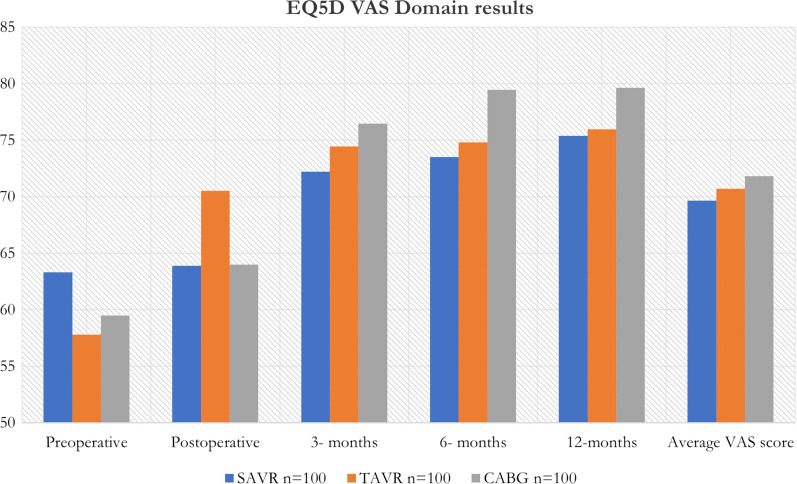
Using logistical regression when all patient factors considered for all patients who had SAVR and TAVR, the only preoperative factors that impacted on 1 year mortality was hypertension and STS score. Quality of life improvements within each group over 12 months was significant (p value = 0.0001). Depression at 12 months between groups (p value = 0.0395) and within each group was significant (p value = 0.0073 for SAVR and 0.0001 for TAVR). Angina was most frequent in TAVR at 12 months in the QL (p = 0.0001), PL (p = 0.0007), and improvement was significant in the QL (SAVR p = 0.0010, TAVR p = 0.0001) and PL (SAVR p = 0.0002), TAVR p = 0.0007) domains in both groups. Frailty at 12 months improved in both groups, but was greatest in TAVR (p value = 0.00126).
This 12 months follow up of cardiac surgical patients has revealed significant improvement in PROMs and frailty in all groups by 3 months postoperative regardless of surgical or transcatheter approach. Outcome measures of quality of life and frailty could be utilized as a measure of outcome more regularly in patients undergoing aortic valve surgery regardless of approach.
我们的目的是报告在接受主动脉瓣介入治疗的主动脉瓣狭窄患者中,行主动脉瓣置换术(SAVR)和经导管主动脉瓣置换术(TAVR)的患者在抑郁、生活质量、心绞痛和虚弱等方面的前瞻性结局。
我们在 12 个月内招募了 300 名患者,分为 3 组(TAVR、SAVR 和 CABG)。评估抑郁、生活质量、虚弱和心绞痛,然后进行倾向评分匹配。
使用逻辑回归分析所有接受 SAVR 和 TAVR 的患者的所有术前因素,唯一影响 1 年死亡率的术前因素是高血压和 STS 评分。每组患者在 12 个月内的生活质量均有显著改善(p 值=0.0001)。组间 12 个月的抑郁(p 值=0.0395)和组内抑郁(SAVR p 值=0.0073,TAVR p 值=0.0001)均有显著差异。12 个月时 TAVR 的心绞痛最常见,QL(p=0.0001)、PL(p=0.0007)均有统计学意义,QL(SAVR p=0.0010,TAVR p=0.0001)和 PL(SAVR p=0.0002,TAVR p=0.0007)均有显著改善。12 个月时,两组患者的虚弱程度均有改善,但 TAVR 组改善最大(p 值=0.00126)。
本研究对心脏手术患者进行了 12 个月的随访,结果显示,无论采用外科手术还是经导管介入治疗,所有患者在术后 3 个月时 PROM 和虚弱程度均有显著改善。生活质量和虚弱程度的评估可以作为衡量主动脉瓣手术患者预后的指标,无论治疗方式如何,都可以更频繁地使用。