Walter Reed Army Institute of Research, 503 Robert Grant Ave, Silver Spring, MD, 20910, USA.
US Army Public Health Center, Aberdeen Proving Ground, Aberdeen, MD, USA.
BMC Public Health. 2022 May 11;22(1):943. doi: 10.1186/s12889-022-13345-z.
Previous studies have documented the impact of domain-specific leadership behaviors on targeted health outcomes in employees. The goal of the present study was to determine the association between specific leadership behaviors addressing COVID-19 and US soldiers' mental health and adherence to COVID-19 public health guidelines.
An electronic, anonymous survey was administered to US Army soldiers across three major commands (N = 7,829) from December 2020 to January 2021. The primary predictor of interest was soldiers' ratings of their immediate supervisors' behaviors related to COVID-19. The outcomes were soldiers' mental health (i.e., depression and generalized anxiety) and adherence to COVID-19 public health guidelines. Covariates were rank, gender, ratings of immediate supervisors' general leadership, level of COVID-19 concerns, and COVID-19 status (e.g., tested positive, became seriously ill). Logistic regressions were used to model the unique association of COVID-19 leadership behaviors with outcomes after adjusting for covariates.
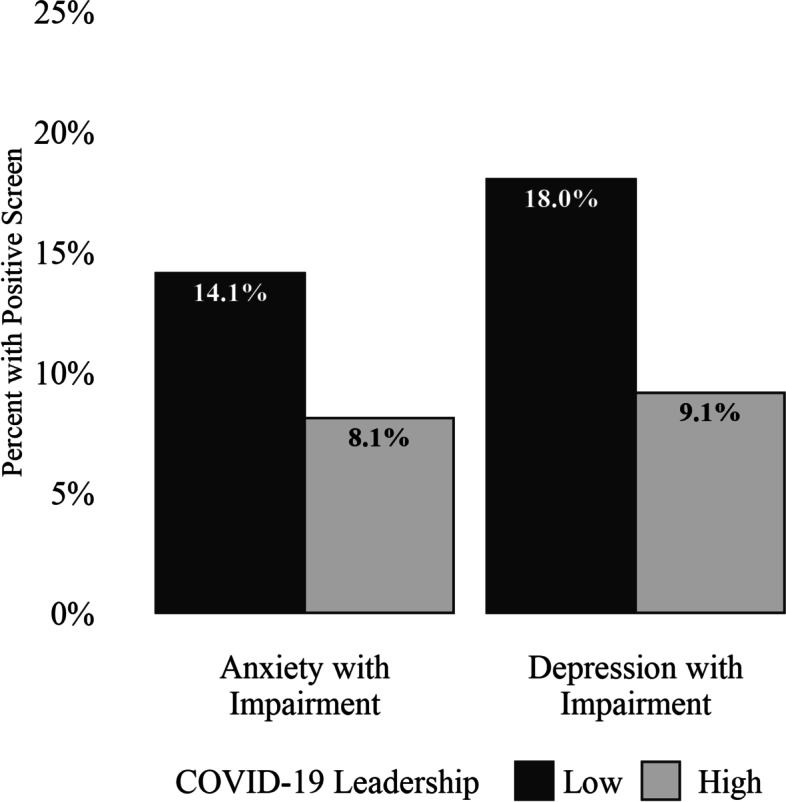
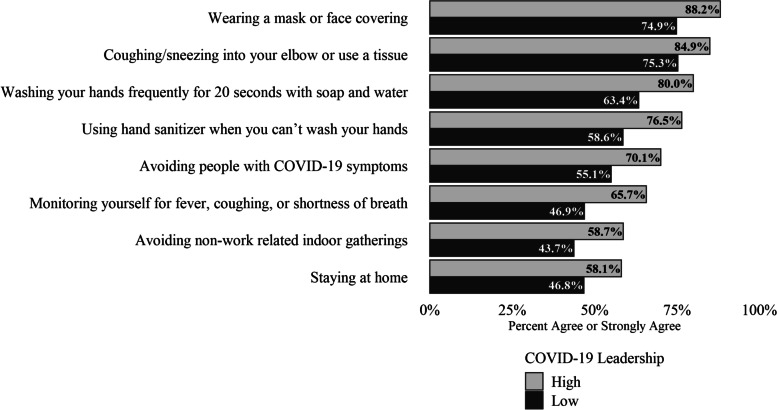
High levels of COVID-19 leadership behaviors were associated with lesser likelihood of soldiers' screening positive for depression (AOR = 0.46; 95% CI [0.39, 0.54]) and anxiety (AOR = 0.54; 95% CI [0.45, 0.64]), and greater likelihood of frequent adherence to preventive health guidelines (AORs = 1.58; 95% CI [1.39, 1.80] to 2.50; 95% CI [2.01, 3.11]).
Higher levels of COVID-19 leadership behaviors may support soldiers' mental health and encourage their adherence to COVID-19 public health guidelines. Given the link between these leader behaviors and soldier adaptation to the pandemic over and above general leadership, training for supervisors should focus on targeting specific health-promoting behaviors. Results can inform leader training for the military and other high-risk occupations.
先前的研究记录了特定领导行为对员工特定健康结果的影响。本研究的目的是确定针对 COVID-19 的特定领导行为与美国士兵的心理健康和对 COVID-19 公共卫生指南的遵守之间的关联。
2020 年 12 月至 2021 年 1 月,对来自三个主要司令部的美国陆军士兵进行了一项电子匿名调查(N=7829)。主要感兴趣的预测因素是士兵对其直接主管与 COVID-19 相关行为的评价。结果是士兵的心理健康(即抑郁和广泛性焦虑)和对 COVID-19 公共卫生指南的遵守情况。协变量是职级、性别、对直接主管一般领导能力的评价、对 COVID-19 的关注程度以及 COVID-19 状况(例如,检测呈阳性、病情严重)。使用逻辑回归模型,在调整协变量后,对 COVID-19 领导行为与结果的独特关联进行建模。
高水平的 COVID-19 领导行为与士兵筛查出抑郁(AOR=0.46;95%CI[0.39,0.54])和焦虑(AOR=0.54;95%CI[0.45,0.64])呈阳性的可能性降低以及更频繁地遵守预防保健指南的可能性更大(AORs=1.58;95%CI[1.39,1.80]至 2.50;95%CI[2.01,3.11])。
更高水平的 COVID-19 领导行为可能有助于士兵的心理健康,并鼓励他们遵守 COVID-19 公共卫生指南。鉴于这些领导行为与士兵对大流行的适应能力与一般领导能力有关,因此主管培训应侧重于针对特定的促进健康行为。结果可为军队和其他高风险职业的领导培训提供信息。