Mansingh Shivani, Handschin Christoph
Biozentrum, University of Basel, Basel, Switzerland.
Front Physiol. 2022 Apr 25;13:902031. doi: 10.3389/fphys.2022.902031. eCollection 2022.
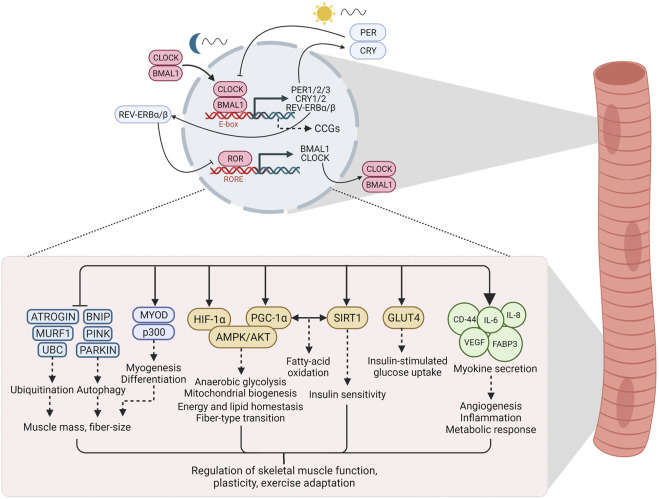
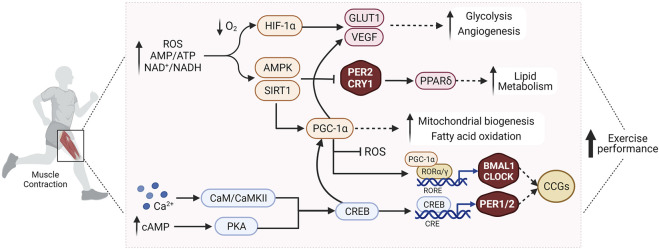
Circadian rhythms regulate a host of physiological processes in a time-dependent manner to maintain homeostasis in response to various environmental stimuli like day and night cycles, food intake, and physical activity. Disruptions in circadian rhythms due to genetic mutations, shift work, exposure to artificial light sources, aberrant eating habits, and abnormal sleep cycles can have dire consequences for health. Importantly, exercise training efficiently ameliorates many of these adverse effects and the role of skeletal muscle in mediating the benefits of exercise is a topic of great interest. However, the molecular and physiological interactions between the clock, skeletal muscle function and exercise are poorly understood, and are most likely a combination of molecular clock components directly acting in muscle as well as in concordance with other peripheral metabolic organ systems like the liver. This review aims to consolidate existing experimental evidence on the involvement of molecular clock factors in exercise adaptation of skeletal muscle and to highlight the existing gaps in knowledge that need to be investigated to develop therapeutic avenues for diseases that are associated with these systems.
昼夜节律以时间依赖的方式调节一系列生理过程,以响应各种环境刺激(如昼夜循环、食物摄入和身体活动)来维持体内平衡。由于基因突变、轮班工作、接触人造光源、异常饮食习惯和异常睡眠周期导致的昼夜节律紊乱会对健康产生严重后果。重要的是,运动训练能有效改善其中许多不良影响,而骨骼肌在介导运动益处中的作用是一个备受关注的话题。然而,生物钟、骨骼肌功能和运动之间的分子和生理相互作用却知之甚少,很可能是分子钟成分直接作用于肌肉,并与肝脏等其他外周代谢器官系统协同作用的结果。本综述旨在整合关于分子钟因素参与骨骼肌运动适应的现有实验证据,并突出知识上存在的空白,这些空白需要进行研究,以开发与这些系统相关疾病(的治疗方法)。