NUTRIM School of Nutrition and Translational Research in Metabolism, Maastricht University Medical Center, Maastricht, The Netherlands.
Department of Nutrition and Movement Sciences, Maastricht University Medical Center, Maastricht, The Netherlands.
Physiol Rep. 2021 Jan;8(24):e14669. doi: 10.14814/phy2.14669.
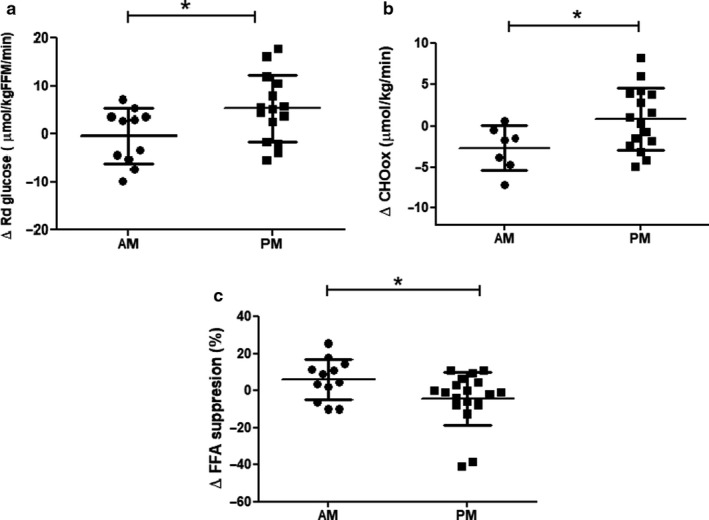
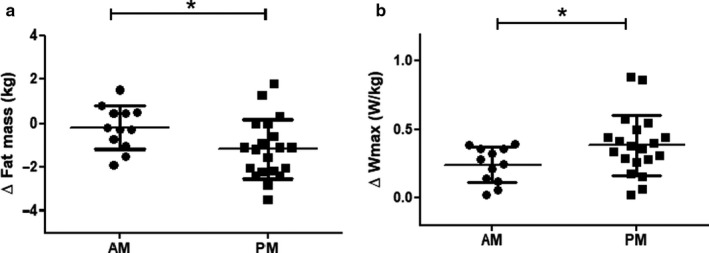
The circadian clock and metabolism are tightly intertwined. Hence, the specific timing of interventions that target metabolic changes may affect their efficacy. Here we retrospectively compared the metabolic health effects of morning versus afternoon exercise training in metabolically compromised subjects enrolled in a 12-week exercise training program. Thirty-two adult males (58 ± 7 yrs) at risk for or diagnosed with type 2 diabetes performed 12 weeks of supervised exercise training either in the morning (8.00-10.00 a.m., N = 12) or in the afternoon (3.00-6.00 p.m., N = 20). Compared to participants who trained in the morning, participants who trained in the afternoon experienced superior beneficial effects of exercise training on peripheral insulin sensitivity (+5.2 ± 6.4 vs. -0.5 ± 5.4 μmol/min/kgFFM, p = .03), insulin-mediated suppression of adipose tissue lipolysis (-4.5 ± 13.7% vs. +5.9 ± 11%, p = .04), fasting plasma glucose levels (-0.3 ± 1.0 vs. +0.5 ± 0.8 mmol/l, p = .02), exercise performance (+0.40 ± 0.2 vs. +0.2 ± 0.1 W/kg, p = .05) and fat mass (-1.2 ± 1.3 vs. -0.2 ± 1.0 kg, p = .03). In addition, exercise training in the afternoon also tended to elicit superior effects on basal hepatic glucose output (p = .057). Our findings suggest that metabolically compromised subjects may reap more pronounced metabolic benefits from exercise training when this training is performed in the afternoon versus morning. CLINICALTRIALS.GOV ID: NCT01317576.
昼夜节律与代谢紧密交织。因此,针对代谢变化的干预措施的具体时间可能会影响其疗效。在这里,我们回顾性比较了代谢受损受试者在参加为期 12 周的运动训练计划中,上午和下午进行运动训练对代谢健康的影响。32 名成年男性(58 ± 7 岁)有患 2 型糖尿病的风险或已被诊断出患有 2 型糖尿病,他们进行了 12 周的监督运动训练,要么在早上(8:00-10:00),要么在下午(3:00-6:00)。与在早上训练的参与者相比,下午训练的参与者在改善外周胰岛素敏感性方面的运动训练效果更显著(+5.2 ± 6.4 比-0.5 ± 5.4 μmol/min/kgFFM,p = 0.03),胰岛素介导的脂肪组织脂解抑制作用(-4.5 ± 13.7%比+5.9 ± 11%,p = 0.04),空腹血糖水平(-0.3 ± 1.0 比+0.5 ± 0.8 mmol/l,p = 0.02),运动表现(+0.40 ± 0.2 比+0.2 ± 0.1 W/kg,p = 0.05)和脂肪量(-1.2 ± 1.3 比-0.2 ± 1.0 kg,p = 0.03)。此外,下午进行运动训练还可能对基础肝葡萄糖输出产生更显著的影响(p = 0.057)。我们的研究结果表明,代谢受损的受试者在下午进行运动训练时可能会获得更显著的代谢益处。临床试验注册号:NCT01317576。