Thakur Harshada, Pareek Priyanka, Sayyad Mehmood G, Otiv Suhas
Department of Nutrition and Dietetics, Symbiosis School of Biological Sciences, Symbiosis International (Deemed University), Pune, India.
Department of Clinical Nutrition, MGM School of Biomedical Sciences, MGMIHS, Navi Mumbai, India.
Int J Womens Health. 2022 May 4;14:665-675. doi: 10.2147/IJWH.S359458. eCollection 2022.
Premenstrual syndrome (PMS) refers to a heterogenous group of symptoms occurring in luteal phase of the menstrual cycle. Women of childbearing age are affected by PMS, and it may impact their quality of life. Various factors related to the biology of menstruation, hormones, and lifestyle are associated with PMS.
To explore the incidence and severity of PMS among students in India and its correlation with nutrient intake, adiposity, and lifestyle factors.
A semi-structured questionnaire was used to collect data on menstrual pattern, nutrient intake, dietary habits, and physical activity. Moose's Menstrual Distress Questionnaire and Premenstrual Symptoms Screening Tool were employed for the identification and classification of PMS. Anthropometric indices included height, weight, body mass index, waist circumference, hip circumference, waist-to-hip ratio, and four-site skinfold thickness-tricep, bicep, subscapular, and suprailiac.
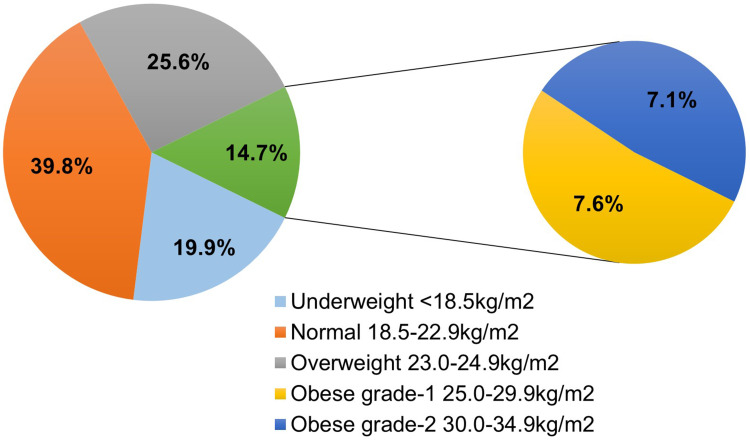
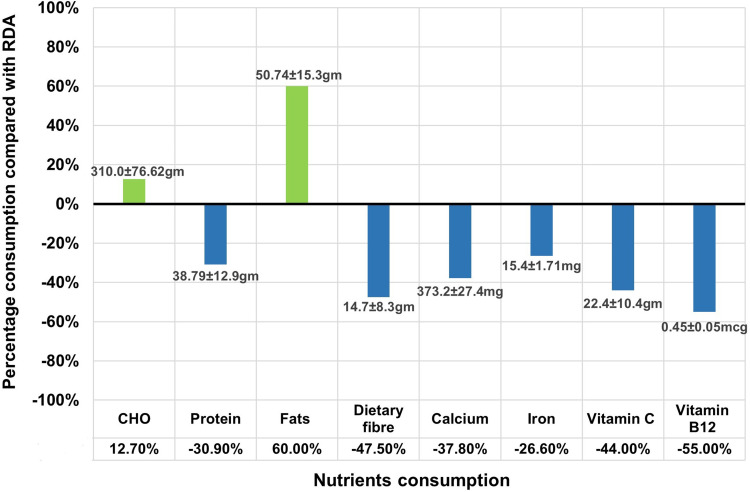
Of the 330 participants, 71.3% reported to have experienced at least one symptom of PMS. Furthermore, 46.9% had mild PMS, 31.5% had moderate PMS, 8.3% had strong PMS, and 13.3% had no symptoms. Anxiety and irritability were the most observed symptoms. The mean body mass index (BMI) of the participants was within the normal range (21.76 ± 4.81 kg/m); however, body fat percentage was above the normal range (33.95% ± 4.89%). PMS severity was significantly correlated with body fat percentage and BMI. Nutrient intake was significantly lower than the recommended dietary allowance (RDA), but dietary fat consumption was higher than the RDA. Protein intake was higher in participants with mild PMS than those with moderate and severe PMS (p<0.05). An inverse association between oilseed consumption and PMS was observed.
PMS was associated with anthropometric parameters, nutrient intake, and dietary preference. PMS showed correlation with the intake of calorie-rich foods, sweets, and fried salted snacks, whereas consumption of oilseeds alleviated its incidence.
经前综合征(PMS)指在月经周期黄体期出现的一组异质性症状。育龄女性受经前综合征影响,它可能会影响她们的生活质量。与月经生物学、激素及生活方式相关的各种因素都与经前综合征有关。
探讨印度学生中经前综合征的发病率和严重程度及其与营养摄入、肥胖和生活方式因素的相关性。
使用半结构化问卷收集月经模式、营养摄入、饮食习惯和身体活动的数据。采用穆尔经前不适问卷和经前症状筛查工具对经前综合征进行识别和分类。人体测量指标包括身高、体重、体重指数、腰围、臀围、腰臀比以及四个部位的皮褶厚度(肱三头肌、肱二头肌、肩胛下和髂嵴上)。
在330名参与者中,71.3%报告至少经历过一种经前综合征症状。此外,46.9%有轻度经前综合征,31.5%有中度经前综合征,8.3%有重度经前综合征,13.3%无症状。焦虑和易怒是最常观察到的症状。参与者的平均体重指数(BMI)在正常范围内(21.76±4.81kg/m²);然而,体脂百分比高于正常范围(33.95%±4.89%)。经前综合征严重程度与体脂百分比和体重指数显著相关。营养摄入量显著低于推荐膳食摄入量(RDA),但膳食脂肪消耗量高于推荐膳食摄入量。轻度经前综合征参与者的蛋白质摄入量高于中度和重度经前综合征参与者(p<0.05)。观察到油籽类食物消费与经前综合征之间存在负相关。
经前综合征与人体测量参数、营养摄入和饮食偏好有关。经前综合征与高热量食物、甜食和油炸咸味零食的摄入相关,而油籽类食物的消费可降低其发病率。