Institute for Parasitology and Tropical Veterinary Medicine, Freie Universität Berlin, Robert-von-Ostertag-Str. 7-13, 14163, Berlin, Germany.
Techion UK, Peithyll Centre, Capel Dewi, Aberystwyth, SY23 3HU, Wales, UK.
Parasit Vectors. 2022 May 12;15(1):166. doi: 10.1186/s13071-022-05266-y.
Due to high prevalence of anthelmintic resistance in equine helminths, selective treatment is increasingly promoted and in some countries a positive infection diagnosis is mandatory before treatment. Selective treatment is typically recommended when the number of worm eggs per gram faeces (epg) exceeds a particular threshold. In the present study we compared the semi-quantitative sedimentation/flotation method with the quantitative methods Mini-FLOTAC and FECPAK in terms of precision, sensitivity, inter-rater reliability and correlation of worm egg counts to improve the choice of optimal diagnostic tools.
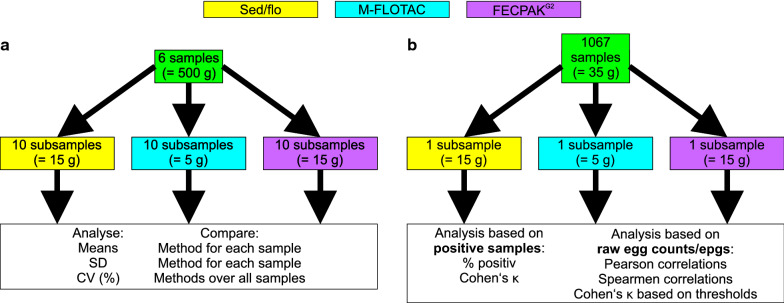
Using sedimentation/flotation (counting raw egg numbers up to 200), we investigated 1067 horse faecal samples using a modified Mini-FLOTAC approach (multiplication factor of 5 to calculate epgs from raw egg counts) and FECPAK (multiplication factor of 45).
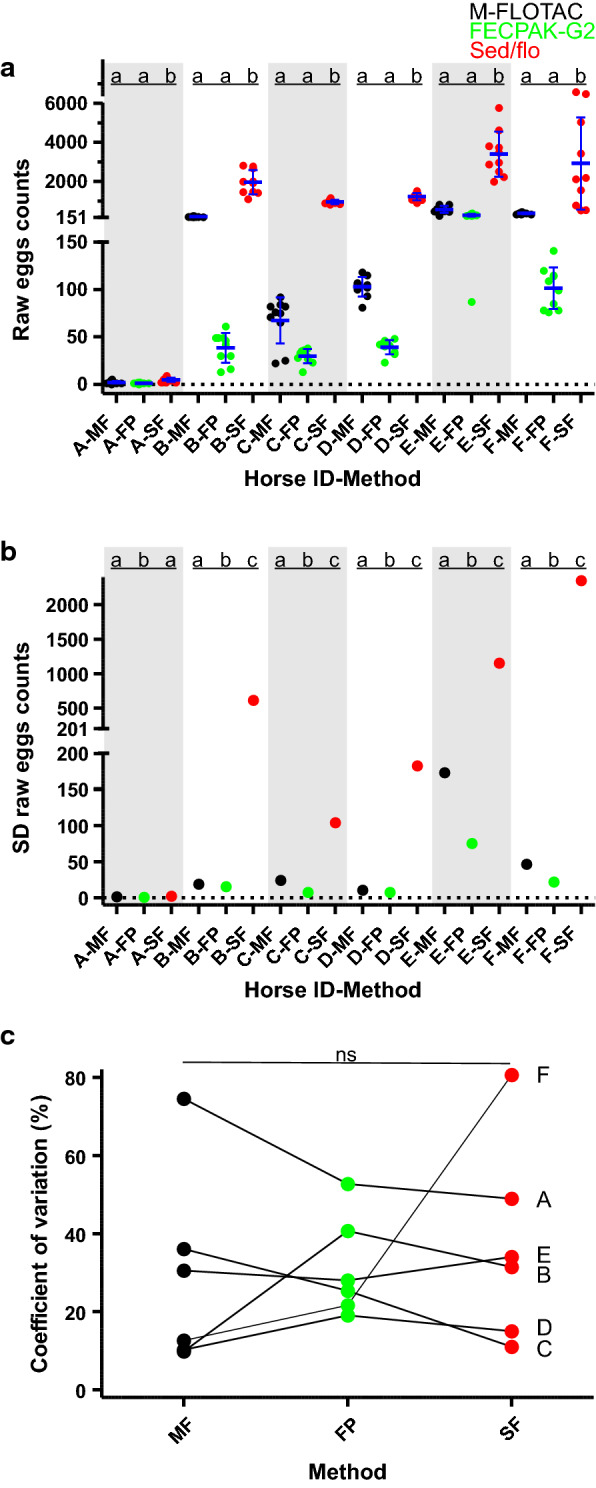
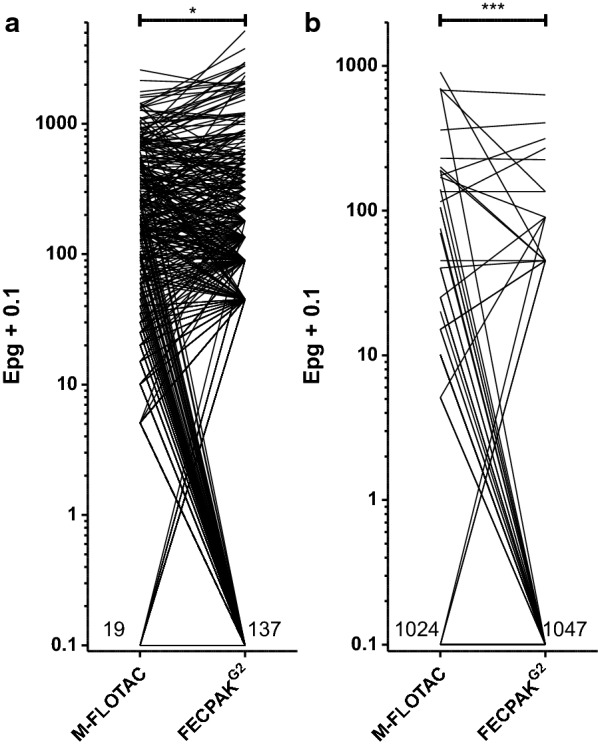
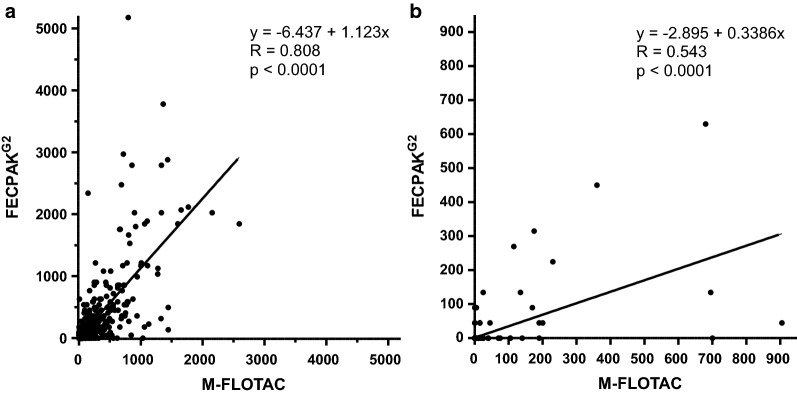
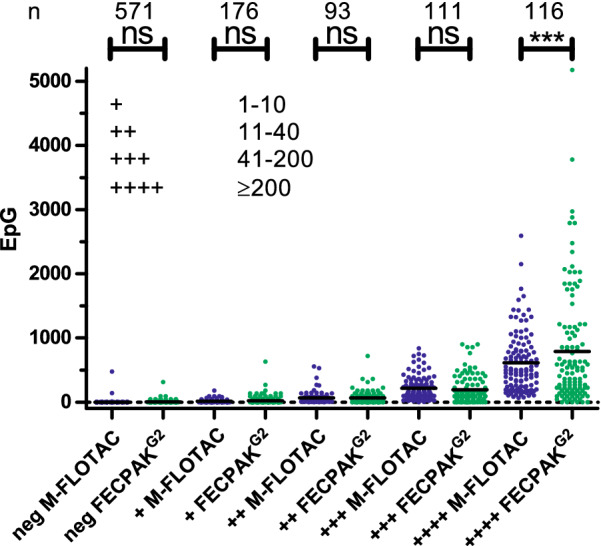
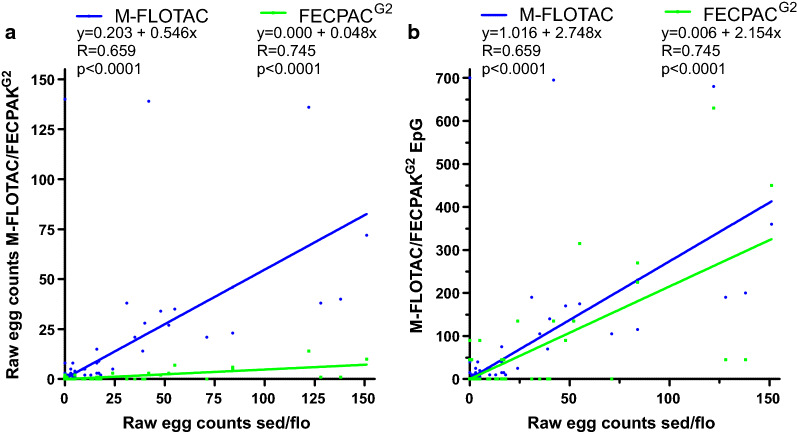
Five independent analyses of the same faecal sample with all three methods revealed that variance was highest for the sedimentation/flotation method while there were no significant differences between methods regarding the coefficient of variance. Sedimentation/flotation detected the highest number of samples positive for strongyle and Parascaris spp. eggs, followed by Mini-FLOTAC and FECPAK. Regarding Anoplocephalidae, no significant difference in frequency of positive samples was observed between Mini-FLOTAC and sedimentation/flotation. Cohen's κ values comparing individual methods with the combined result of all three methods revealed almost perfect agreement (κ ≥ 0.94) for sedimentation/flotation and strong agreement for Mini-FLOTAC (κ ≥ 0.83) for strongyles and Parascaris spp. For FECPAK, moderate and weak agreements were found for the detection of strongyle (κ = 0.62) and Parascaris (κ = 0.51) eggs, respectively. Despite higher sensitivity, the Mini-FLOTAC mean epg was significantly lower than that with FECPAK due to samples with > 200 raw egg counts by sedimentation/flotation, while in samples with lower egg shedding epgs were higher with Mini-FLOTAC than with FECPAK.
For the simple detection of parasite eggs, for example, to treat foals infected with Parascaris spp., sedimentation/flotation is sufficient and more sensitive than the other two quantitative investigared in this study. Mini-FLOTAC is predicted to deliver more precise results in faecal egg count reduction tests due to higher raw egg counts. Finally, to identify animals with a strongyle epg above a certain threshold for treatment, FECPAK delivered results comparable to Mini-FLOTAC.
由于马属动物蠕虫的驱虫药耐药性普遍较高,因此越来越提倡选择性治疗,在一些国家,在治疗前必须进行阳性感染诊断。当粪便中的每克虫卵数(epg)超过特定阈值时,通常推荐进行选择性治疗。在本研究中,我们比较了半定量沉淀/浮选法与定量 Mini-FLOTAC 和 FECPAK 方法在精密度、灵敏度、组内一致性和虫卵计数与感染相关性方面的差异,以改进最佳诊断工具的选择。
使用沉淀/浮选法(最多可计数 200 个原始虫卵),我们用改良的 Mini-FLOTAC 方法(将原始虫卵数乘以 5 来计算 epg)和 FECPAK 对 1067 份马粪便样本进行了检测(乘以 45 倍)。
三种方法对同一份粪便样本的五次独立分析表明,沉淀/浮选法的方差最高,而三种方法之间的变异系数没有显著差异。沉淀/浮选法检测到的强捻线虫和副蛔虫属虫卵阳性样本数量最多,其次是 Mini-FLOTAC 和 FECPAK。关于类圆线虫科,Mini-FLOTAC 和沉淀/浮选法检测到的阳性样本频率没有显著差异。比较三种方法与三种方法综合结果的 Cohen's κ 值表明,沉淀/浮选法具有近乎完美的一致性(κ≥0.94),Mini-FLOTAC 对强捻线虫和副蛔虫属的一致性也很高(κ≥0.83)。对于 FECPAK,强捻线虫(κ=0.62)和副蛔虫属(κ=0.51)虫卵的检测一致性分别为中度和弱度。尽管 Mini-FLOTAC 的灵敏度更高,但由于沉淀/浮选法的粪便样本中原始虫卵数超过 200,因此其平均 epg 显著低于 FECPAK,而在低卵脱落的粪便样本中,Mini-FLOTAC 的 epg 高于 FECPAK。
对于寄生虫卵的简单检测,例如治疗感染副蛔虫属的幼驹,沉淀/浮选法就足够了,且比本研究中另外两种定量方法更敏感。由于更高的原始虫卵计数,Mini-FLOTAC 预计在粪便虫卵减少试验中能提供更精确的结果。最后,为了确定具有特定强捻线虫 epg 值的动物需要进行治疗,FECPAK 与 Mini-FLOTAC 相比提供了可比的结果。