Björklund Erik, Xu Chao, Dose Wesley M, Sole Christopher G, Thakur Pardeep K, Lee Tien-Lin, De Volder Michael F L, Grey Clare P, Weatherup Robert S
Department of Materials, University of Oxford, Parks Road, Oxford OX1 3PH, U.K.
The Faraday Institution, Quad One, Harwell Science and Innovation Campus, Didcot OX11 0RA, U.K.
Chem Mater. 2022 Mar 8;34(5):2034-2048. doi: 10.1021/acs.chemmater.1c02722. Epub 2022 Feb 18.
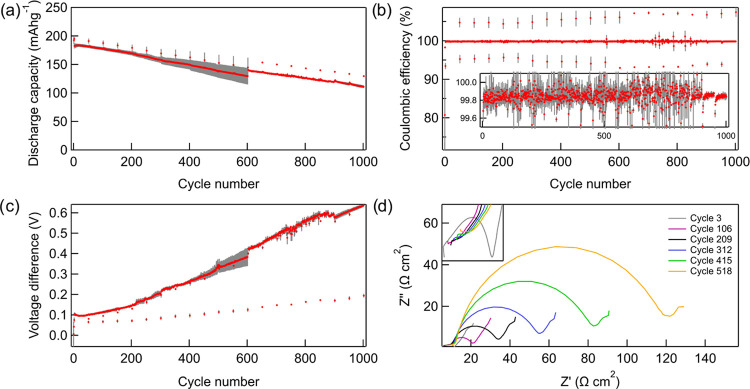
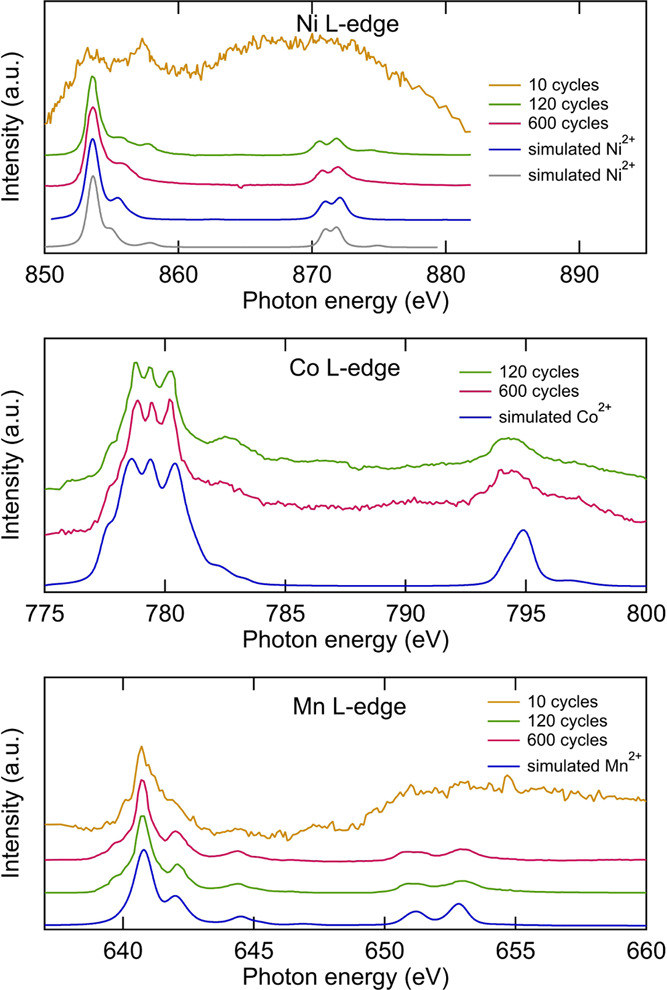
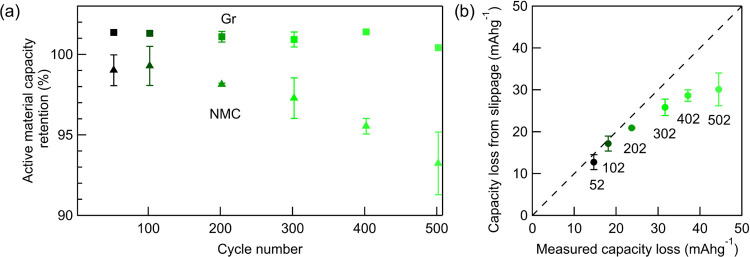
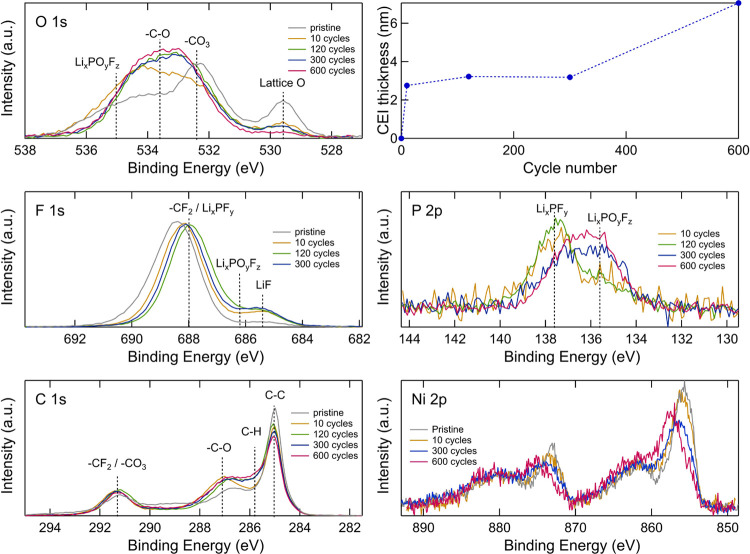
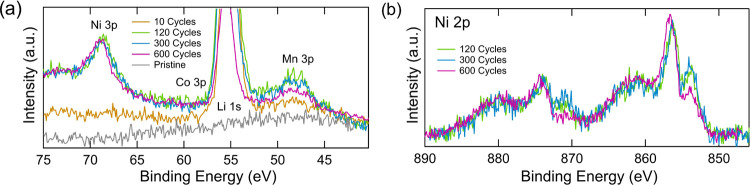
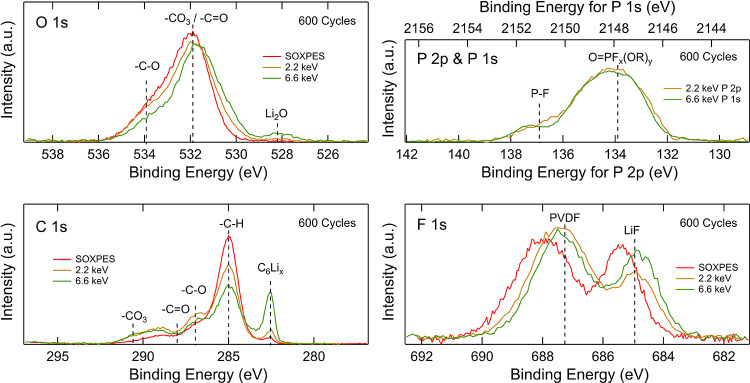
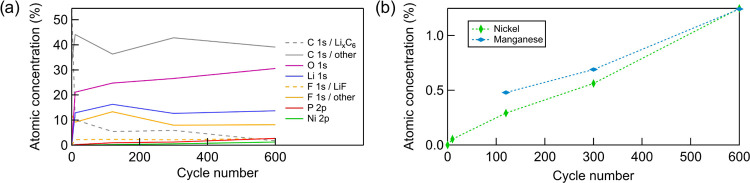
Ni-rich lithium nickel manganese cobalt (NMC) oxide cathode materials promise Li-ion batteries with increased energy density and lower cost. However, higher Ni content is accompanied by accelerated degradation and thus poor cycle lifetime, with the underlying mechanisms and their relative contributions still poorly understood. Here, we combine electrochemical analysis with surface-sensitive X-ray photoelectron and absorption spectroscopies to observe the interfacial degradation occurring in LiNiMnCoO-graphite full cells over hundreds of cycles between fixed cell voltages (2.5-4.2 V). Capacity losses during the first ∼200 cycles are primarily attributable to a loss of active lithium through electrolyte reduction on the graphite anode, seen as thickening of the solid-electrolyte interphase (SEI). As a result, the cathode reaches ever-higher potentials at the end of charge, and with further cycling, a regime is entered where losses in accessible NMC capacity begin to limit cycle life. This is accompanied by accelerated transition-metal reduction at the NMC surface, thickening of the cathode electrolyte interphase, decomposition of residual lithium carbonate, and increased cell impedance. Transition-metal dissolution is also detected through increased incorporation into and thickening of the SEI, with Mn found to be initially most prevalent, while the proportion of Ni increases with cycling. The observed evolution of anode and cathode surface layers improves our understanding of the interconnected nature of the degradation occurring at each electrode and the impact on capacity retention, informing efforts to achieve a longer cycle lifetime in Ni-rich NMCs.
富镍锂镍锰钴(NMC)氧化物阴极材料有望使锂离子电池具有更高的能量密度和更低的成本。然而,较高的镍含量伴随着加速降解,因此循环寿命较差,其潜在机制及其相对贡献仍知之甚少。在这里,我们将电化学分析与表面敏感的X射线光电子能谱和吸收光谱相结合,以观察在固定电池电压(2.5 - 4.2V)之间经过数百次循环的LiNiMnCoO-石墨全电池中发生的界面降解。在最初的约200次循环中,容量损失主要归因于石墨阳极上通过电解质还原导致的活性锂损失,这表现为固体电解质界面(SEI)增厚。结果,阴极在充电结束时达到越来越高的电位,并且随着进一步循环,进入了一个区域,在该区域中可及的NMC容量损失开始限制循环寿命。这伴随着NMC表面过渡金属还原加速、阴极电解质界面增厚、残留碳酸锂分解以及电池阻抗增加。还通过SEI中过渡金属掺入增加和增厚检测到过渡金属溶解,发现Mn最初最为普遍,而Ni的比例随着循环增加。观察到的阳极和阴极表面层的演变增进了我们对每个电极上发生的降解的相互关联性质及其对容量保持的影响的理解,为实现富镍NMC更长的循环寿命提供了依据。