School of Public Health, University of California, Berkeley.
Department of Maternal and Child Health, Gillings School of Global Public Health, University of North Carolina at Chapel Hill.
JAMA Netw Open. 2022 May 2;5(5):e2212065. doi: 10.1001/jamanetworkopen.2022.12065.
Many people face barriers to abortion care, including long distances to an abortion facility.
To investigate the association of distance to the nearest abortion facility with abortion or pregnancy outcome.
DESIGN, SETTING, AND PARTICIPANTS: This cohort study was conducted using data from the Google Ads Abortion Access study, a prospective cohort study of individuals considering abortion recruited between August 2017 and May 2018. Individuals from 50 states and Washington, District of Columbia, who were pregnant and considering abortion based on self-report were recruited online using a stratified sampling technique. Participants completed online baseline and 4-week follow-up surveys. Data were analyzed between May and August 2021.
Driving distance to an abortion facility calculated from participant zip code and grouped into 4 categories (<5 miles, 5-24 miles, 25-49 miles, and ≥50 miles).
Abortion or pregnancy outcome reported at 4-week follow-up, categorized as had an abortion, still seeking an abortion, or planning to continue pregnancy. Other measures included reported experience of 8 distance-related barriers to abortion, such as having to gather money for travel expenses and having to keep the abortion a secret.
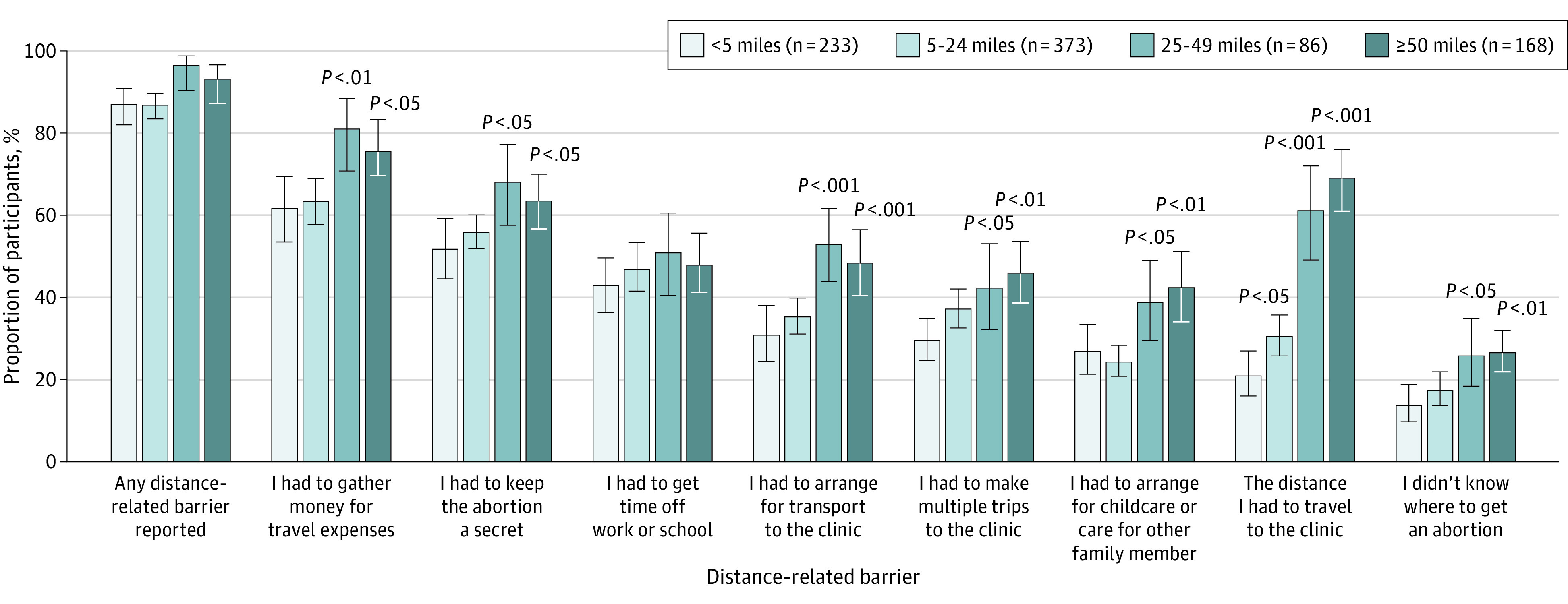
Among 1485 pregnant individuals considering abortion who completed the baseline survey and provided contact information, 1005 individuals completed follow-up (follow-up rate, 67.7%) and 856 participants were included in the analytic sample (443 individuals ages 25-34 years [51.8%]; 208 Black individuals [24.3%]; 101 Hispanic or Latinx individuals [11.8%], and 468 White individuals [54.8%]). Most participants had at least some college education (474 individuals [55.5%]). Distance to an abortion facility was less than 5 miles for 233 individuals (27.2%), 5 to 24 miles for 373 individuals (43.6%), 25 to 49 miles for 85 individuals (9.9%), and 50 or more miles for 165 individuals (19.3%) (mean [SD] distance = 28.3 [43.8] miles). Most participants reported at least 1 distance-related barrier (763 individuals [89.1%]), with a mean of 3.3 barriers (95% CI, 3.2-3.5 barriers) reported. For 7 of 8 distance-related barriers, an increased percentage of participants living farther from an abortion facility reported the barrier compared with participants living less than 5 miles from a facility; for example, 61.8% (95% CI, 53.5%-69.4%) of individuals living less than 5 miles reported having to gather money for travel expenses, while 81.2% (95% CI, 70.8%-88.5%; P = .002) of those living 25 to 49 miles and 75.8% (95% CI, 69.9%-81.0%; P = .02) of those living 50 or more miles from a facility reported this barrier. At follow-up, participants living 50 or more miles from a facility had higher odds of still being pregnant and seeking abortion (adjusted odds ratio [aOR] = 2.07; 95% CI, 1.35-3.17; P = .001) or planning to continue pregnancy (aOR = 1.96; 95% CI, 1.06-3.63; P = .03) compared with participants living within 5 miles.
This study found that greater distance from an abortion facility was associated with delays in obtaining abortion care and inability to receive abortion care. These findings suggest that innovative approaches to abortion provision may be needed to mitigate outcomes associated with long distances to abortion facilities.
许多人在堕胎护理方面面临障碍,包括距离堕胎设施的长途跋涉。
调查距离最近的堕胎设施的距离与堕胎或妊娠结局的关联。
设计、地点和参与者:这项队列研究使用了 Google Ads 堕胎准入研究的数据,这是一项针对 2017 年 8 月至 2018 年 5 月期间考虑堕胎的个体的前瞻性队列研究。通过分层抽样技术,从 50 个州和哥伦比亚特区华盛顿招募了自我报告怀孕并考虑堕胎的个体。参与者在线完成基线和 4 周随访调查。数据在 2021 年 5 月至 8 月之间进行分析。
根据参与者邮政编码计算的堕胎设施距离,并分为 4 类(<5 英里、5-24 英里、25-49 英里和≥50 英里)。
在 4 周随访时报告的堕胎或妊娠结局,分为堕胎、仍在寻求堕胎或计划继续妊娠。其他措施包括报告 8 项与堕胎相关的距离障碍,例如需要筹集旅行费用和需要对堕胎保密。
在完成基线调查并提供联系方式的 1485 名考虑堕胎的孕妇中,有 1005 名完成了随访(随访率为 67.7%),856 名参与者被纳入分析样本(443 名年龄在 25-34 岁的参与者[51.8%];208 名黑人参与者[24.3%];101 名西班牙裔或拉丁裔参与者[11.8%]和 468 名白人参与者[54.8%])。大多数参与者至少接受过一些大学教育(474 人[55.5%])。距离堕胎设施不到 5 英里的有 233 人(27.2%),5 到 24 英里的有 373 人(43.6%),25 到 49 英里的有 85 人(9.9%),50 英里或以上的有 165 人(19.3%)(平均[SD]距离=28.3[43.8]英里)。大多数参与者报告了至少 1 项与距离相关的障碍(763 人[89.1%]),平均报告了 3.3 项障碍(95%CI,3.2-3.5 项障碍)。对于 8 项与距离相关的障碍中的 7 项,与距离堕胎设施不到 5 英里的参与者相比,距离设施较远的参与者报告该障碍的比例更高;例如,61.8%(95%CI,53.5%-69.4%)的不到 5 英里的人报告需要筹集旅行费用,而 25 到 49 英里的参与者中 81.2%(95%CI,70.8%-88.5%;P=.002)和 50 英里或以上的参与者中 75.8%(95%CI,69.9%-81.0%;P=.02)报告了这一障碍。随访时,距离堕胎设施 50 英里或以上的参与者继续怀孕和寻求堕胎的可能性更高(调整后的优势比[aOR]=2.07;95%CI,1.35-3.17;P=.001)或计划继续怀孕的可能性更高(aOR=1.96;95%CI,1.06-3.63;P=.03)与距离 5 英里以内的参与者相比。
这项研究发现,距离堕胎设施越远与获得堕胎护理的延迟和无法获得堕胎护理有关。这些发现表明,可能需要创新的堕胎提供方法来减轻与堕胎设施距离较远相关的结果。