Kumsa Fekede Asefa, Prasad Rameshwari, Shaban-Nejad Arash
The University of Tennessee Health Science Center (UTHSC) - Oak Ridge National Laboratory (ORNL) Center for Biomedical Informatics, Department of Pediatrics, College of Medicine, Memphis, TN, 38103, USA.
NPJ Digit Med. 2023 Jul 12;6(1):128. doi: 10.1038/s41746-023-00871-2.
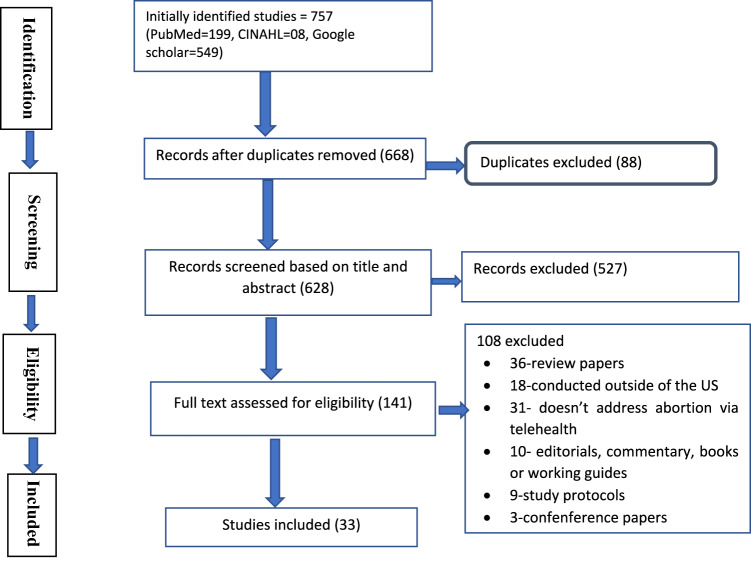
Digital health, including telemedicine, has increased access to abortion care. The convenience, flexibility of appointment times, and ensured privacy to abortion users may make abortion services via telemedicine preferable. This scoping review systematically mapped studies conducted on abortion services via telemedicine, including their effectiveness and acceptability for abortion users and providers. All published papers included abortion services via telemedicine in the United States were considered. Articles were searched in PubMed, CINAHL, and Google Scholar databases in September 2022. The findings were synthesized narratively, and the PRISMA-ScR guidelines were used to report this study. Out of 757 retrieved articles, 33 articles were selected based on the inclusion criteria. These studies were published between 2011 and 2022, with 24 published in the last 3 years. The study found that telemedicine increased access to abortion care in the United States, especially for people in remote areas or those worried about stigma from in-person visits. The effectiveness of abortion services via telemedicine was comparable to in-clinic visits, with 6% or fewer abortions requiring surgical intervention. Both care providers and abortion seekers expressed positive perceptions of telemedicine-based abortion services. However, abortion users reported mixed emotions, with some preferring in-person visits. The most common reasons for choosing telemedicine included the distance to the abortion clinic, convenience, privacy, cost, flexibility of appointment times, and state laws imposing waiting periods or restrictive policies. Telemedicine offered a preferable option for abortion seekers and providers. The feasibility of accessing abortion services via telemedicine in low-resource settings needs further investigation.
包括远程医疗在内的数字健康增加了堕胎护理的可及性。远程医疗的便利性、预约时间的灵活性以及为堕胎使用者确保的隐私性,可能使通过远程医疗提供的堕胎服务更受青睐。本综述系统地梳理了关于通过远程医疗提供堕胎服务的研究,包括其对堕胎使用者和提供者的有效性及可接受性。所有在美国发表的包含通过远程医疗提供堕胎服务的论文均被纳入考虑。2022年9月在PubMed、CINAHL和谷歌学术数据库中进行了文献检索。研究结果以叙述方式进行了综合,并使用PRISMA-ScR指南报告本研究。在检索到的757篇文章中,根据纳入标准选择了33篇文章。这些研究发表于2011年至2022年之间,其中24篇发表于过去3年。研究发现,远程医疗增加了美国堕胎护理的可及性,尤其是对于偏远地区的人群或那些担心面对面就诊带来污名的人。通过远程医疗提供堕胎服务的有效性与门诊就诊相当,需要手术干预的堕胎比例为6%或更低。护理提供者和堕胎寻求者对基于远程医疗的堕胎服务均表达了积极看法。然而,堕胎使用者的情绪不一,有些人更喜欢面对面就诊。选择远程医疗的最常见原因包括到堕胎诊所的距离、便利性、隐私性、成本、预约时间的灵活性以及州法律规定的等待期或限制性政策。远程医疗为堕胎寻求者和提供者提供了一个更优选择。在资源匮乏地区通过远程医疗获取堕胎服务的可行性需要进一步研究。