Nova Medical School, Comprehensive Health Research Centre (CHRC), Universidade NOVA de Lisboa, Campo Mártires da Pátria, 130, 1169-056, Lisbon, Portugal.
Research Centre in Economic and Organizational Sociology, Lisbon, School of Economics and Management, University of Lisbon (CSG-SOCIUS/ISEG, U.Lisboa), Lisbon, Portugal.
BMC Health Serv Res. 2022 May 13;22(1):638. doi: 10.1186/s12913-022-08019-w.
Continuing medical education (CME), as a systematic attempt to facilitate change in General Practitioners' (GPs) practices, is considered crucial, assuming that if physicians are up-to-date, they will change and improve their practice, resulting in better performance and ultimately better patient care. However, studies continue to demonstrate considerable gaps between the real and ideal performance and patient-related outcomes. The objective of this study was to explore GP's perception of the factors affecting the implementation of a CME digital platform in a primary health care setting in Portugal.
Our work is framed in a larger effectiveness-implementation hybrid type 1 study, where a Digital Behaviour Change Intervention (DBCI), called ePrimaPrescribe, was developed and implemented with the aim of changing benzodiazepines (BZD) prescribing patterns. Our design used mixed methodologies to obtain an enriched knowledge on GPs' perspectives on the facilitators and barriers to implementing a Digital Behaviour Change Intervention (DBCI) applied to CME. To do so, we used data coming from an onsite questionnaire, an adapted version of the Barriers and Facilitators Assessment Instrument (BaFAI) and in-depth interviews.
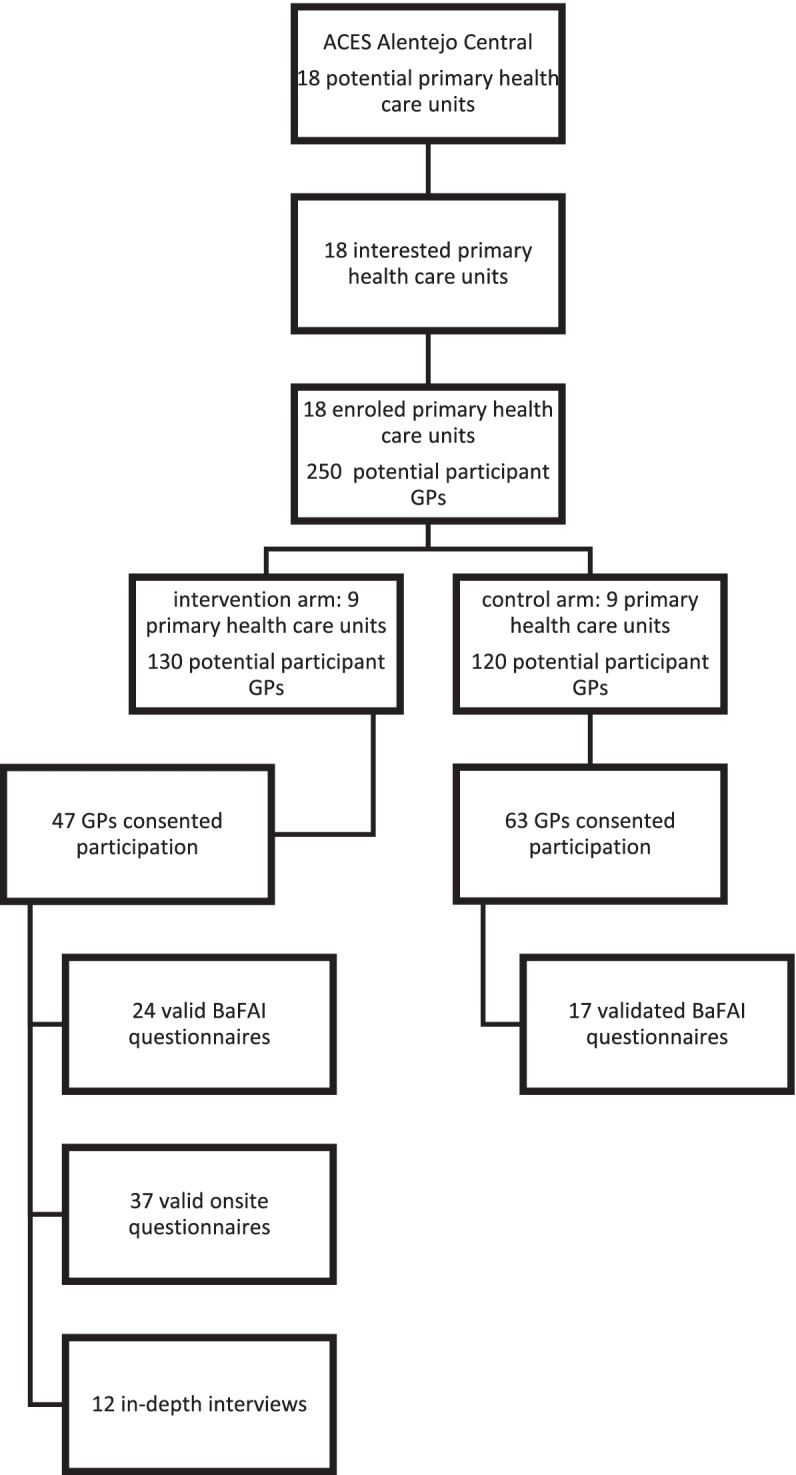
From the 47 GPs successfully included in the intervention arm of our cluster-randomized effectiveness study, we collected 37 onsite questionnaires, 24 BaFAIs, and performed 12 in-depth interviews. GPs reported as the main barriers to CME a lack of time, a perception of work overload, a lack of digital competence, a lack of digital infrastructure, and motivational and emotional factors. They reported as facilitators to CME delivered through a DBCI the convenience of the delivery method, the practical and pragmatic characteristics of the content, and the possibility for CME to be mandatory.
The perceptions of the barriers and facilitators reported by GPs represent an important contribution to improving knowledge regarding the factors influencing the implementation of CME in primary health care settings. We consider that our study might bring useful insights to other countries where primary health care plays a central role in the provision of care.
ClinicalTrials.gov number NCT04925596 .
继续医学教育(CME)作为系统地促进全科医生(GP)实践改变的尝试,被认为是至关重要的,因为如果医生能够与时俱进,他们就会改变和改进自己的实践,从而提高绩效,最终为患者提供更好的护理。然而,研究继续表明,实际绩效和患者相关结果之间存在相当大的差距。本研究的目的是探讨葡萄牙初级保健环境中 GP 对影响 CME 数字平台实施的因素的看法。
我们的工作框架是在一项较大的有效性-实施混合类型 1 研究中,开发并实施了一种名为 ePrimaPrescribe 的数字行为改变干预(DBCI),旨在改变苯二氮䓬类药物(BZD)的处方模式。我们的设计使用混合方法学来获得有关 GP 对实施应用于 CME 的数字行为改变干预(DBCI)的促进因素和障碍的更丰富的知识。为此,我们使用了来自现场问卷、改编版的障碍和促进因素评估工具(BaFAI)和深入访谈的数据。
在我们的聚类随机有效性研究的干预组中,成功纳入了 47 名 GP,我们收集了 37 份现场问卷、24 份 BaFAI 和 12 份深入访谈。GP 报告 CME 的主要障碍是缺乏时间、工作负荷过重的感觉、缺乏数字能力、缺乏数字基础设施以及动机和情感因素。他们报告 CME 通过 DBCI 实施的促进因素包括交付方法的便利性、内容的实际和务实特征以及 CME 强制性的可能性。
GP 报告的障碍和促进因素的看法为改善关于影响初级保健环境中 CME 实施的因素的知识做出了重要贡献。我们认为,我们的研究可能为其他初级保健在提供护理中发挥核心作用的国家带来有用的见解。
ClinicalTrials.gov 编号 NCT04925596。