Centre for Tissue Engineering and Regenerative Medicine (CTERM), Faculty of Medicine, Universiti Kebangsaan Malaysia, Jalan Yaacob Latiff, Bandar Tun Razak, Cheras, Kuala Lumpur 56000, Malaysia.
Department of Microbiology, Faculty of Science, Universiti Tunku Abdul Rahman, Kampar 31900, Malaysia.
Int J Mol Sci. 2022 Apr 21;23(9):4580. doi: 10.3390/ijms23094580.
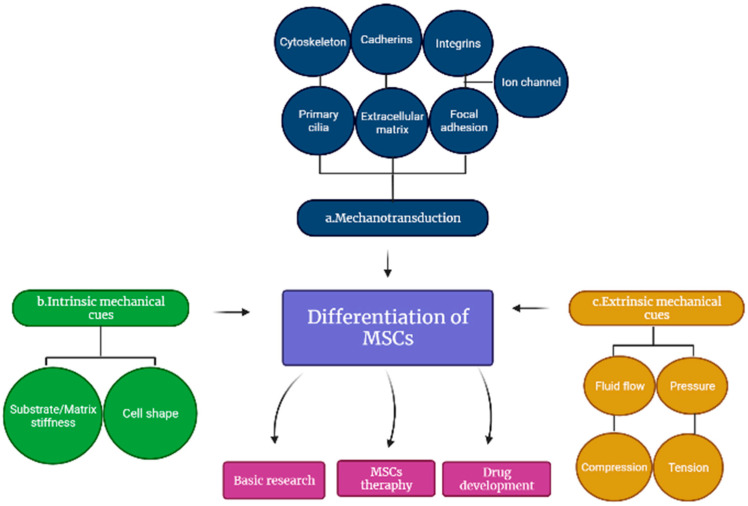
Mechanotransduction is the process by which physical force is converted into a biochemical signal that is used in development and physiology; meanwhile, it is intended for the ability of cells to sense and respond to mechanical forces by activating intracellular signals transduction pathways and the relative phenotypic adaptation. It encompasses the role of mechanical stimuli for developmental, morphological characteristics, and biological processes in different organs; the response of cells to mechanically induced force is now also emerging as a major determinant of disease. Due to fluid shear stress caused by blood flowing tangentially across the lumen surface, cells of the cardiovascular system are typically exposed to a variety of mechanotransduction. In the body, tissues are continuously exposed to physical forces ranging from compression to strain, which is caused by fluid pressure and compressive forces. Only lately, though, has the importance of how forces shape stem cell differentiation into lineage-committed cells and how mechanical forces can cause or exacerbate disease besides organizing cells into tissues been acknowledged. Mesenchymal stem cells (MSCs) are potent mediators of cardiac repair which can secret a large array of soluble factors that have been shown to play a huge role in tissue repair. Differentiation of MSCs is required to regulate mechanical factors such as fluid shear stress, mechanical strain, and the rigidity of the extracellular matrix through various signaling pathways for their use in regenerative medicine. In the present review, we highlighted mechanical influences on the differentiation of MSCs and the general factors involved in MSCs differentiation. The purpose of this study is to demonstrate the progress that has been achieved in understanding how MSCs perceive and react to their mechanical environment, as well as to highlight areas where more research has been performed in previous studies to fill in the gaps.
力学转导是物理力转化为生化信号的过程,用于发育和生理学;同时,它旨在使细胞能够通过激活细胞内信号转导途径和相对表型适应来感知和响应机械力。它涵盖了机械刺激在不同器官的发育、形态特征和生物过程中的作用;细胞对机械诱导力的反应现在也被认为是疾病的主要决定因素。由于血流沿管腔表面切向流动引起的流体剪切力,心血管系统的细胞通常会受到各种力学转导的影响。在体内,组织会持续受到从压缩到应变等物理力的作用,这些力是由流体压力和压缩力引起的。只是最近,人们才认识到力如何塑造干细胞向谱系定向细胞的分化,以及机械力如何除了将细胞组织成组织外,还会导致或加剧疾病。间充质干细胞(MSCs)是心脏修复的有力介质,可以分泌大量的可溶性因子,这些因子在组织修复中起着重要作用。MSCs 的分化需要调节各种信号通路来感知和响应力学因素,如流体剪切力、机械应变和细胞外基质的刚性,以用于再生医学。在本综述中,我们强调了力学对 MSCs 分化的影响以及 MSCs 分化中涉及的一般因素。本研究的目的是展示在理解 MSCs 如何感知和对其机械环境做出反应方面所取得的进展,并强调在以前的研究中已经进行了更多研究的领域,以填补空白。