Department of Laboratory Diagnostics and Clinical Immunology of Developmental Age, Medical University of Warsaw, Zwirki i Wigury 63a, 02-097 Warsaw, Poland.
Centre for Preclinical Research, Department of Methodology, Medical University of Warsaw, Banacha 1b, 02-097 Warsaw, Poland.
Int J Mol Sci. 2022 May 3;23(9):5076. doi: 10.3390/ijms23095076.
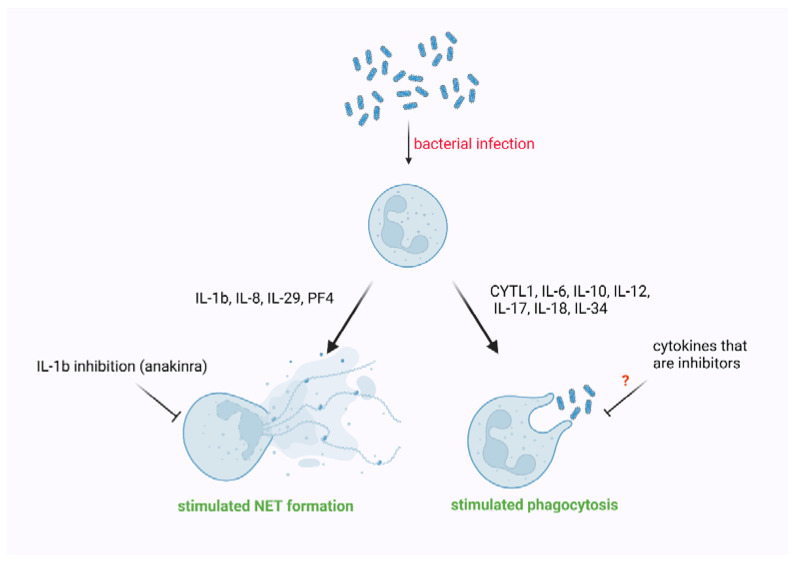
Sepsis is an overwhelming inflammatory response to infection, resulting in multiple-organ injury. Neutrophils are crucial immune cells involved in innate response to pathogens and their migration and effector functions, such as phagocytosis and neutrophil extracellular trap (NET) formation, are dependent on cytokine presence and their concentration. In the course of sepsis, recruitment and migration of neutrophils to infectious foci gradually becomes impaired, thus leading to loss of a crucial arm of the innate immune response to infection. Our review briefly describes the sepsis course, the importance of neutrophils during sepsis, and explains dependence between cytokines and their activation. Moreover, we, for the first time, summarize the impact of cytokines on phagocytosis and NET formation. We highlight and discuss the importance of cytokines in modulation of both processes and emphasize the direction of further investigations.
脓毒症是一种对感染的过度炎症反应,导致多器官损伤。中性粒细胞是参与病原体先天反应的关键免疫细胞,其迁移和效应功能,如吞噬作用和中性粒细胞胞外陷阱(NET)的形成,依赖于细胞因子的存在及其浓度。在脓毒症的过程中,中性粒细胞向感染灶的募集和迁移逐渐受损,从而导致感染的先天免疫反应丧失了一个重要的分支。我们的综述简要描述了脓毒症的病程,中性粒细胞在脓毒症中的重要性,并解释了细胞因子之间的依赖性及其激活。此外,我们首次总结了细胞因子对吞噬作用和 NET 形成的影响。我们强调并讨论了细胞因子在这两个过程中的调节作用,并强调了进一步研究的方向。