Department of Veterinary Pathobiology, College of Veterinary Medicine, Oklahoma State University, Stillwater, OK 74078, USA.
Department of Mathematical Sciences, College of Arts and Sciences, Oklahoma State University, Stillwater, OK 74078, USA.
Int J Mol Sci. 2024 Sep 19;25(18):10054. doi: 10.3390/ijms251810054.
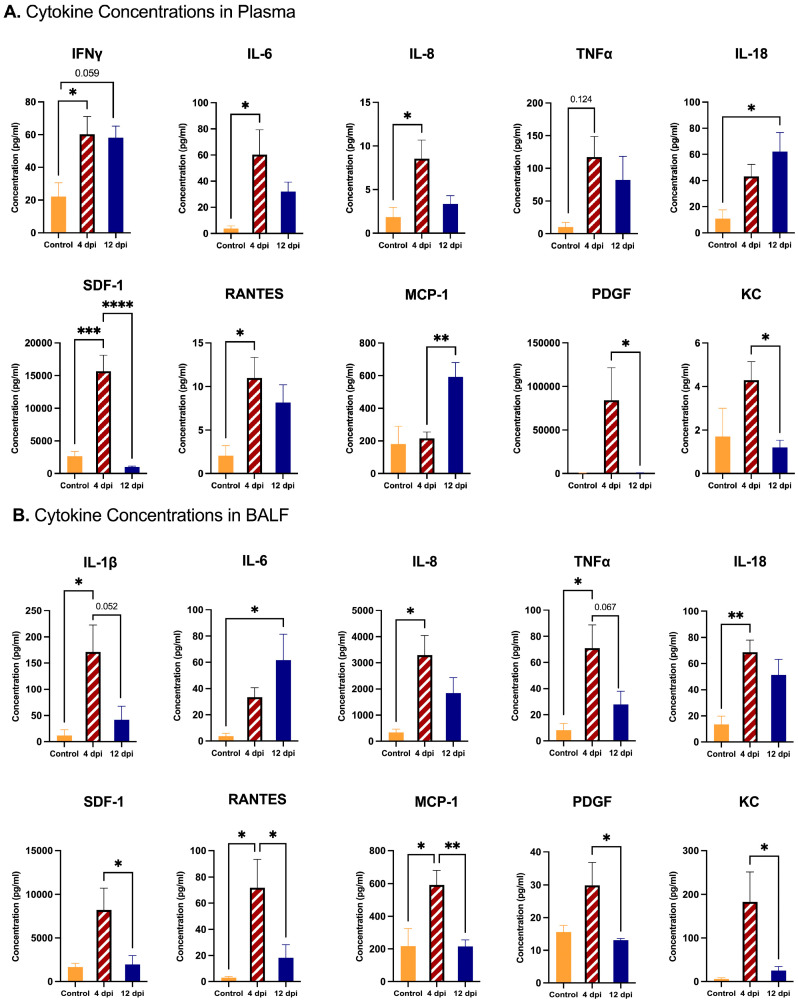
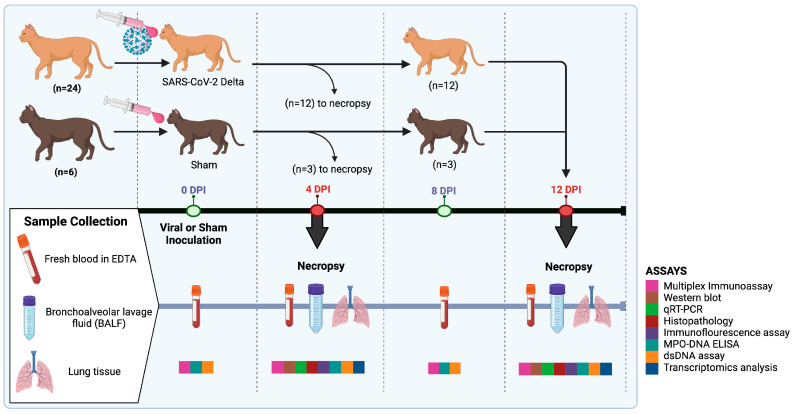
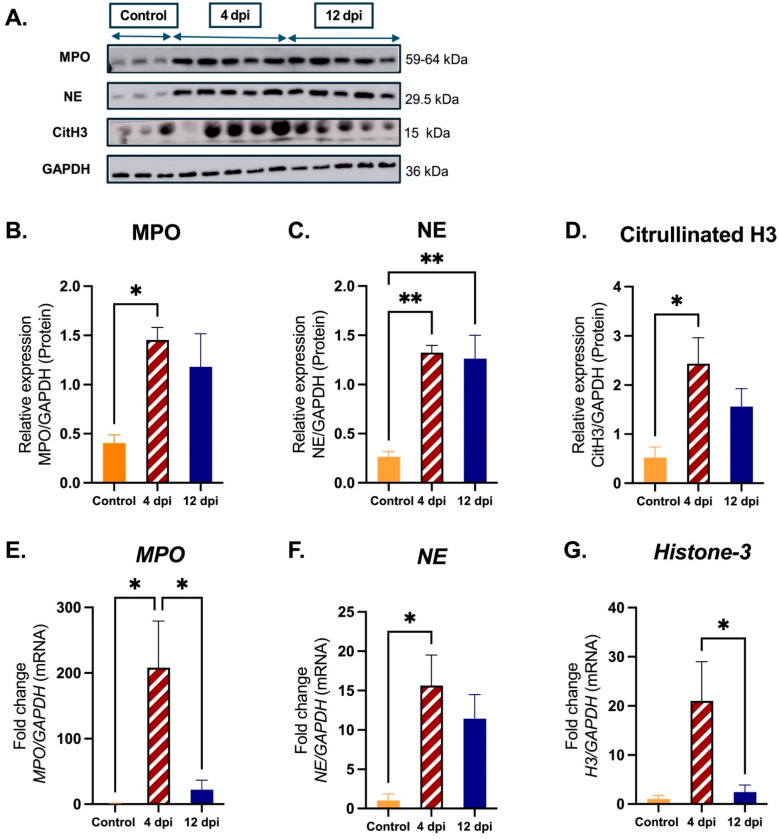
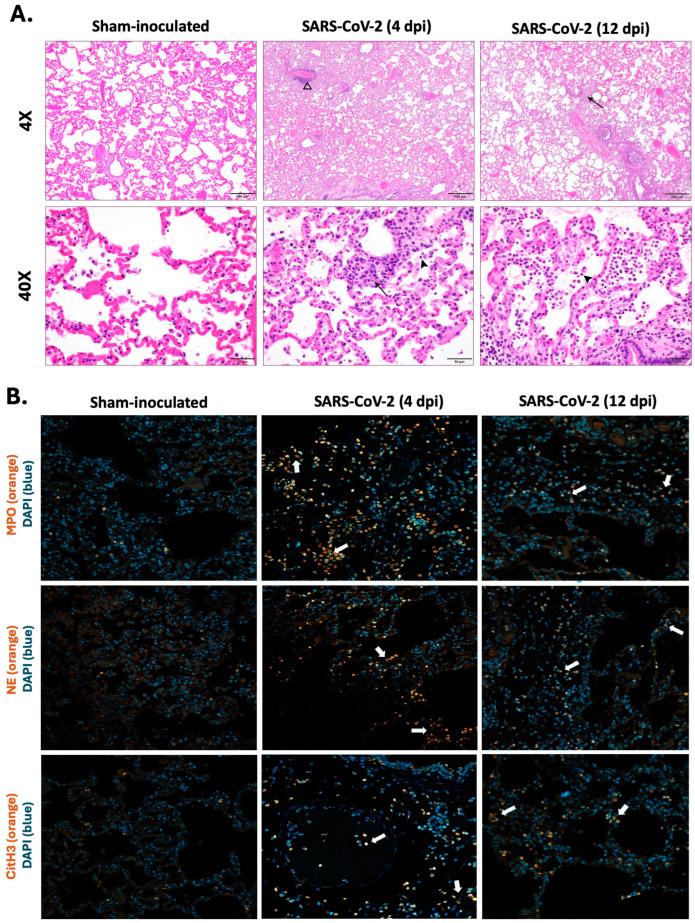
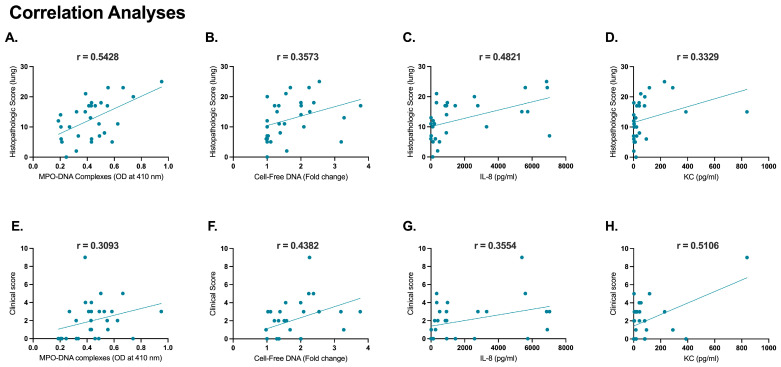
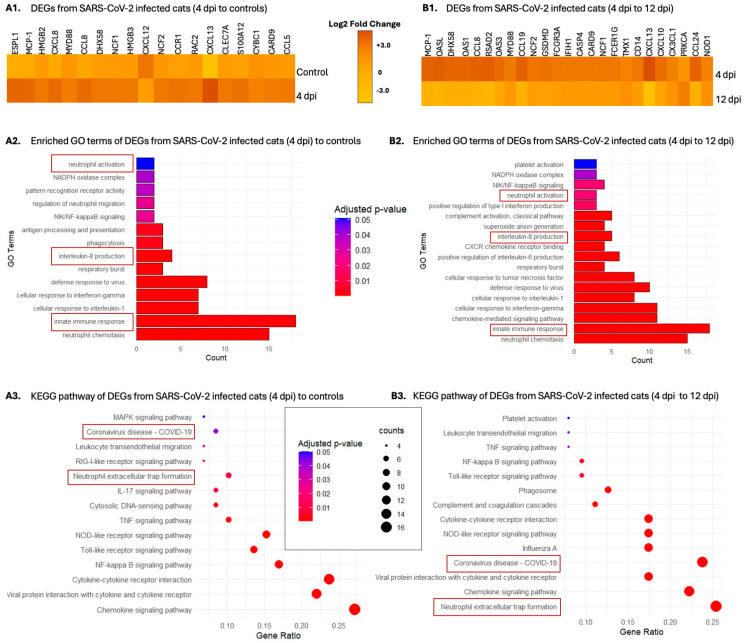
There is a complex interplay between viral infection and host innate immune response regarding disease severity and outcomes. Neutrophil hyperactivation, including excessive release of neutrophil extracellular traps (NETs), is linked to exacerbated disease in acute COVID-19, notably in hospitalized patients. Delineating protective versus detrimental neutrophil responses is essential to developing targeted COVID-19 therapies and relies on high-quality translational animal models. In this study, we utilize a previously established feline model for COVID-19 to investigate neutrophil dysfunction in which experimentally infected cats develop clinical disease that mimics acute COVID-19. Specific pathogen-free cats were inoculated with SARS-CoV-2 (B.1.617.2; Delta variant) ( = 24) or vehicle ( = 6). Plasma, bronchoalveolar lavage fluid, and lung tissues were collected at various time points over 12 days post-inoculation. Systematic and temporal evaluation of the kinetics of neutrophil activation was conducted by measuring markers of activation including myeloperoxidase (MPO), neutrophil elastase (NE), and citrullinated histone H3 (citH3) in SARS-CoV-2-infected cats at 4 and 12 days post-inoculation (dpi) and compared to vehicle-inoculated controls. Cytokine profiling supported elevated innate inflammatory responses with specific upregulation of neutrophil activation and NET formation-related markers, namely IL-8, IL-18, CXCL1, and SDF-1, in infected cats. An increase in MPO-DNA complexes and cell-free dsDNA in infected cats compared to vehicle-inoculated was noted and supported by histopathologic severity in respiratory tissues. Immunofluorescence analyses further supported correlation of NET markers with tissue damage, especially 4 dpi. Differential gene expression analyses indicated an upregulation of genes associated with innate immune and neutrophil activation pathways. Transcripts involved in activation and NETosis pathways were upregulated by 4 dpi and downregulated by 12 dpi, suggesting peak activation of neutrophils and NET-associated markers in the early acute stages of infection. Correlation analyses conducted between NET-specific markers and clinical scores as well as histopathologic scores support association between neutrophil activation and disease severity during SARS-CoV-2 infection in this model. Overall, this study emphasizes the effect of neutrophil activation and NET release in SARS-CoV-2 infection in a feline model, prompting further investigation into therapeutic strategies aimed at mitigating excessive innate inflammatory responses in COVID-19.
病毒感染与宿主固有免疫反应之间存在复杂的相互作用,这与疾病的严重程度和结局有关。中性粒细胞的过度激活,包括中性粒细胞胞外诱捕网(NETs)的过度释放,与急性 COVID-19 中病情加重有关,尤其是在住院患者中。区分保护性和有害性的中性粒细胞反应对于开发针对 COVID-19 的靶向治疗至关重要,这依赖于高质量的转化动物模型。在这项研究中,我们利用先前建立的用于 COVID-19 的猫模型来研究中性粒细胞功能障碍,即实验感染的猫会发展出类似于急性 COVID-19 的临床疾病。无特定病原体的猫被接种了 SARS-CoV-2(B.1.617.2;Delta 变体)(=24)或载体(=6)。在接种后 12 天的不同时间点收集血浆、支气管肺泡灌洗液和肺组织。通过测量在接种后 4 天和 12 天的 SARS-CoV-2 感染猫中的髓过氧化物酶(MPO)、中性粒细胞弹性蛋白酶(NE)和瓜氨酸化组蛋白 H3(citH3)等激活标志物,对中性粒细胞激活的动力学进行系统和时间评估,并与载体接种的对照进行比较。细胞因子谱支持先天炎症反应升高,感染猫中特定的中性粒细胞激活和 NET 形成相关标志物(即 IL-8、IL-18、CXCL1 和 SDF-1)上调。与载体接种的猫相比,感染猫中观察到 MPO-DNA 复合物和细胞游离 dsDNA 的增加,并支持呼吸道组织的组织病理学严重程度。免疫荧光分析进一步支持 NET 标志物与组织损伤的相关性,尤其是在 4 天。差异基因表达分析表明,与先天免疫和中性粒细胞激活途径相关的基因上调。在感染后 4 天,与激活和 NETosis 途径相关的转录本上调,而在 12 天下调,这表明在感染的早期急性阶段,中性粒细胞和 NET 相关标志物的激活达到峰值。NET 特异性标志物与临床评分和组织病理学评分之间的相关性分析支持在该模型中 SARS-CoV-2 感染期间中性粒细胞激活与疾病严重程度之间的关联。总的来说,这项研究强调了 SARS-CoV-2 感染中中性粒细胞激活和 NET 释放的影响,促使进一步研究旨在减轻 COVID-19 中过度先天炎症反应的治疗策略。