Faculty of Education, University of Hamburg, 20146 Hamburg, Germany.
Leibniz Institute for Science and Mathematics Education (IPN), 24118 Kiel, Germany.
Int J Environ Res Public Health. 2022 Apr 22;19(9):5098. doi: 10.3390/ijerph19095098.
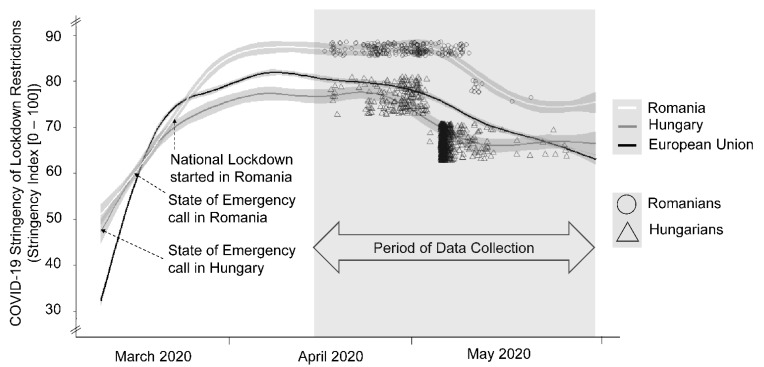
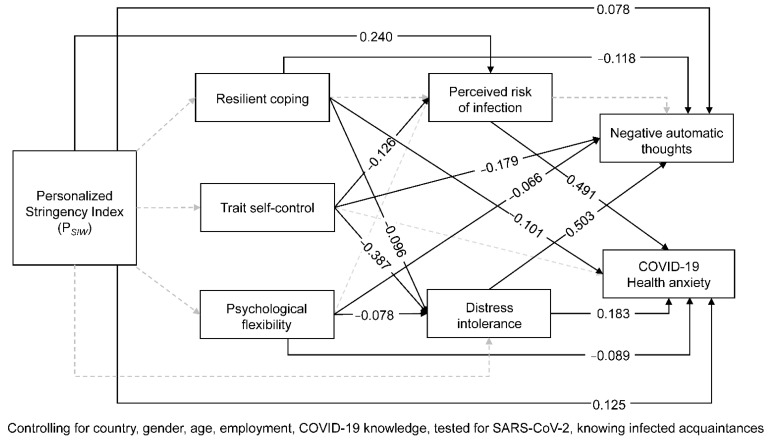
Studies provide evidence that distress, (health) anxiety, and depressive symptoms were high during the first weeks of COVID-19 lockdown restrictions, decreasing over time (possibly due to individuals' protective psychological factors). Relations between different lockdown restrictions, mental health issues, and protective factors need to be explored, since even small lockdown effects might increase the risk of future mental health issues. We merged objective lockdown stringency data with individual data ( = 1001) to examine differences in lockdown effects in strict lockdown (Romania) and mild lockdown (Hungary) conditions between March and May 2020 on stressors and mental health symptoms, taking protective factors into account. The stricter lockdown in Romania revealed higher levels of perceived risk of infection, distress intolerance, and COVID-19 health anxiety. Protective psychological factors were not affected by the lockdown measures. Surpassing psychological flexibility and resilient coping, self-control proved to be the most promising protective factor. It is recommended that future research merge objective data with study data to investigate the effects of different COVID-19 lockdown measures on mental health and protective factors. Policy decisions should consider lockdown-dependent consequences of mental health issues. Intervention programs are suggested to mitigate mental health issues and to strengthen peoples' protective psychological factors.
研究提供的证据表明,在 COVID-19 封锁限制的最初几周,痛苦、(健康)焦虑和抑郁症状很高,随着时间的推移而下降(可能是由于个体的保护心理因素)。不同的封锁限制、心理健康问题和保护因素之间的关系需要探讨,因为即使是微小的封锁效应也可能增加未来心理健康问题的风险。我们将客观的封锁严格程度数据与个体数据(=1001)合并,以研究 2020 年 3 月至 5 月期间罗马尼亚严格封锁和匈牙利轻度封锁条件下封锁效应的差异,考虑到保护因素。罗马尼亚更严格的封锁显示出更高水平的感染风险感知、痛苦耐受力和 COVID-19 健康焦虑。保护心理因素不受封锁措施的影响。超越心理灵活性和有弹性的应对,自我控制被证明是最有前途的保护因素。建议未来的研究将客观数据与研究数据合并,以调查不同的 COVID-19 封锁措施对心理健康和保护因素的影响。政策决策应考虑到心理健康问题的封锁相关后果。建议实施干预计划,以减轻心理健康问题,并加强人们的保护心理因素。